
Monthy Continuous PNAD
Unemployment rate stays at 5.6% in May, best result for the month since 2012


June 26, 2026 09h00 AM | Last Updated: June 29, 2026 09h22 AM
The unemployment rate in Brazil reached 5.6% in the quarter from March to May 2026, showing stability in relation to the immediately previous quarter and a drop of 0.6 p.p. compared to the same quarter last year (6.2%). The indicator's result is the lowest for May since the beginning of the Continuous PNAD time series, in 2012. The unemployment rate reached 14.9% (January-March) in 2021, due to the effects of Covid-19 on the national labor market. The data are from the Continuous PNAD - Monthly edition, released today (26) by the IBGE.
“The stability in the change is seasonal, as it is the period in which the sectors begin to look towards the second half of the year, but reaching the historical low for the period indicates that the market maintains a structural trend of heating and expansion in the absorption of the workforce,” explains the survey analyst, William Kratochwill.
The unemployed population (6.1 million) remained stable in comparison with the quarter from December 2025 to February 2026 (6.2 million). Compared to the same quarter of the previous year (6.7 million), it dropped 9.3% (624 thousand people less). The employed population (102.7 million) registered an increase of 0.5% in the quarter (558 thousand more people) and an increase of 0.8% in the year (840 thousand more). And the employment-population ratio (percentage of employed persons in the population at working age) was 58.6%, with a change of 0.2 p.p. in the quarter (58.4%) and remaining stable in the year (58.6%).
The Monthly PNAD showed that the number of employees in the private sector with a formal employment contract (excluding domestic workers), estimated at 39.3 million people, remained stable compared to the previous quarter and compared to the same quarter in 2025. The category of employees in the private sector without a formal employment contract (13.4 million people) also showed stability in both comparisons. The same occurred with self-employed workers, made up of 26.0 million people, and with employers (4.2 million people).
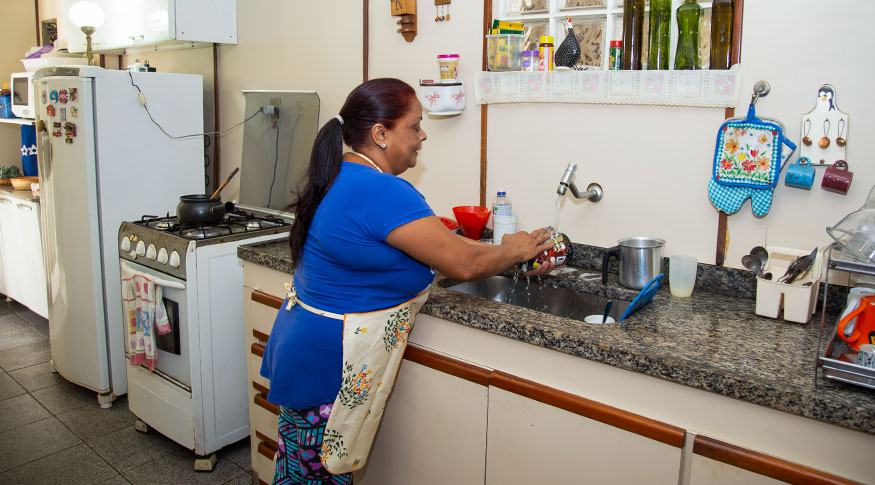
Unlike the previous categories, a group that has shown stability or decline in the last five quarters is domestic workers, estimated at 5.4 million people. The contingent showed stability in the comparison with the quarter from December 2025 to February 2026, but, in comparison with the same quarter last year, it shows a drop of 328 thousand jobs. The survey analyst highlights that “in scenarios of low unemployment, the opportunity cost of this workforce increases, generating a structural migration to formal positions in other activities, which offer better salaries, working conditions and guarantees.
The group of employees in the public sector (including statutory and military employees), estimated at 13.1 million people, grew 3.6% compared to the previous quarter. When compared to the same quarter of the previous year, it rose 2.8%, representing an estimated additional 350 thousand people. However, the increase in the number of persons employed in this group in the quarter was accompanied by a 3.1% drop in the usual real average monthly earnings, equivalent to less R$172. The comparison with the quarter from March to May 2025 indicated an increase in earnings in the categories: employee with a formal employment contract (3.0%, or more R$99) domestic workers (3.8%, or more R$52) and self-employed workers (4.4%, or more R$130).
“The real reduction in the earnings of employees in the public sector is due to the effect of the change in the composition of this group, because during this period there is an increase in the hiring of new temporary or municipal employees with lower salaries, coupled with the rigidity of nominal adjustments in the public sector,” explained Kratochwill.
Underutilization rate drops to 13.3% and reaches lowest level since 2012
The composite underutilization rate (13.3%) changed -0.8 p.p. compared to the previous quarter (14.1%) and had a drop of 1.6 p.p. in the year (14.9%). It is the lowest level since the beginning of the time series and is accompanied by drops in other similar indicators such as: underutilized population (15.1 million), which fell 5.7% in the quarter (920 thousand less) and fell 11.3% in the year (1.9 million less underutilized people), and the time-related underemployed population (4.1 million), which fell 5.7% in the quarter (251 thousand less people) and declined 10.6% in the year (4.6 million).
The discouraged population (2.4 million) also showed a reduction of 10.2% in the quarter (277 thousand people less) and a 14.6% drop in the year (2.9 million discouraged people). The percentage of discouraged people (2.2%) showed a change of -0.3 percentage points. in the quarter (2.4%) and of -0.4 p.p. in the year (2.6%).
The informality rate was 37.3% of the employed population (or 38.3 million informal workers), compared to 37.5% (or 38.3 million) in the quarter ended in February and 37.8% (or 38.5 million) in the quarter from March to May 2025.
More about Continuous PNAD
The Continuous PNAD is the major survey on workforce in Brazil. Its sample includes 211 thousand households, spread along 3.500 municipalities, which are visited every quarter. Nearly two thousand interviewers work in the survey, integrated with more than 500 IBGE branches in the entire country. The unemployment rate measures the percentage of people at working age who are unemployed and have looked for work in relation to the total workforce (employed plus unemployed people).
Due to the Covid-19 pandemic, the IBGE implemented data collection by telephone on March 17, 2020. In July 2021, the data collection became face-to-face once again. The identity of the interviewers can be confirmed at the Answering the IBGE website or through the Call Center (0800 7218181), and their ID numbers can be requested by the informants.
Check out the PNAD data on Sidra. The next release of the Continuous Monthly PNAD, for the quarter ending in June, will be on July 30th.
What is the Continuous PNAD?
Time Series
Tables
Publications