
CEMPRE
Number of Brazilian companies grows in 2024; average salary remains stable


June 25, 2026 10h00 AM | Last Updated: June 25, 2026 03h44 PM
Highlights
- Number of companies and other organizations increased by nearly 600 thousand in 2024 compared to the previous year.
- Considering the period from 2022 to 2024, the growth in the number of companies and other organizations in Brazil reached 12.5%, going from 9.4 million to 10.6 million, which represents a positive balance of approximately 1.2 million companies.
- Compared to 2023, the number of salaried personnel grew by 3.0%, from 52.6 million to 54.2 million in 2024, but the average monthly salary changed by 0.2%.
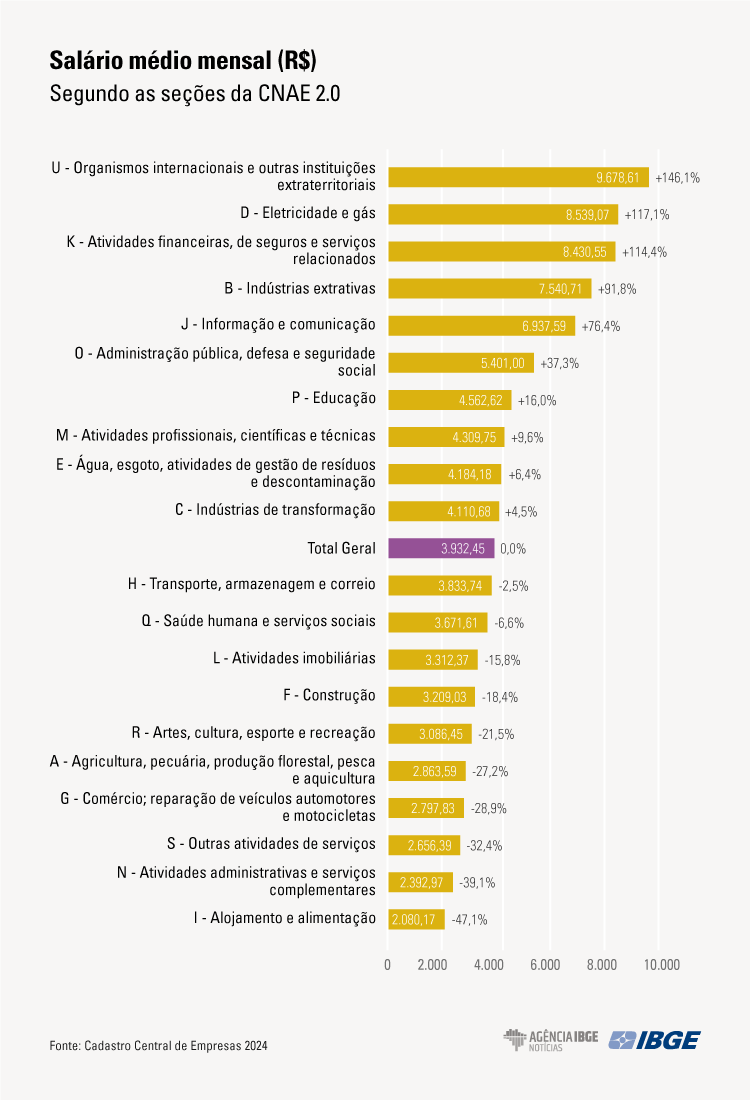
- The highest average monthly salaries were paid by the sector of International Organizations and other extraterritorial Institutions, followed by Electricity and gas and Financial, insurance and related services activities.
- Companies and other organizations with 250 people or more concentrate the largest number of total employed persons (44.4%), salaried employed persons (55.7%) and wage bill (69.0%).
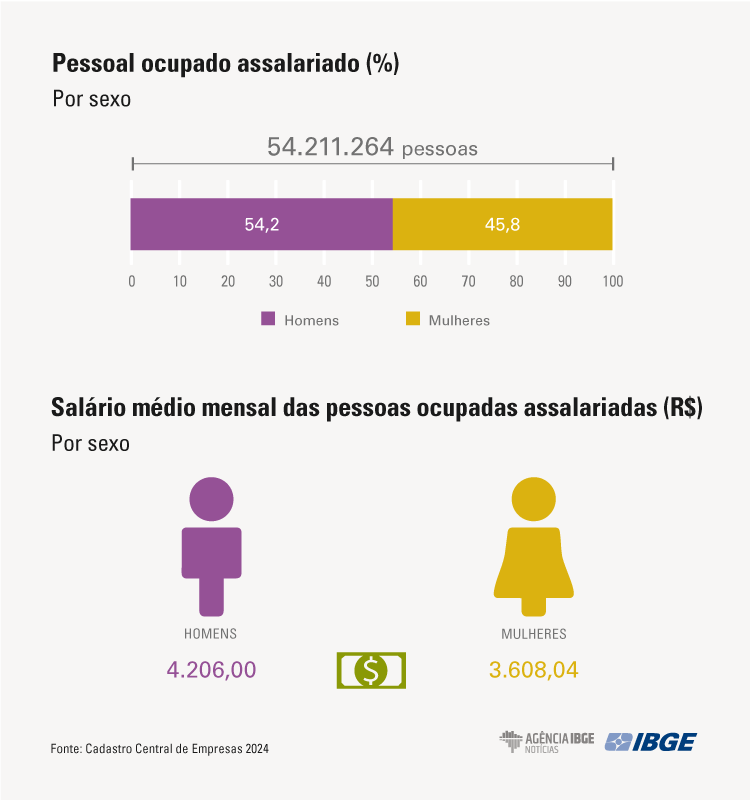
- The average monthly salary of men remained higher than that of women in 2024: R$4,206.00 against R$3,608.04.
- According to the level of schooling, 76.4% of salaried employed persons did not have higher education in 2024. On the other hand, 23.6% who had higher education had an average monthly salary of R$7,776.59, corresponding to triple the average salary of those who did not have higher education, who received R$2,742.41.
- In the analysis by legal nature and disaggregation by sex, the highest average salaries were paid by public administration, both for men (R$6,058.19) and women (R$4,967.51). When disaggregated by level of schooling, the average salary is higher in business entities among those with higher education (R$8,429.42) and lower in non-profit entities for those without higher education (R$2,510.32).
- The greatest salary inequalities were found in business entities, in which the average salary of women corresponds to 78.1% of the average salary of men and the average salary of employees without higher education corresponds to 31.5% of the average salary of those with higher education.
- The Southeast Region concentrated the largest number of total employed persons, 33.3 million (49.0%), and salaried workers, 26.1 million (48.2%), and paid the largest wage bill and other compensations, R$ 1.5 trillion (52.3%).

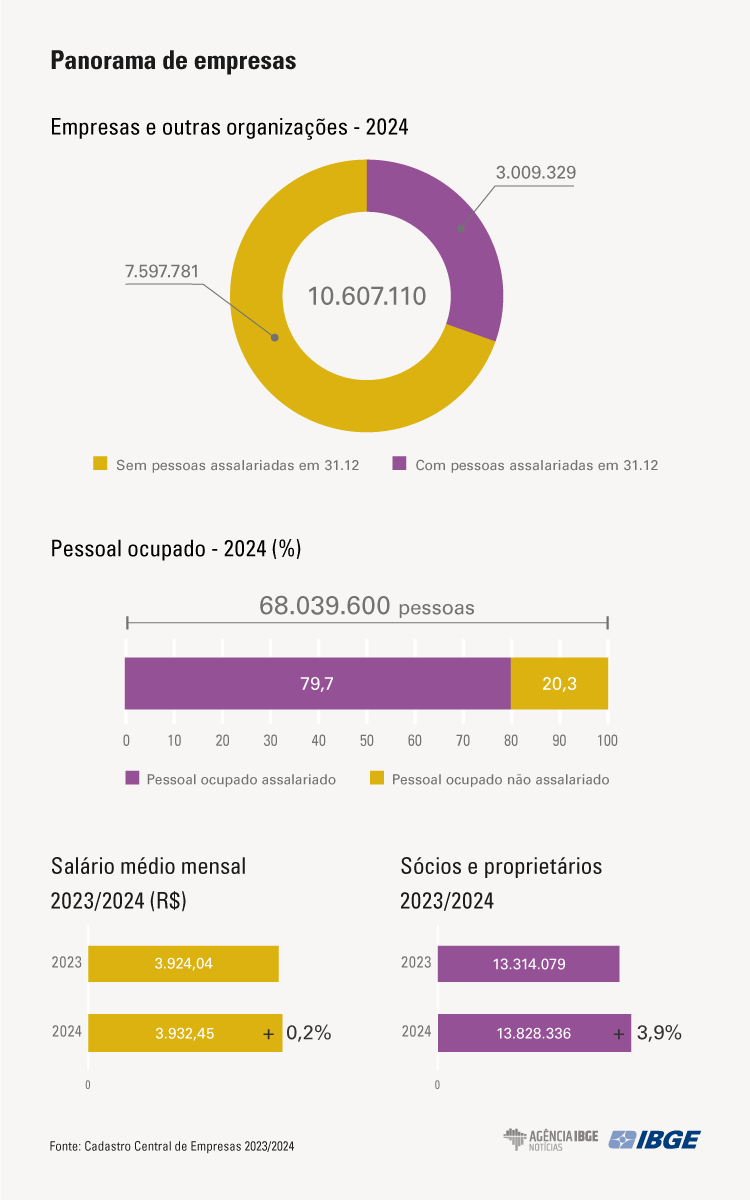
In 2024, the number of companies and other organizations in Brazil grew 5.8% in relation to 2023, going from 10.0 million to 10.6 million. The number of salaried personnel increased by 3.0% in the same period, going from 52.6 million to 54.2 million. The average monthly salary changed by 0.2% and went from R$3,924.04 to R$3,932.45, maintaining the value equivalent to 2.8 minimum wages.
“The growth in the number of companies is more concentrated in small ones, with 0 to 9 people. There is a mismatch between the growth of small companies and the evolution in the number of companies, in the number of paid salaried staff, because small companies employ less. So, this employment is more concentrated in larger companies. Despite an increase in the number of companies, most of it is due to the arrival of new small ones, which creates this mismatch in employment,” explains Francisco Marta, coordinator of Registers and Classifications at the Brazilian Institute of Geography and Statistics (IBGE).
Considering the period from 2022 to 2024, the growth in the number of companies and other organizations in Brazil reaches 12.5%, going from 9.4 million to 10.6 million, which represents a positive balance of approximately 1.2 million companies. The largest portion of this increase came from the section of Human health and social services, which showed a growth of approximately 177.7 thousand entities, followed by that of Scientific and technical professional activities (174.0 thousand) and Trade, repair of motor vehicles and motorcycles (166.7 thousand).
The data comes from 2024 Demography of Enterprises (CEMPRE), released today (25) by the IBGE. CEMPRE gathers registry and economic information on companies and other organizations present in the national territory, registered in the National Register of Legal Entities (CNPJ), of the Special Secretariat of the Federal Revenue of Brazil, and their respective local units.
Among the companies and other organizations existing in 2024, a total of 3.0 million had salaried people (28.4%). As of December 31, 2024, these entities employed 68.0 million people, 54.2 million (79.7%) as salaried employees and 13.8 million (20.3%) as partners and owners. Salaries and other compensation paid added up to R$2.8 trillion.
Three activities with the highest salaries account for just 2.6% of employees
Among the economic activities, the highest average monthly salary values were paid by the sector of International organizations and other extraterritorial institutions (R$9,678.61), followed by Electricity and gas (R$8,539.07) and Financial activities, insurance and related services (R$8,430.55). Together, the three activities employed 1.4 million salaried employees, that is, only 2.6% of the salaried workforce. In 2024, the average monthly salary for all activities stayed at R$3,932.45.
Sector of Trade, repair of motor vehicles and motorcycles recorded higher shares in three categories
Among the number of companies and other organizations, the sector of Trade, repair of motor vehicles and motorcycles ranked first, with 27.4%. It was followed by Administrative activities and services, with 10.1%; and Professional, scientific and technical activities, with 9.0%.
In terms of total employed persons, the sector of Trade, repair of motor vehicles and motorcycles came first, with 20%. It was followed by Manufacturing industries (13.4%) and Public administration, defense and social security (12.9%).
Among the number of salaried employed personnel, the sector of Trade, repair of motor vehicles and motorcycles ranked first (18.2%) as well. Public administration, defense and social security occupied the second place (16.2%). It was followed by Manufacturing industries (15.3%).
In terms of wage bill, the first place went to the sector of Public administration, defense and social security (23.0%). Manufacturing industries came in the second place (16.1%). It was followed by Trade, repair of motor vehicles and motorcycles (13.0%).
Large companies pay more than twice the salary of those with up to 9 people
Of the total number of companies and other organizations in 2024, 93.4% had 0 to 9 salaried people; 5.6%, 10 to 49 people; 0.8%, 50 to 249 people; and 0.2%, 250 people or more. The average monthly salary among companies and other organizations was R$3,932.45 and only companies with 250 people or more paid above this amount, R$4,913.27, which is more than twice the salary received by those with 0 to 9 employed people, R$2,116.21.
Companies and other organizations with 250 people or more concentrated the highest percentages of total employed persons (44.4%), salaried employed persons (55.7%) and wage bill (69.0%).
“Traditionally, bigger companies have better salaries. The economic sectors that most concentrate small businesses are Trade and Administrative activities, which pay lower salaries than the average. Large companies are concentrated in industry sectors that have better salaries,” points out Marta.
CEMPRE statistics disregard Individual Micro-Entrepreneurs (MEIs) as they are not required to complete the administrative records of the Special Secretariat for Social Security and Labor.
Men are the majority among salaried employees and continue to earn more than women
In 2024, the average monthly salary received by women (R$3,608.04) was 16% lower than that of men (R$4,206.00). Still in 2024, women earned, on average, the equivalent of 85.8% of men's average monthly salary, which represents a reduction of 0.6 percentage points compared to 2023. Men were also the majority among salaried employed persons (54.2%).
Male workforce was concentrated in the sector of Manufacturing industries (19.4%), followed by Trade, repair of motor vehicles and motorcycles (18.5%) and Public administration, defense and social security (13.3%). However, Construction is the one with the highest participation of men in the sector (87.2%), followed by Mining and quarrying industries (82.5%) and Transportation, storage and mailing (80.5%).
In relation to women, Public administration, defense and social security retained the largest share of the female workforce (19.7%), followed by Trade, repair of motor vehicles and motorcycles (18.0%) and Human health and social services (11.2%). In terms of participation in the sector, Human health and social services has a greater participation of women in its workforce (75.0%), followed by Education (67.6%), and Financial activities, insurance and related services (57.6%) along with Lodging and food (57.6%).
“Female participation has been growing, especially in sectors that employ more women. Healthcare has shown very strong growth in recent years, especially in 2024, due to the need for greater demand for this service. When we look at employment in these sectors, most of them have female workforce. So, there was sectoral growth very favorable to the sector that employs more women. And, in other sectors, such as Education, which also employ more women,” highlights Marta.
Those with higher education earn three times the salary of those without it
The survey also analyzed the level of schooling and found that 76.4% of the salaried employees did not have a higher education course in 2024, which represents stability in relation to the previous year.
On the other hand, 23.6% who had higher education had an average monthly salary of R$7,776.59, approximately three times the value of those who did not have higher education, who earned, on average, R$2,742.41.
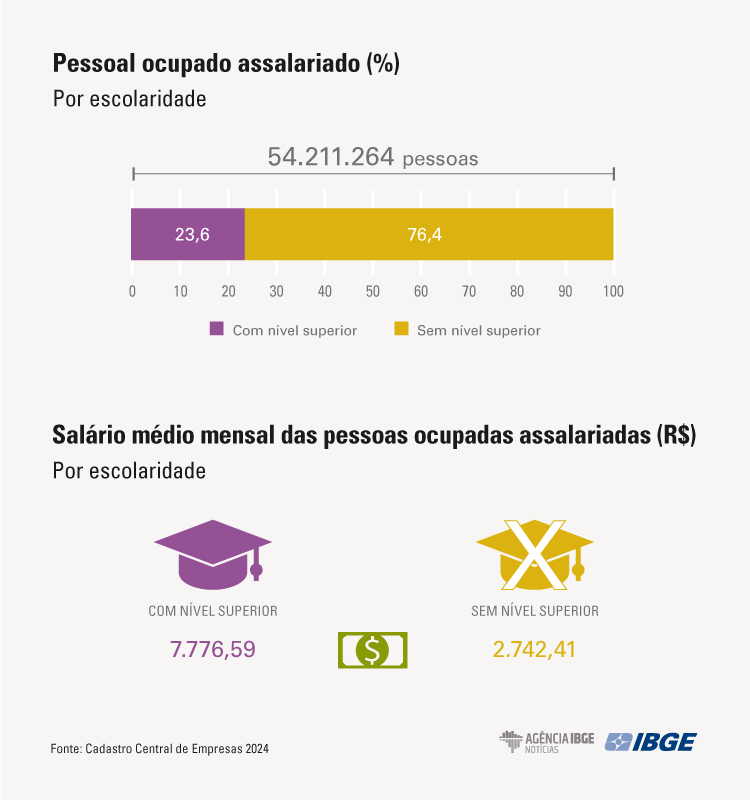
Therefore, in 2024, a salaried worker without a higher education degree received, on average, approximately 35.3% of the compensation paid to a worker with a higher education degree.
"Those salaried without higher education obtained a greater real increase in the average salaries than those with higher education. Salaried persons without higher education, who earned approximately 34.6% of the salary of those with higher education, in 2023, started to earn 35.3%, in 2024," points out Caroline Santos, Manager of Analysis and Dissemination at the IBGE.
Three sectors show a majority of personnel with higher education: Education (64.6%), Financial activities, insurance and related services (58.7%) and International organizations and other extraterritorial institutions (58.2%). Public administration, defense and social security also stood out with a high share of salaried personnel with higher education (45.8%).
Still in 2024, in terms of distribution, 31.5% of the workforce with higher education was in Public Administration, defense, and social security, 19.9% in Education, and 8.8% in Human health and social services. On the other hand, 21.8% of the workforce without higher education was allocated to Trade, repair of motor vehicles and motorcycles, followed by Manufacturing industries (17.6%) and Administrative activities and complementary services (12.8%).
Business entities are the majority, while public administration pays higher salaries
In 2024, 89.4% of companies and other organizations were business entities; 10%, of non-profit entities; and 0.6%, of public administration entities. However, public administration absorbed 17.1% of total employed persons and 21.5% of salaried employed persons and paid 30.3% of salaries and other compensation. Non-profit entities registered the lowest participation in the economic variables analyzed, with 6.6% of total employed personnel; 7.0% of salaried employed persons; and 6.5% of salaries and other compensation paid during the year.
The highest average salaries were paid by public administration, both for men (R$6,058.19) and women (R$4,967.51). Business entities paid R$3,838.67 and R$2,996.79, respectively, for men and women. Non-profit entities were those that recorded the smallest salary gap between men and women, with R$3,768.81 and R$3,589.82, respectively.
Southeast has a greater concentration of companies and pays higher salaries
In 2024, 10.6 million Brazilian companies and other active organizations had 11.9 million local units. The Southeast Region is where most of them were concentrated, with 6.1 million local units (51.4%). It was followed by the South, with 2.3 million (19.6%); Northeast, with -1.9 million (15.6%); Central-West, with 1.0 million (8.7%), and North, with 559.7 thousand (4.7%).
The Southeast also concentrated the largest number of total employed persons, 33.3 million (49.0%), and salaried workers, 26.1 million (48.2%), and paid the largest amount of salaries and other compensation, R$ 1.5 trillion (52.3%).
The South had 17.8% of total employed personnel (12.1 million), 17.2% of salaried personnel (9.3 million) and paid 17.0% of salaries and other compensation (R$472.1 billion).
The Northeast Region concentrated 18.0% of total employed persons (12.3 million), 18.9% of salaried employees (10.2 million) and 14.8% of salaries and other compensation (R$412.1 billion). Finally, the Central-West and North presented the lowest distributions in the three variables: 9.3% and 5.9% of total personnel; 9.4% and 6.3% of salaried personnel; and 10.3% and 5.6% of wage bill.
“Analyzing the time series, which begins in 2022, the Southeast Region maintained the highest relative shares, although there was a reduction in both variables in the period, of 0.2 percentage points in the number of local units, which went from 51.6% to 51.4%, and of 0.6 percentage points in salaried employed persons, which went from 48.9% to 48.2% of the total. In the same time period, the Central-West Region increased its participation in both variables. Gains of 0.3 percentage points in the number of local units and 0.6 percentage points in salaried employed persons. However, in light of the available data, it is not possible to conclude that the observed movement reflects a structural change in the distribution of the economic activity, and may only be a short-term fluctuation," explains Santos.
Among the Federation Units, São Paulo had the highest concentration of total employed personnel (28.9%), salaried personnel (27.8%) and salaries and other compensation (32.3%). Minas Gerais showed the second highest concentration of total and salaried personnel (10.2% in both variables), but the third highest concentration of wage bill (9.0%). Rio de Janeiro had the third highest concentration of total and salaried personnel (8.1% and 8.3%, respectively) and the second highest concentration of wage bill (9.2%). The highest average monthly salary was paid in the Federal District (4.1 minimum wages), followed by São Paulo (3.3) and Rio de Janeiro (3.1).