
Continuous PNAD
Proportion of Internet users in Brazil exceeded 90% of population aged 10 or over, in 2025


July 02, 2026 10h00 AM | Last Updated: July 16, 2026 04h25 PM
Highlights
- In 2025, out of Brazil’s estimated population of 186.4 million people aged 10 and older, 90.5% (168.7 million) used the Internet during the three-month reference period, surpassing the 90% user threshold at the national average for the first time.
- Among the Major Regions, the Central-West (93.6%) maintained the highest proportion of Internet users.
- Nationwide, 91.1% of women used the Internet in 2025, slightly higher than the percentage among men (89.9%).
- Internet usage remains lower among older adults (aged 60 or older), with 74.5% using it in 2025. However, this age group is experiencing rapid growth in Internet usage, with a 4.4 percentage point (pp) increase compared to 2024.
- In 2025, among people aged 10 and older who used the Internet during the three-month reference period, 95.6% used it habitually on a daily basis.
- Among the purposes for accessing the Internet, making voice or video calls remained the most common activity, involving 95.3% of Internet users.
- Using the Internet to access banks or other financial institutions (74.2% of users), purchasing or ordering goods or services (52.7%), and using public services (41.1%) were the activities that saw the greatest growth compared to the previous year, increasing by 3.2 pp, 4.8 pp, and 2.5 pp, respectively.
- Among those who did not use the Internet during the reference period, 44.9% reported lack of knowledge on how to use it as the primary reason. Among older adults, this reason was reported by 66.5% of those who did not use the Internet.
- In 2025, concerns regarding privacy or security were mentioned by 5.3% of non-Internet users, whereas in 2022 the figure was 2.3%. Among individuals aged 10 to 13 who did not use the Internet, 30.3% mentioned privacy or security concerns as the primary reason.
- In 2025, it is estimated that 167.4 million people aged 10 and older in the country owned a mobile phone for personal use, representing 89.8% of the population in that age group.
The proportion of Internet users in the country surpassed 90% of the population aged 10 and older in 2025. This information was released by the IBGE this Thursday (2) in the Continuous PNAD Survey: 2025 Access to Internet and TV and Ownership of Mobile Phone for Personal Use.
In 2025, out of Brazil's estimated population of 186.4 million people aged 10 and older, 90.5% (168.7 million) had used the Internet during the reference period of the previous three months. Regarding the location of the household, the percentage of people living in urban areas who used the Internet was 91.5%, whereas among rural residents, the proportion was 83.0%.
The percentage of Internet users has been rising since 2016—the start of the Continuous PNAD series—when 66.0% of the population aged 10 and older had used the Internet during the reference period. The figure rose from 79.4% in 2019 to 90.5% in 2025, marking the first time the national average for Internet users surpassed the 90% threshold. Compared to 2024, when 89.2% of people aged 10 and older had used the Internet, there was a variation of 1.3 percentage points.
In 2025, an analysis of the Major Regions showed that the Central-West (93.6%) maintained the highest proportion of Internet users, while the North (89.7%) and Northeast (88.5%) Regions continued to show lower figures than the other Major Regions.

In Brazil, women use the Internet more
Regarding sex, 91.1% of women in the country used the Internet in 2025, slightly higher than the percentage for men (89.9%). When analyzing by level of schooling, the group with no formal education (50.1%) showed an Internet usage rate significantly lower than that of other educational groups. The highest percentages were estimated for individuals with incomplete higher education (98.4%) and those with a completed higher education degree (97.4%).
By color or race, it is observed that in 2025, the percentage of people self-declared as white who used the Internet during the reference period was 91.3%, slightly higher than the estimates for those self-declared as black (90.0%) or brown (*parda*) (89.9%).
Meanwhile, the percentage of people in the 10–13 age group who used the Internet during the three-month reference period was 84.4%. This percentage rose steadily across subsequent age groups, reaching over 96% among the population aged 20 to 39. Subsequently, the proportion of users declined gradually to 91.8% in the 50–59 age group, dropping more sharply among older adults (60 years or older), where the usage rate was 74.5%.
Although Internet usage remains lower among people aged 60 and older, rapid growth in the number of users is observed within the older adult population. Compared to 2024, this age group showed the largest increase (4.4 percentage points).
Private school students still use the Internet more
In 2025, the percentage of people who used the Internet during the three-month reference period was 92.4% among students, the same figure recorded in 2024. Among non-students, this figure was 90.0%, an increase of 1.6 percentage points compared to the previous year.
Regarding the school system, significant differences in Internet usage are observed among Brazilian students. While 97.2% of private school students used the Internet in 2025, the figure for public school students was 89.9%. The largest gap occurs among primary school students: 93.8% of private school students and 85.0% of public school students used the Internet (a difference of 8.8 percentage points). At the higher education or postgraduate level, access rates are near-universal regardless of the school system (98.4% of private school students and 98.9% of public school students used the Internet).
Internet usage is daily, and mobile phones are the primary means of access
Starting in 2022, the Continuous PNAD survey began tracking the frequency with which people typically use the Internet. In 2025, among individuals aged 10 or older who had used the Internet during the three-month reference period, 95.6% used it habitually every day; 1.8% used it almost every day (five or six days a week); 2.1% used it one to four times a week; and only 0.5% used it less than once a week. Looking at the 2022–2025 period, a slight year-over-year increase is evident in the percentage of people who used the Internet on a daily, habitual basis, rising from 93.4% in 2022 to 95.6% in the final year.
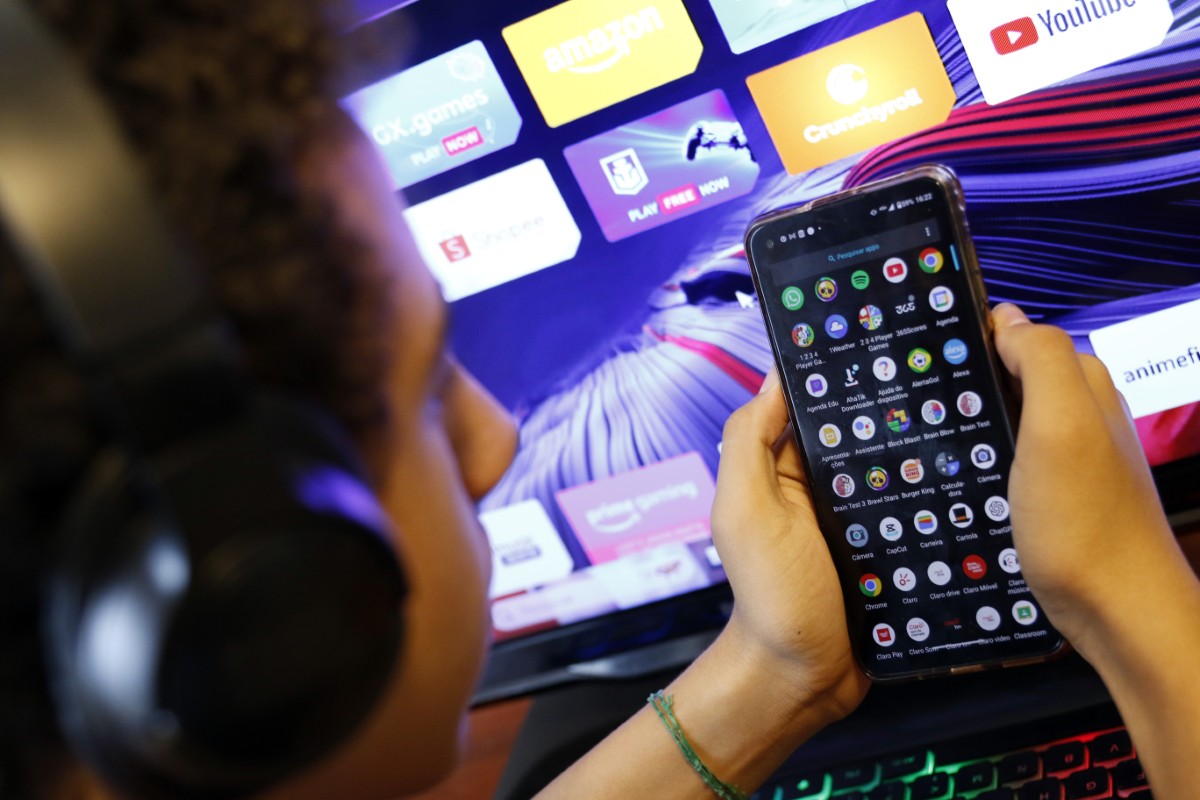
In 2025, the primary means of access reported by people aged 10 and older who used the Internet was, by a wide margin, the mobile phone (98.7%), followed—to a lesser extent—by television (57.8%), personal computers (33.4%), and tablets (9.2%). Between 2024 and 2025, there was an increase in the number of people using televisions and tablets to access the Internet (up 4.3 pp and 1.0 pp, respectively), whereas usage of mobile phones and personal computers remained virtually stable.
Making voice or video calls remained the most frequently reported reason for Internet use, accounting for 95.3% of users in 2025. The second most reported purpose was sending or receiving text, voice, or image messages via apps other than email (90.2%).
Other purposes mentioned by more than half of Internet users during the reference period included: watching videos, including programs, series, and movies (89.3%); using social media (84.9%); listening to music, radio, or podcasts (83.7%); accessing banking or other financial institutions (74.2%); reading newspapers, news, books, or magazines online (69.0%); and sending or receiving emails (61.2%). In addition to these activities, it was observed that, for the first time in the series, more than half of users reported making purchases or ordering goods or services online (52.7%).
Among these purposes, notable is the expansion in Internet usage compared to the previous year for purchasing or ordering goods or services (an increase of 4.8 percentage points) and for accessing banks or other financial institutions (3.2 percentage points). Another purpose that showed growth was Internet access for using public services, with a change of 2.5 percentage points (from 38.6% in 2024 to 41.1% in 2025).
Concerns about privacy or security have increased
Nationwide, in 2025, 9.5% of people aged 10 or older did not use the Internet during the three-month reference period—representing 17.7 million people, the lowest figure in the time series. Compared to 2024, when 10.8% of the population did not access the Internet (20.0 million people), there was a 1.3 percentage point drop in this proportion; meanwhile, compared to 2019 (20.6% or 36.7 million), there was an 11.1 percentage point reduction in the share of the population that did not access the Internet.
The two most frequently given reasons by these individuals were not knowing how to use the Internet (44.9%) and a lack of need (27.8%). The subsequent reasons were economic (high cost of Internet access services and necessary electronic equipment), accounting for a combined 9.0%.
Concerns regarding privacy or security were reported by 5.3% of people, while a lack of time was mentioned by 4.6%. Notably, since 2022—when this reason was first included in the survey—concern about privacy or security has steadily increased year-over-year as a primary reason for not using the Internet, rising by a total of 3.0 percentage points over the period. This increase occurred primarily among younger age groups.
Among the population aged 10 to 13, concerns regarding privacy or security were the second most common reason for not using the Internet (cited by 30.3%), which may reflect apprehension on the part of parents or guardians, whereas only 8.2% stated they did not know how to use the Internet. In contrast, among older adults who did not use the Internet, 66.5% mentioned lack of knowledge on how to use it as the primary reason.
Mobile phone usage continues to expand
In 2025, it is estimated that 167.4 million people aged 10 or older owned a mobile phone for personal use, representing 89.8% of the country's population in that age group.
A continuous expansion in mobile phone ownership is observed over the period covered by the survey, rising from 77.4% of the population aged 10 or older in 2016 to 81.3% in 2019, and reaching 89.8% in 2025—the highest figure in the series. There was a 0.9 percentage point fluctuation compared to 2024, when the percentage of people owning the device stood at 88.9%.

Nationwide, in 2025, the percentage of people owning a mobile phone for personal use was lowest in the 10-to-13 age group (55.2%), rising sharply among those aged 14 to 19 (88.5%). The highest rates were found among young adults aged 25–29 and 30–39, both at 97.2%. In subsequent age groups, the percentage declined gradually down to the 50–59 age group (93.5%), with a steeper drop among older adults aged 60 and over (80.3%).
10.2% of the population aged 10 and older still do not own a mobile phone
In 2025, an estimated 19.1 million people in the country did not own a mobile phone for personal use, representing 10.2% of the population aged 10 and older. This figure stood at 18.7% in 2019 and 11.1% in 2024.
Among the reasons given, the top three accounted for approximately two-thirds of the people aged 10 and older who did not own such a device: 31.1% stated they did not know how to use a mobile phone; 21.1% reported lack of need for one; and 14.9% mentioned the high cost of the device. Other reasons listed included: concerns about privacy or security (11.8%); habitually using someone else's mobile phone (10.1%); the cost of the service (1.9%); and the unavailability of mobile phone service in places they use to go (0.4%). Additionally, 8.9% of respondents mentioned a reason that did not fall into the other surveyed categories.
About the survey
Since 2016, the annual Information and Communication Technology (ICT) module of the Continuous National Household Sample Survey (Continues PNAD) has analyzed Internet and television access, as well as mobile phone ownership for personal use, with geographic breakdowns for Brazil, Major Regions, and Federation Units. Access the supporting materials and the full publication for more information.