
PNAD Contínua Mensal
Unemployment drops to 5.1% in December and 2025 records the best results in the time series


January 30, 2026 09h00 AM | Last Updated: February 02, 2026 07h15 PM

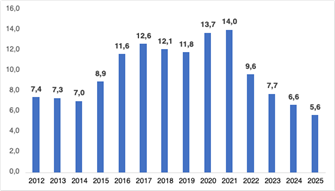
In the quarter ending in December, the country's unemployment rate fell to 5.1%, the lowest level in the time series that began in 2012, when it was 8.0%. This means that approximately 5.5 million persons tried to find a job in the last three months of the year and join the employed population, a total of 103 million persons.
With the December result, the annual unemployment rate fell from 6.6% in 2024 to 5.6% in 2025, the lowest level since 2012. In one year, the average number of unemployed people fell from 7.2 to 6.2 million. Due to the Covid-19 pandemic, in 2020 and 2021 the rate reached 13.7% and 14.0%, respectively, with approximately 14 million unemployed. The data comes from the Continuous National Household Sample Survey (Pnad Contínua), released today (30) by the IBGE.
Unemployment rate - Brazil (%)
"It is worthy of mention that the decrease in unemployment was not caused by an increase in undeutilization of workforce or discouragement. The downward trend of unemployment rate in 2025 was supported by the expansion of employment, mainly in service activities, highlights Adriana Beringuy, coordinator of Household Sample Surveys at the IBGE.
The employed population in 2025 hit a record high in the time series, with 103 million people, compared to 101.3 million in 2024. In 2012, the figure was 89.3 million.
Another important indicator for assessing the quality of the labor market, the annual employment rate (percentage of employed people in the working-age population) was also a record high in 2025 (59.1%), while in 2024 it was 58.6% and in 2012 it was 58.1%.
Annual underutilization rate falls to 14.5%, the lowest in the series
The annual estimate of the underutilized population (unemployed or underemployed people due to insufficient working hours or in the potential workforce) decreased by 10.8% between 2025 and 2024, from 18.7 million persons in 2024 to approximately 16.6 million in 2025. Despite the reduction, this figure is still above the lowest level in the series, reached in 2014 (16.3 million people). In 2012, it totaled 19 million people. And during the Covid years, it reached 31.2 million in 2020 and 32.1 million in 2021.
Underutilized population in the extented workforce - Brazil (million)
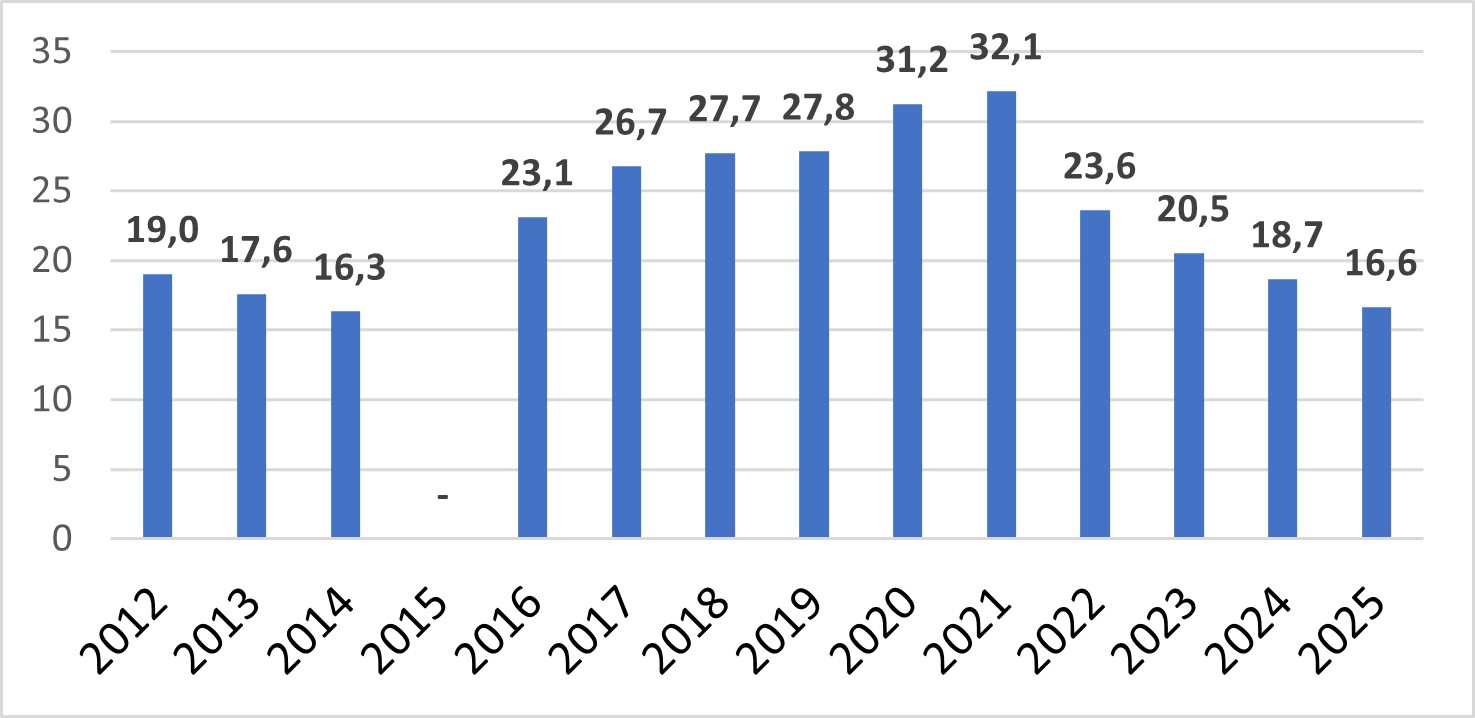
Thus, the composite underutilization rate for 2025 (14.5%) was the lowest in the series, while in 2024 it was 16.2%. This indicator reached 28.3% and 28.5% in 2020 and 2021 due to the effects of the Covid-19 pandemic on the labor market.
Average earnings and total income hit record increases in 2025
The value of the average real earnings of employed persons was estimated at R$ 3,560, an increase of 5.7% (or R$ 192) compared to 2024. In the time series of the survey, since 2012, the lowest result had been in 2022 (R$ 3,032). The annual value of the usual real earnings reached R$ 361.7 billion in 2025, the highest in the series, with an increase of 7.5% (R$ 25.4 billion more) compared to 2024.
"By sector, the activities with greatest expansion of employment were Information, Communication, and Financial, Real Estate, Professional, and Administrative activities, as well as the group formed by Public Administration, Defense, Education, Human Health, Social Security, and Social Services. These activities concentrate totals of more educated workers, with more formal employment and higher earnings, contributing to the expansion of the average income of the employed population," highlighted Adriana Beringuy.
A coordenadora acrescentou que “além desses impulsos setoriais, a valorização do salário-mínimo influenciou o ganho de rendimento nos segmentos de atividades mais elementares e menos formalizadas. Dessa forma, independente da forma de inserção na ocupação, o crescimento do rendimento foi difundido para a população ocupada como um todo".
The coordinator added that “in addition to these sectoral impulses, the increase in the minimum wage influenced gains in earnings in the most basic and least formal activity segments. Thus, regardless of the form of employment, income growth was spread to the employed population as a whole.”
An additional 1 million workers with formal contracts in 2025, reaching a record level
The annual estimate of the number of private sector workers with formal employment contracts grew by 2.8% in 2025 compared to 2024, reaching 38.9 million persons, the highest in the series, an increase of approximately 1 million persons with formal contracts from the previous year.
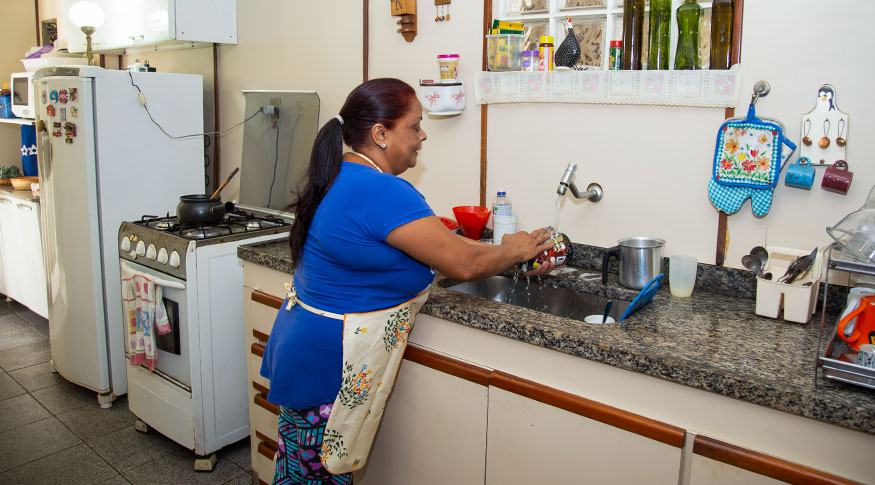
Meanwhile, the annual number of private sector employees without formal contracts fell by 0.8%, from 13.9 million to 13.8 million. The number of domestic workers showed a reduction of 4.4%, reaching 5.7 million people.
The number of self-employed workees reached its highest point in the historical series, with an annual estimate of 26.1 million, a growth of 2.4% compared to 2024, when it was 25.5 million. Compared to the beginning of the series in 2012, when it was 20.0 million, there was a 30.4% increase. The annual informality rate fell from 39.0% in 2024 to 38.1% in 2025.
“The informality rate continued to fall in 2025. Its significant value (38.1%), however, reflects a structural characteristic of the Brazilian labor market. The composition and dynamics of the employed population are still highly dependent on informality, especially due to the large participation of workers in commerce and even complex service sectors,” commented Adriana Beringuy.
Unemployment falls and formal employment hits record high in the fourth quarter of 2024
Considering only the indicator for the quarter from October to December 2024, the Continuous PNAD released today (30) shows that the unemployment rate (5.1%) fell in both comparisons; -0.5 p.p. compared to the quarter from July to September (5.6%) and -1.1 p.p. compared to the same quarter of 2024 (6.2%). The result is the lowest in the series that began in 2012, considering comparable moving quarters.
The total persons in the workforce (employed and unemployed persons), in the quarter from October to December 2025, was estimated at 108.5 million, with stability in both comparisons.
The analysis of employment by group of activity compared to the July-September 2025 quarter showed increases in: Trade, repair of motor vehicles and motorcycles (1.6%, or 299,000 more persons) and Public administration, defense, social security, education, human health and social services (1.5%, or 282,000 more persons). The other groups did not show significant change.
"After a drop in employment recorded in the 3rd quarter, the retail sector recovered at the end of the year, expanding its workforce in various segments, especially in trade of wearing apparel and footwear," explained Adriana Beringuy, coordinator of Household Sample Surveys at IBGE.
Compared to the October-December 2024 quarter, an increase was observed in the following groups: Information, Communication and Financial, Real Estate, Professional and Administrative Activities (3.7%, or 475,000 more people) and Public administration, defense, social security, education, human health and social services (5.5%, or 1 million more people). There was a reduction in the Domestic Services group (4.9%, or 289,000 ).
More about the survey
The Continuous PNAD is the main survey on workforce in Brazil. At each quarter, two thousand interviewers in more than 500 branches of the IBGE's data collection network visit a sample of 211 thousand households, covering nearly 3,500 municipalities located in the 27 Brazilian Federation Units.
The identity of the interviewers can be confirmed on the Answering the IBGE website or through the Call Center (0800 7218181), and their ID numbers can be requested by the informants.
The survey data can also be accessed on Sidra. The next release of the Quarterly Continuous PNAD, relative to the quarter nding November, will be on February 20, 2026.