
Continuous PNAD
Illiteracy stays under 5% in 2025, though 8.4 million still do not know how to read and write


June 19, 2026 10h00 AM | Last Updated: June 29, 2026 04h52 PM
Highlights
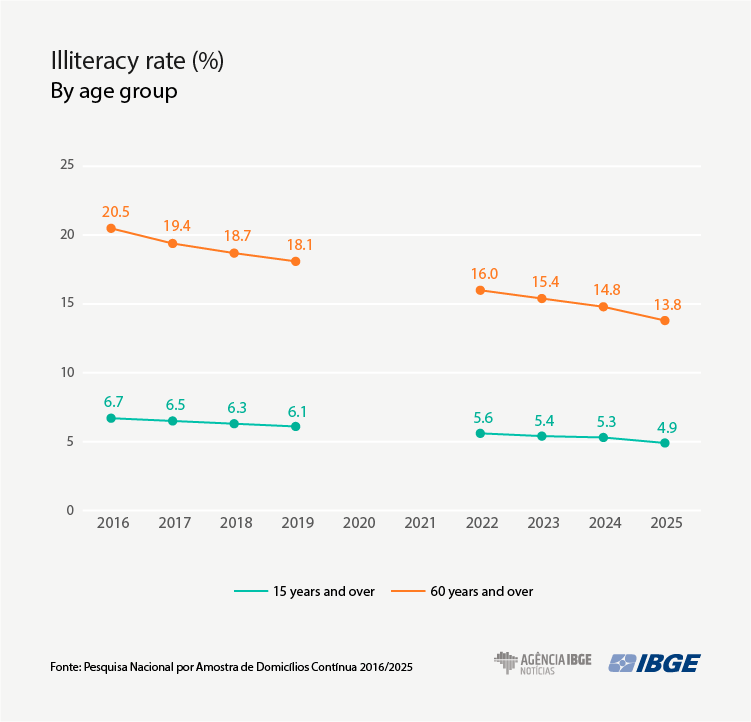
- Brazil had 8.4 million illiterate people aged 15 or over in 2025, which corresponds to an illiteracy rate of 4.9%. It is the first time that the illiteracy rate has been below 5% since 2016.
- More than half of the illiterate people (4.8 million people) were in the Northeast, with a rate of 10.6%.
- The population aged 60 or over was more than half (58%) of the total illiterate population in 2025. There were 4.9 million people who did not know how to read and write a simple note.
- Still in the population aged 60 or over, the illiteracy rate of women (13.7%) became lower than that of men (14.1%) for the first time. The illiteracy rate of black or brown people (20.6%) was almost three times higher than that of white people (7.3%) in this age group.
- Without considering the elderly population, the illiteracy rate fell to 2.6% among people aged 15 to 59 years.
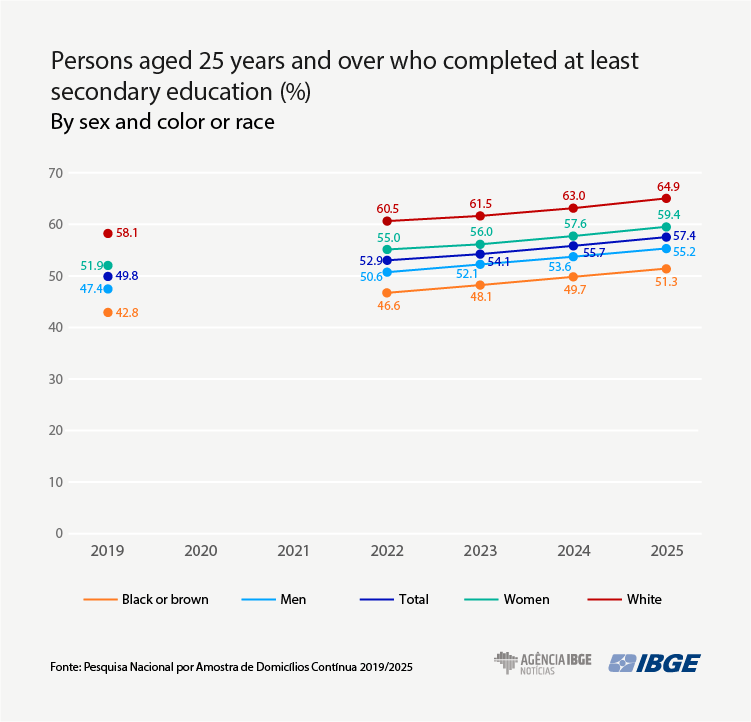
- For the first time, more than half of black or brown people aged 25 or over (51.3%) have completed secondary education.
- In the North, 35.2% of babies aged 0 to 1 year old and 44.5% of children aged 2 to 3 years old were out of daycare due to lack of school/daycare in the locality, lack of vacancy or non-acceptance of enrollment due to the child's age. In the Northeast, the percentages were 36.1% and 37.2%, respectively.
- Proportion of children aged 6 to 14 years in the ideal stage (primary education) meets the target (96.1%) of the National Education Plan (PNE), but does not return to pre-pandemic levels.
- Men (77.4%) and black or brown people (77.8%) aged 15 to 17 attend secondary school less than women (84%) and white people (84.9%).
- The proportion of white people aged 18 to 24years with higher education and who do not attend an educational institution (6.2%) is more than double that of black or brown people (3.0%)
- Higher percentages of school dropouts occur from the age of 16 years: 18.5% left school at that age, 20.0% at 17 years of age and 17.6% at 18 years of age.
- One out of four young people (25.6%) aged 14 to 29 years have no interest in studying.
- Work (26.2%) and pregnancy (24.7%) are the main reasons for women aged 14 to 29 years to abandon studies.
- The data are from the Education module of the Continuous National Household Sample Survey (PNAD), which had the time series (2016-2025) re-weighted based on the results of the 2022 Census.
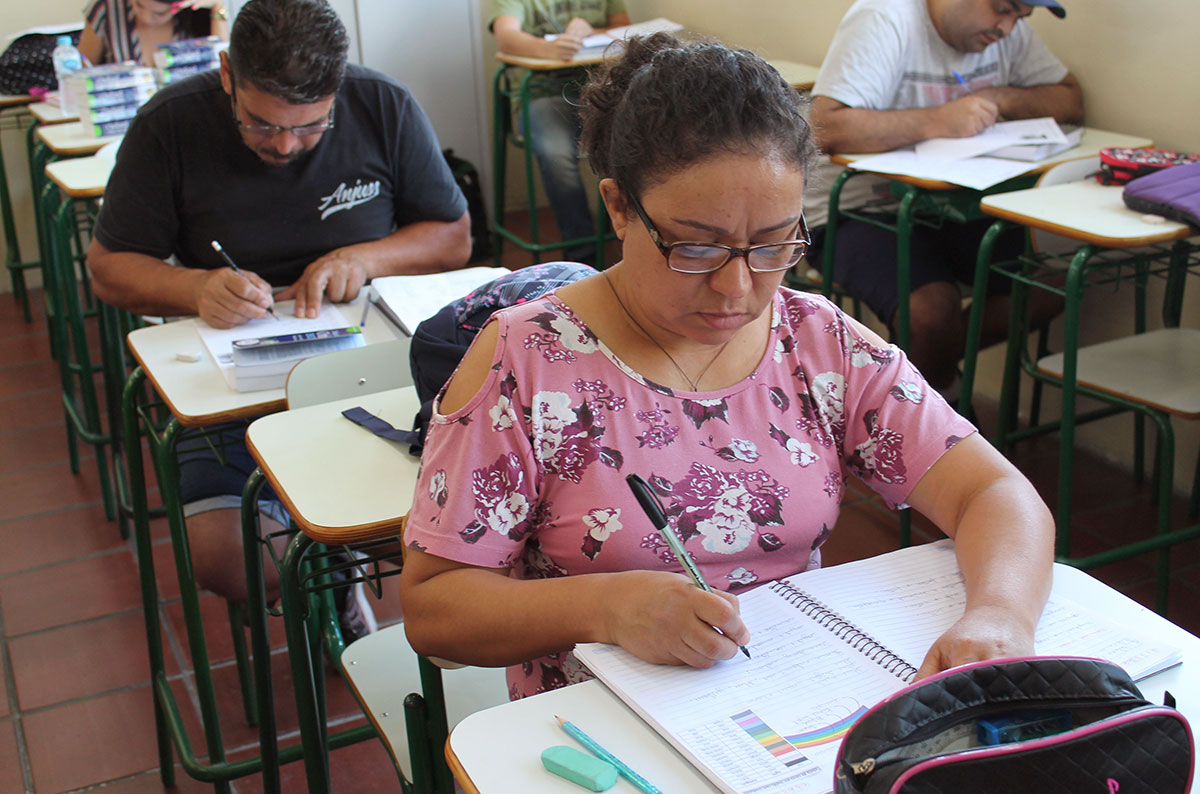
Brazil had 8.4 million illiterate people in 2025, which corresponds to an illiteracy rate of 4.9%. It is the first time that the Brazilian illiteracy rate has been below 5% since 2016. There are 592 thousand fewer people aged 15 or over unable to read and write a simple note compared to 2024.
Released today (19) by the IBGE, the data is from the Education module of the Continuous National Household Sample Survey (PNAD), which had the time series (2016-2025) re-weighted based on the results of the 2022 Census. Despite the progress in the indicator, the National Education Plan (PNE) predicted the eradication of illiteracy by 2024.
More than half of the illiterate people (4.8 million people) were in the Northeast, with a rate of 10.6%. The North comes next (5.7%), followed by the Central-West (3.3%), South (2.4%) and Southeast (2.3%). Compared to 2024, only the Southeast showed a reduction in the illiteracy rate, of 0.5 percentage points (p.p).
The population aged 60 or over corresponded to more than half (58%) of the total illiterate population in 2025. There were 4.9 million illiterate people in this age group, equivalent to 13.8% of the total number of people aged 60 or over. Without considering the elderly population, the illiteracy rate drops to 2.6% among people aged 15 to 59 years.
“The difference between these population groups reinforces the importance of policies to keep children and young people in school, as well as those specific to literacy for adults and the old population. It also indicates that new generations had greater access to schooling and learned how to read and write during their childhood. Therefore, illiteracy remains more associated with the old people," highlights the survey analyst, William Kratochwill.
Proportion of illiterate women aged 60 or over is now lower than that of men
Still in the population aged 60 or over, the illiteracy rate of women (13.7%) became lower than that of men (14.1%) for the first time in 2025. The illiteracy rate among women aged 15 or over remains lower (4.6%) than that of men (5.2%). According to the survey analyst, “these results suggest advances in female schooling across all generations, pointing to a reversal of the legacy of educational inequality from the past.”
Illiteracy among black or brown people aged 60 or over is nearly three times higher than that of white people
Nearly 2.8% of white people aged 15 or over were illiterate, while this proportion was 6.5% for black or brown people in the same age group. The difference is accentuated among the old people. In the age group of 60 or over, the illiteracy rate of black or brown people (20.6%) was almost three times higher than that of white people (7.3%).
"In relation to 2024, there was a drop of 1.2 p.p. in the illiteracy rate among old black or brown people, which suggests progress, but highlights a public structural legacy of educational exclusion," highlights Kratochwill.
For the first time ever, more than half of black or brown people aged 25 or over (51.3%) have completed secondary education
The proportion of black and brown people aged 25 or over who completed the basic educational cycle (secondary education) reached more than half (51.3%) of this population for the first time. However, in relation to white people (64.9%), there is still a difference of 13.6 p.p. This distance remains practically unchanged in relation to 2024, when it was 13.3 p.p, despite having already been 16.4 p.p. in 2016.
Considering the entire population aged 25 or over who completed compulsory basic education (secondary education), it maintained a growth trajectory and reached 57.4% in 2025. The percentage of people who completed the secondary education only stood out, having changed from 27.1% in 2016 to 31.8% in 2025.
The average number of years of study for people aged 25 or over was 10.2 years in 2025, up from 9.1 years observed in 2016 and 10.1 years in 2024. Women continue to have a higher average level of schooling (10.4 years) compared to men (10.0 years). As for color or race, the difference remains significant: white people achieved 11.1 years of study, while black or brown people reached 9.5 years, resulting in a difference of 1.6 years, still high, although slightly lower than the two-year difference recorded in 2016.
North and Northeast have a greater lack of daycare centers for children aged 0 to 3 years
In 2025, 64.1% of children aged 0 to 1 year old and 57.1% of those aged 2 to 3 years old who did not attend daycare were out of school by choice of their parents or guardians. This was the most cited reason in all Major Regions. The Central-West registered the highest percentage for children aged 0 to 1 year (73.6%), while the lowest one was recorded in the Northeast (58.5%). For the 2- to 3-year-old group, the highest percentage was also observed in the Central-West (65.5%) and the lowest, in the North (49.4%).
The second most cited reason was not having a school/daycare center in the locality, lack of vacancy or non-acceptance of enrollment due to the child's age. Among children aged 0 to 1 year, 28.1% of those responsible for them pointed out this factor; among those aged 2 to 3 years, the percentage was 33.4%. The North and Northeast were the regions most affected by this type of barrier. In the North, 35.2% of babies and 44.5% of children aged 2 to 3 were out of daycare for this reason, while in the Northeast, the percentages were 36.1% and 37.2%, respectively.
Proportion of children aged 6 to 14 years in the ideal stage meets the PNE target (96.1%), but does not return to pre-pandemic levels
Nearly 96.1% of children aged 6 to 14 years attended primary school in 2025, which is the school stage established for this age group. The result exceeds the 95% target established by the PNE and represents an increase in relation to 2024 (94.6%); however, it did not exceed the pre-pandemic period.
Kratochwill explains that younger children may have faced more difficulties adapting to classes during the pandemic. “These children may not have adapted to on-line classes or may have been taken out of school by their parents during the pandemic. Therefore, this period created a group of children who lost one or two years of study, thus falling behind," assesses him.
Men and black or brown people aged 15 to 17 years have lower attendance in secondary school
In relation to young people aged 15 to 17 years, 80.6% attended or completed secondary school in 2025, an appropriate stage for this age group. The indicator advanced 3.8 p.p. compared to 2024, but remains 4.4 p.p. below the target of 85% foreseen in the PNE.
By sex, 84.0% of women aged 15 to 17 years were in secondary school or had already completed it, while among men, this rate was 77.4%. As for color or race, 84.9% of white people aged 15 to 17 years were in the appropriate stage (secondary school), compared to 77.8% of black or brown people. This proportion for those who declare themselves black or brown increased by 14.7 p.p. since 2016, against 8.8 p.p. of white people. Among men, the growth was 14.0 p.p. compared to 10.7 p.p. of women from 2016 to 2025.
The data shows that despite the reduction, barriers still persist in students' access and retention in secondary education. "Although black or brown people and men are still behind in relation to white people and women, the data shows a reduction in inequality in the time series of the survey," says IBGE analyst William Kratochwill.
The proportion of white people between 18 and 24 years old with higher education and who do not attend an educational institution (6.2%) is more than double that of black or brown people (3.0%)
Among people aged 18 to 24 years, 24.5% were attending the appropriate stage for their age (higher education). This indicator advanced 1.4 p.p. in relation to 2024. Another 7.0% were late at school.
In relation to color or race, 6.2% of white people had already completed their degree, more than double (3.0%) of black or brown people. 33.4% of white people and 18.9% of black or brown people were in the ideal stage (higher education). Among those who did not attend and had not completed the ideal stage, the proportion of black or brown people was 70.1%, while among white people, 55.0%.
Kratochwill recalls that the PNE target 12 envisaged increasing the net school attendance rate in higher education to 33.0% by 2024. "This target was surpassed only among white people. Therefore, the Brazilian challenge involves reducing inequalities in access and completion in higher education, tackling school delays, as well as ensuring the permanence of young people in the educational system."
Regarding sex, 35.1% of women aged 18 to 24 years were enrolled in some course, compared to 28.0% of men. Among women, 28.8% attended higher education, compared to 20.3% of men. Moreover, 5.2% of women had already completed this level, while among men this percentage was 3.4%. Men also showed greater delays (7.7%) and a higher percentage of non-attendance and non-completion (68.7%), compared to the percentage of 59.7% among women.
The highest percentages of school dropouts are from the age of 16 onwards
Among young people aged 14 to 29 years, 7.7 million had not completed secondary education in 2025, either because they had left school before completing this stage or because they had never attended it. Of this total, 59.8% were men and 40.2% were women. By color or race, 26.4% were white and 72.8% were black or brown.
When analyzing the age at which these young people aged 14 to 29 years left school, the highest dropout percentages occurred from the age of 16: 18.5% left school at that age, 20.0% at 17 and 17.6% at 18. Even so, early school dropout continues to be present at the ages corresponding to primary education: 7.5% left school by the age of 13 and 7.6%, by the age of 14.
"The dropout percentages before the age of 14 are equivalent to 15.1% of the total. They are high and are characterized as fundamental elements in the precariousness of the individual's training. This data represents dropouts during elementary school, a stage that should be fully universalized. This pattern remained similar between men and women and between white and black or brown people," says Kratochwill.
He adds that the major milestone in school transition continues to be the age of 15 years, which may be linked both to changes in the curricular structure and to the perceived usefulness of secondary education or the need for early entry into the labor market. "At this point, the percentage of school dropouts almost doubles compared to the age of 14, reaching 13.5%," says Kratochwill.
One out of four young people (25.6%) aged 14 to 29 years have no interest in studying
Nearly 43.0% of young people aged 14 to 29 years have dropped out or never attended school due to the need to work in 2025. This was the most cited reason. The result represents a slight increase of 1.0 p.p. in relation to 2024. The second reason was not being interested in studying, which reached 25.6% of cases, confirming the reversal of the downward trend observed since 2024.
"The increase compared to recent years may signal a misalignment between young people's expectations and the educational model," highlights the survey analyst.
The other reasons remained stable or showed modest changes: pregnancy was mentioned by 9.9% of young people; permanent health problems, by 4.4%; carrying out household chores or taking care of people, by 3.9%; and not having a school in the desired location, vacancy or shift, by 2.8%.
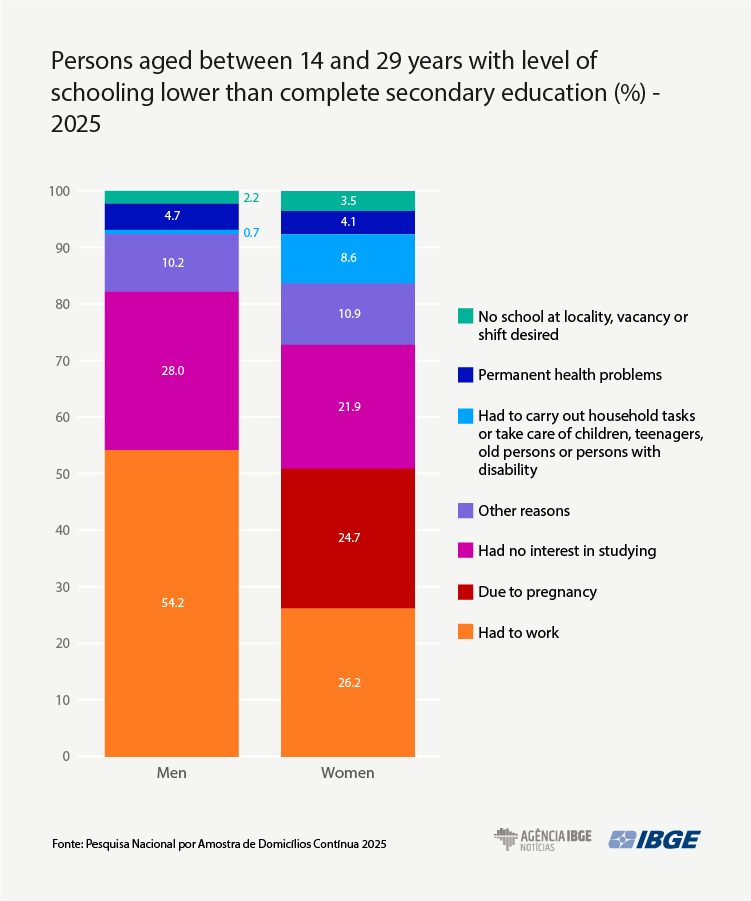
Among men aged 14 to 29 years with a level of schooling below complete secondary education, the main reason for dropping out or never having attended school was the need to work (54.2%), followed by lack of interest in studying (28.0%) and permanent health problems (4.7%). Among women in this group, although the most cited reason was also the need to work (26.2%), other factors related to gender dynamics stand out. Pregnancy was mentioned by 24.7% of women and carrying out household chores or caring for other people, by 8.6%. Moreover, 21.9% of women indicated a lack of interest in studies as a justification for leaving school.
"These are results that show that, in addition to economic conditions, reproductive and domestic responsibilities are still among the main obstacles to young women remaining in school, while the need to work keeps men out of school to a greater extent," says Kratochwill.
More about the survey
In addition to current information about the labor market, Continuous PNAD annually investigates structural themes relevant to understanding the Brazilian reality. The Education module analyzes the illiteracy of people aged 15 or over, the level of schooling and average number of years of study of people aged 25 or over, the schooling rate and adjusted rates of net school attendance, in addition to the study condition and employment status of people aged 15 to 29 years, among other indicators.
In the second quarter of 2020, first year of the COVID-19 pandemic, the IBGE changed the form of data collection, and the interviews, which were previously conducted face-to-face, started being carried out exclusively by telephone, up to the end of Q2 2021. This form of obtention of data caused impacts on collection and, therefore, a considerable reduction in the success rate of the sample in 2020 and 2021. Due to the lack of information for this period, the survey time series encompasses the period 2016-2019 and the years 2022 to 2024.