
PAIC
In 2024, Construction Industry generates R$522.5 billion; employs 2.5 million


June 10, 2026 10h00 AM | Last Updated: June 10, 2026 04h13 PM
Highlights
- In 2024, Brazil had 191 thousand construction companies, employing 2.5 million people. In the year, these companies paid R$95.6 billion in salaries.
- The value generated in developments, works and/or construction services by the construction sector, in nominal terms, reached R$522.5 billion.
- The segment of Infrastructure works was the most relevant in terms of value of developments, works and/or construction services, with R$200.9 billion (or 38.4% of share), followed by Construction of buildings, with R$198.9 billion (38.1%) and Specialized services for construction, with R$122.8 billion (23.5%).
- Of the total generated by the construction industry, 33.0% originated from demand in the public sector. In the segment of Infrastructure Works , the public sector's participation reached almost to half (48.2%) of the amount spent.
- The Southeast Region concentrated the largest share in both employment and the value generated by the construction industry, accounting for 50.0% of employed persons and 49.4% of the total value of developments, works and construction services.
- In line with other statistical offices, this edition of PAIC begins a new format in economic structural surveys, through the data panel where the results can be better visualized. It is also available at Sidra.
In 2024, the sector of Construction Industry generated a total value in developments, works and/or services of R$522.5 billion. Bringing together 191 thousand companies in Brazil, it employed 2.5 million people, paying R$95.6 billion in salaries. In the year, there was a balance in the segments of Infrastructure Works, with R$200.9 billion (or 38.4%) and of Building Construction, with R$198.9 billion (38.1%). Specialized services for construction accounted for 23.5% of the sector's value (R$122.8 billion).
Of the total generated by the construction industry, 33.0% originated from demand in the public sector. In the segment of Infrastructure Works, the public sector's participation reached almost half (48.2%) of the amount spent. This and other information are part of the Annual Survey of the Construction Industry, released today (June 10) by the IBGE. PAIC brings data for Brazil, Major Regions and Federation Units.
“The main point of the survey in 2024 is how important infrastructure works are within the Construction Industry scenario in Brazil, not only in terms of the value of works but also in terms of compensation paid. Moreover, it shows the importance of the public sector in this segment, for example, which corresponds to almost 50% of the Brazilian infrastructure works,” explained the survey manager, Marcelo Miranda.
Average salaries in the Construction Industry range from 1.8 to 2.6 minimum wages
Construction of buildings occupies the second place in value, losing to Infrastructure works, but it is the segment that employs the most. Of the total number of employees, 35.7% were in Building construction, 34.4% in Specialized construction services and 29.9% in Infrastructure works.
Regarding the value of compensation, the sector practices average monthly salaries that range from just 1.8 to 2.6 minimum wages. The average for the Construction Industry sector was 13 persons employed per company, with an average monthly compensation equivalent to 2.1 minimum wages (s.m.). Infrastructure works companies showed a larger average size, with 39 employees per company, in addition to the highest average monthly compensation, of 2.6 minimum wages. Construction of buildings showed an average of 13 persons employed per company and an average compensation of 1.9 minimum wage. Specialized services for construction recorded an average of 8 employees per company and compensation of 1.8 minimum wage.
From the analysis of costs and expenses in the construction industry, it appears that personnel expenses represented the largest component of the sector's expenses in 2024, corresponding to 30.7% of the total. It was followed by intermediate consumption, except construction material and services contracted to third parties, with 22.5%; consumption of construction materials, with 22.3%; other expenses, 14.7%; and expenses with works and services contracted to third parties corresponded to 9.7%.
Construction of highways, railways, urban works, special works of art and residential works were the main groups of PAIC
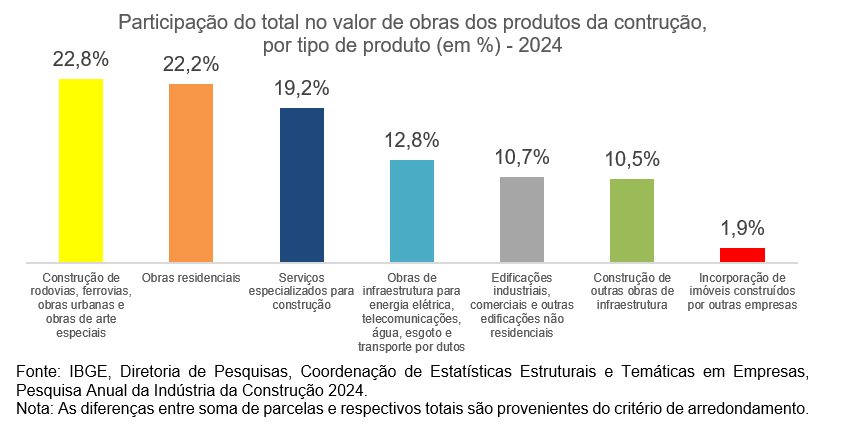
In PAIC, Construction Industry products and services were organized into seven groups: in 2024, construction of highways, railways, urban works and special works of art represented the main construction product, with a share of 22.8% of the total value of developments, works and/or services. Residential works followed, with 22.2%, and specialized services for construction, with 19.2% of the total value generated by the construction industry.
“Specialized services for construction are those activities that are auxiliary to the Construction Industry. So, a company that goes to a development and does a painting, it is there in the services. A company that does cabling, a company that does the plumbing part of a project. They are not specific building construction or infrastructure construction companies, they carry out these auxiliary activities in large developments and large works. Although they occupy the third place in most of these activities that we are looking at, they are not far behind the other two activities in terms of employed personnel, value of works and salaries, and we know that they have grown in recent years,” highlighted Marcelo Miranda.
The degree of market concentration, measured by the indicator Concentration ratio of order 8 (R8), which calculates the percentage of the total value of developments, works and/or services generated by the eight largest companies in the sector, reached 3.1% in 2024.
Southeast Region concentrated greater participation in both employment and value generated
In 2024, the Southeast Region concentrated the largest share in both employment and the value generated by the construction industry, accounting for 50.0% of employed persons and 49.4% of the total value of construction developments, works and services.
The Northeast Region occupied the second position in the value generated by construction, with a share of 17.9%, followed by the South Region, with 17.0%. The Central-West and North Regions accounted for 9.1% and 6.5%, respectively. In relation to employed persons, the Southeast was followed by the Northeast, South, Central-West and North Regions, with shares of 19.6%, 16.2%, 8.2% and 6.0%, respectively.
Impact of changing RAIS to eSocial on surveys
The change from RAIS to eSocial impacted the sampling design of the surveys and culminated in the beginning of a new series of economic structural surveys, including PAIC. This means that data collected before and after these changes are not directly comparable, as the universe of companies and selection criteria have changed.
In recent years, the IBGE surveys have been impacted by the change in the administrative source used to update the Central Registry of Enterprises - Cempre, with the replacement, in 2022, of the Annual List of Social Information (RAIS) with the Digital Bookkeeping System for Tax, Social Security and Labor Obligations (eSocial).
The transition generated a break in the time series in several survey activities, temporarily reducing the number of companies. In 2023, calibration adjustments were applied to mitigate these effects and preserve the coherence of the estimates. In 2024, there was a definitive break in the time series of surveys with the introduction of the new activity indicator originating from the administrative records of the Special Secretariat of the Federal Revenue of Brazil.
For more information, access the Methodological Report.
More about the survey
The Annual Survey of the Construction Industry (PAIC) is an important source of statistical information on the business segment of the construction industry in Brazil. The main variables covered by the survey are: employment and salaries; revenue, costs and expenses; value of developments, works and/or construction services; types of construction works and/or services; construction products.