
2022 Census
Nearly 20% of favela residents lived in streets without access for cars, buses and trucks


December 05, 2025 10h00 AM | Last Updated: December 08, 2025 04h40 PM
Highlights
- In 2022, Brazil had 3.1 million people living on roads in favelas and urban communities accessible only by motorcycles, bicycles or on foot, representing 19.2% of the entire population in these territories. Outside these areas, only 1.4% of the population lived in this situation.
- In 2022, 78.3% (12.7 million) of favela residents lived on paved stretches of roads, while 21.7% (3.5 million) lived on unpaved stretches. Outside these territories, 91.8% of the inhabitants lived on paved stretches of roads.
- Less than half (45.4%) of favela residents lived on stretches of roads with manholes or storm drains, adding up to 7.3 million people, while 54.6% (8.8 million) lived on stretches without the presence of this infrastructure. In areas outside favelas, the proportion of people with this equipment rises to 61.8%.
- Nine out of ten favela residents (91.1%) lived on stretches of roads with street lighting, adding up to 14.7 million people, while 8.9% (1.4 million) lived on stretches without street lighting. In areas outside these territories, the proportion of people with this urban equipment reached 98.5%.
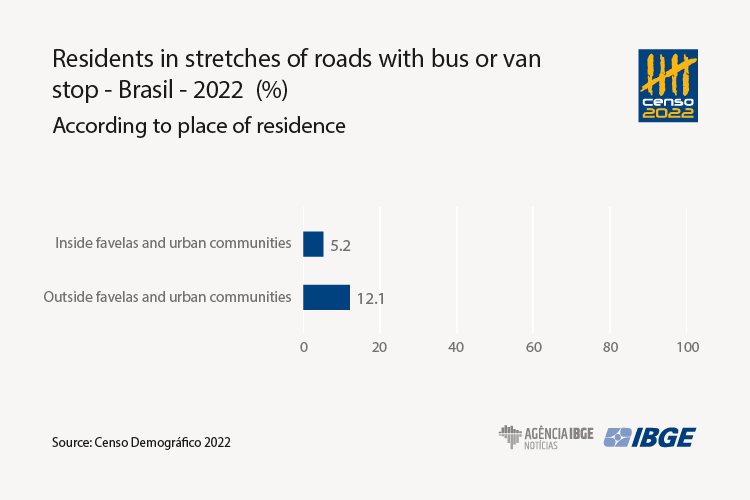
- Only 5.2% (836 thousand) of favela residents lived on stretches of roads with a bus or van stop. Outside these areas, the proportion of people with this urban infrastructure was more than double (12.1%).
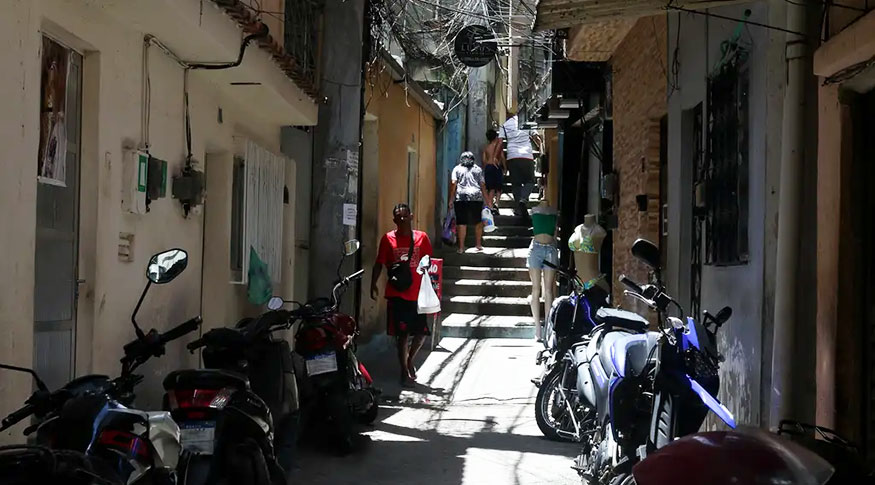
In 2022, Brazil had 19.2% of the population in favelas and urban communities living on roads accessible only by motorcycles, bicycles or on foot. That proportion represents 3.1 million inhabitants in stretches without access for cars, trucks, buses and cargo transportation vehicles. Outside these communities, only 1.4% of the population lived in this situation. For example, ambulances had restricted access to these places as well.
Released today (5) by the IBGE, the data are from the publication 2022 Census: Favelas and Urban Communities - Urban characteristics of the surroundings of housing units. The survey covers 16.2 million people living in 12.3 thousand favelas and urban communities in 656 Brazilian municipalities. Comparisons are restricted to municipalities with favelas and urban communities.
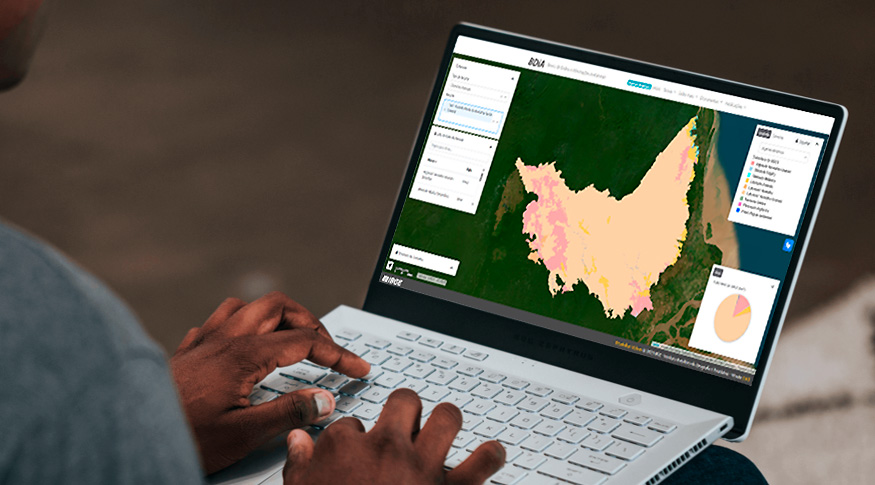
The release takes place at the Franco Pellegrini Human Rights Center (CEDHU), in Salvador (BA), broadcast through social media and the IBGE Portal. The results are accessible via Sidra and the Interactive Geographic Platform (PGI).
Find out more: IBGE changes name from Subnormal Agglomerates to Favelas and Urban Communities
IBGE considered the width of the road and the existence of wiring that prevents the circulation of vehicles as capacity limitations.
Among the 20 most populous favelas, Rocinha and Rio das Pedras, both in Rio de Janeiro (RJ), and Paraisópolis, in São Paulo (SP), had the highest percentages of residents living on stretches of roads with maximum capacity for circulation by motorcycles, bicycles or pedestrians: 81.9%, 71.5% and 59.2%, respectively.
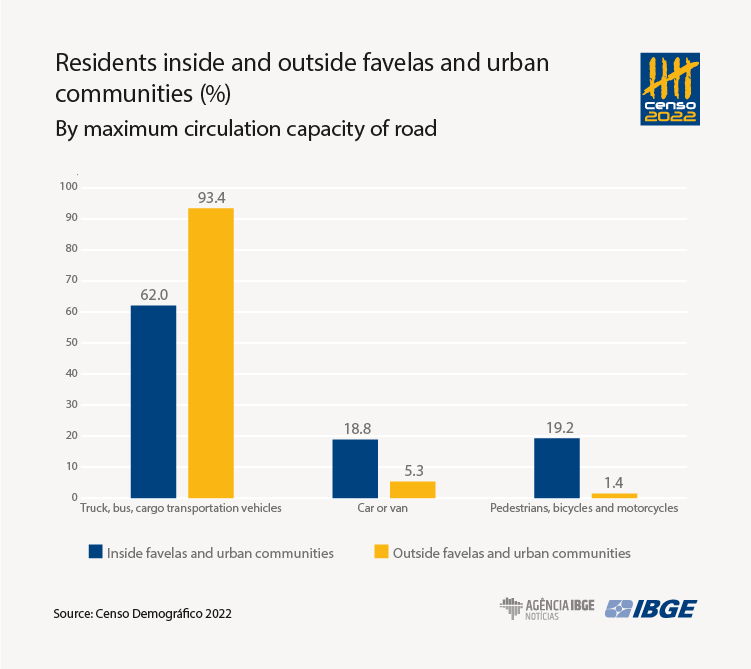
The survey also shows that 62.0% (10.0 million) of favela residents lived on stretches of roads with maximum traffic capacity for trucks, buses and cargo transportation vehicles, while outside these territories, the percentage was 93.4%. The proportion of the population that lived on stretches of roads with maximum capacity for cars or vans was 18.8% (3.0 million) in favelas and 5.3% in other areas of the city.
Read also: More than 60% of residents of favelas and urban communities lived in treeless places
An issue intrinsically related to the circulation capacity of roads is the destination of household waste. “For garbage to be collected directly by cleaning services, it is expected that houses are located on stretches of roads with maximum capacity for circulation by trucks, buses and cargo transportation vehicles,” explains the head of the IBGE´s Sector of Territorial Surveys, Filipe Borsani.
In Brazil, among the inhabitants who lived in stretches of favela roads with maximum circulation capacity for trucks, buses and cargo transportation vehicles, 86.6% (8.7 million) had waste collected at home by a cleaning service, while 11.1% (1.1 million) had garbage deposited in dumpsters. Outside these territories, the percentages found were 92.4% and 7.0%.
The favelas in the Central-West had the lowest percentage of residents on stretches of roads with maximum circulation capacity for trucks, buses and cargo transportation vehicles and with home waste collection by cleaning services (76.8%), while 19.1% had garbage deposited in dumpsters and 4.1% had another destination for the garbage. Outside these territories, the percentages were 94.6%, 5.0% and 0.4%, respectively.
As for residents who lived on stretches of roads with maximum circulation capacity for motorcycles, bicycles or pedestrians, the Southeast had the greatest disparity. While in the favelas less than half (48.6%) of residents who lived on streets accessible only to smaller vehicles had garbage collected directly by cleaning services, in areas outside these territories, the percentage jumped to 73.3%.
More than 20% of the population in favelas lived in unpaved stretches
In 2022, 78.3% of favela residents lived on paved stretches of roads, adding up to 12.7 million people, while 21.7% (3.5 million) lived on unpaved stretches. Outside these territories, 91.8% of the inhabitants lived on paved stretches of roads.
Almost all states had a lower percentage of residents in favelas on paved stretches of roads compared to residents who did not live in these territories. The biggest differences were observed in the Federal District (47.8% versus 98.1%), Tocantins (42.4% versus 92.7%), Mato Grosso do Sul (14.6% versus 79.2%) and Roraima (21.8% versus 95.1%). The exception was Bahia (92.1% against 89.7%).
Among large urban concentrations, Campo Grande/MS (12.3%) had the lowest percentage of residents on paved stretches of roads in favelas, where the difference in relation to people who did not reside in these territories (76.5%) was the highest one (64.2 percentage points). In São José dos Campos/SP (44.1%), Cuiabá/MT (47.0%) and Brasília/DF (47.5%) less than 50.0% of favela residents lived on paved stretches of roads. In absolute values, São Paulo/SP stands out, where there were 396 thousand residents in favelas on stretches of unpaved roads, followed by Recife/PE (345 thousand), Belém/PA (255 thousand) and Rio de Janeiro/RJ (233 thousand).
In Brazil, 67.3% (8.5 million) of people who lived on paved stretches of roads in favelas had sewage disposal (through a general network, rainwater system or septic tank or filter tank connected to the network). This proportion rises to 83.3% outside favelas.
The North Region showed the lowest percentages of people living in housing units with sewage disposal (through a general network, rainwater system or septic tank or filter tank connected to the network) on paved stretches of roads both inside (40.2%) and outside (43.6%) favelas. On the other hand, the Southeast showed the highest percentages of residents in houses with these two infrastructures, both inside (82.8%) and outside (94.7%) these territories.
“Sewage disposal and road paving are two interdependent elements in urban planning. Paving a road without an adequate sewage system can mask the lack of local basic sanitation and, sometimes, even worsen the situation of the rainwater drainage system. Conversely, the existence of a sewage network without paving the road reduces its effectiveness, since paving works as an element to direct water and serves as a physical protection for the sewage disposal system,” assesses the head of the IBGE´s Support Sector for Favelas and Urban Communities, Larissa Catala.
Less than half (45.4%) of favela residents lived on stretches of roads with manholes or storm drains
Less than half (45.4%) of favela residents lived on stretches of roads with manholes or storm drains, adding up to 7.3 million people, while 54.6% (8.8 million) lived on stretches without the presence of this infrastructure. In areas outside favelas, the proportion rises to 61.8% of inhabitants who lived on stretches of roads with this equipment.
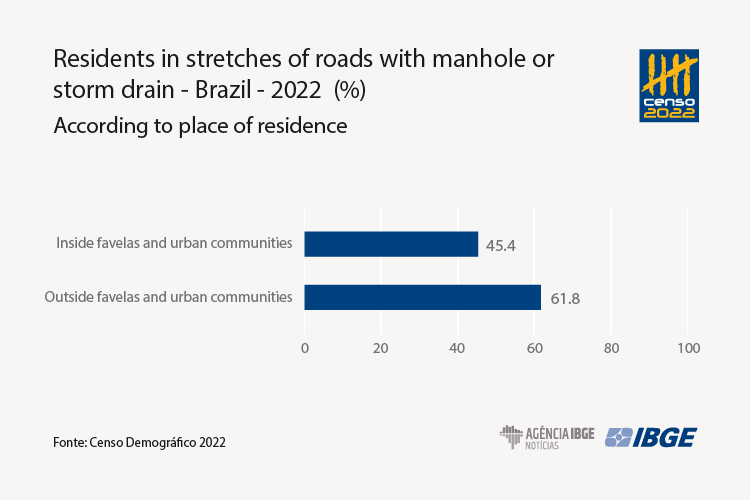
When considering the 20 most populous favelas and urban communities, Cidade Olímpica stands out, in São Luís (MA), with only 16.3% of its residents living in stretches of roads with manholes or storm drains, followed by Coroadinho (17.0%), also in São Luís (MA), Rocinha (25.5%), in Rio de Janeiro (RJ) and Chafik/Macuco (27.9%), in Mauá (SP). Among the favelas with the highest percentage of residents living on roads with this structure, highlights include Baixadas do Condor (90.2%) and Baixadas da Estrada Nova Jurunas (77.9%), located in Belém (PA), and Zumbi dos Palmares/Nova Luz (77.3%), in Manaus (AM).
The Central-West (27.9%) and Northeast (34.9%) regions showed the lowest percentages of favela residents on roads with the presence of manholes or storm drains, with 11 out of 13 states having a proportion below 40%, with the lowest ones being observed in Mato Grosso do Sul (6.0%) and Piauí (13.5%). In the North (51.4%), Amapá (12.6%) and Roraima (19.3%) had the lowest percentages in favelas, with the biggest differences in relation to residents outside these territories (50.3% and 54.4%, respectively). On the other hand, eight out of 27 Federation Units had more than 50% of their favela residents on stretches of roads with the presence of manholes or storm drains, with emphasis on Sergipe (62.5%), Santa Catarina (61.8%), Espírito Santo (59.2%) and Rio de Janeiro (58.9%).
In large urban concentrations, there was a low percentage of residents living on roads with manholes or storm drains in the favelas of Campo Grande/MS (7.0%), Teresina/PI (13.4%), São Luís/MA (25.8%) and Brasília/DF (26.2%). In contrast, the difference between the percentage of residents on stretches of roads with manholes or storm drains inside and outside these territories was more pronounced in Campo Grande/MS (7.0% versus 54.4%) and Porto Alegre/RS (44.1% versus 86.1%).
In absolute figures, it is worth highlighting that in São Paulo/SP there were 1.6 million favela residents in stretches of roads without manholes or storm drains, followed by Rio de Janeiro/RJ (694,764), Recife/PE (626,292) and Salvador/BA (607,608), which indicates the lack of this type of urban infrastructure in these territories, as well as the inequality in relation to other areas of the cities.
Street lighting was present on stretches of roads for 91.1% of favela residents
Nine out of ten favela residents (91.1%) lived on stretches of roads with street lighting, adding up to 14.7 million people, while 8.9% (1.4 million) lived on stretches without street lighting. In areas outside these territories, the proportion of people who lived on stretches of roads with this urban equipment is higher (98.5%).
In the 20 largest favelas and urban communities in terms of number of residents, the highlight is Rocinha – Rio de Janeiro (RJ), which had just over half (54.3%) of its residents living on stretches of roads with street lighting, followed by Paraisópolis – São Paulo (SP) (66.9%) and Rio das Pedras – Rio de Janeiro (RJ) (89.6%). The other favelas in the top 20 showed percentages above 90.0%.
Mato Grosso do Sul (51.4%), Amapá (71.6%), Roraima (72.1%) and the Federal District (73.1%) had less than 75.0% of their favela residents on stretches of roads with street lighting. On the other hand, nine states had more than 95% of their favela residents on stretches of roads with street lighting, with emphasis on Maranhão (97.9%) and Ceará, Rio Grande do Norte and Espírito Santo, all with 97.6%. In all states, however, there was a lower percentage of favela residents on stretches of roads with street lighting compared to those who did not live in these territories. The biggest discrepancies were in Mato Grosso do Sul (51.4% versus 99.4%), Roraima (72.1% versus 98.8%), Amapá (71.6% versus 96.6%) and the Federal District (73.1% versus 95.4%).
Among the large urban concentrations, Campo Grande/MS (48.0%), Sorocaba/SP (68.5%), Brasília/DF (75.9%) and Porto Alegre/RS (80.3%) showed the lowest percentages of residents on stretches of roads with street lighting in the favelas. In absolute figures, São Paulo/SP had 437,765 favela residents on stretches of roads without street lighting, followed by Rio de Janeiro\/RJ (161 thousand) and Manaus (85 thousand), indicating the lack of this type of urban infrastructure in these territories.
Only 5.2% of favela residents lived on stretches of roads with a bus or van stop
Only 5.2% (835,936 people) of favela residents lived on stretches of roads with a bus or van stop. Outside these areas, the proportion of people with this urban infrastructure on their stretch of road was more than double (12.1%).
“Bus or van stops are one of the issues investigated in this survey that do not need to be on every stretch of road. There is no need to have a bus stop on every two corners, for example,” says the head of the IBGE´s Sector of Territorial Surveys, Filipe Borsani.
Among the 20 most inhabited favelas and urban communities, Rio das Pedras - Rio de Janeiro (RJ) and Pernambués - Salvador (BA) had only 1.9% of their residents living on stretches of roads with a bus or van stop. Vila São Pedro - São Bernardo do Campo (SP) (12.3%), Colônia Terra Nova - Manaus (AM) (11.2%), Zumbi dos Palmares/Nova Luz - Manaus (AM) (10.6%) and Chafik/Macuco - Mauá (SP) (10.2%) had more than 10% of their residents in this condition.
The percentage of residents on stretches of roads with a bus or van stop in favelas was higher than outside these areas in Tocantins (3.7% versus 2.9%), Acre (9.7% versus 9.1%), Amazonas (5.2% versus 5.0%) and Maranhão (5.6% versus 5.4%). In the other states, the relationship was inverse, with emphasis on Minas Gerais (7.9% versus 17.8%), Rio Grande do Sul (7.9% versus 17.6%), São Paulo (6.3% versus 15.2%) and Paraná (5.4% versus 14.2%).
Among large urban concentrations, the biggest differences between inside and outside favelas are located in the South and Southeast Regions: Porto Alegre/RS (6.4% versus 19.7%), Belo Horizonte/MG (6.6% versus 18.9%), Florianópolis/SC (7.6% versus 19.1%), Curitiba/PR (5.7% versus 16.5%) and São Paulo/SP (6.2% versus 16.5%).