
2022 Census
More than 60% of residents in favelas and urban communities lived in treeless places


December 05, 2025 10h00 AM | Last Updated: December 08, 2025 04h42 PM
Highlights
- In favelas and urban communities, 35.4% of residents lived on stretches of tree-lined roads. Outside these areas, the proportion was 69.0%.
- Among residents of favelas and urban communities who declared themselves black, 68.0% lived on stretches of roads without trees, while 9.4% of this population lived on stretches with 5 or more trees.
- Among the 20 largest favelas and urban communities in Brazil, two had less than 20% of residents living on roads with sidewalks: Rocinha, in Rio de Janeiro (RJ), and Pernambués, in Salvador (BA).
- Within Brazilian favelas and urban communities, only 3.8% of residents lived on stretches of roads with unobstructed sidewalks, while outside these areas, this percentage was 22.4%.
- More than 95% of residents of favelas and urban communities lived on stretches of roads without ramps for wheelchair users.
- Less than 1% of favela residents lived on roads marked for bicycles.
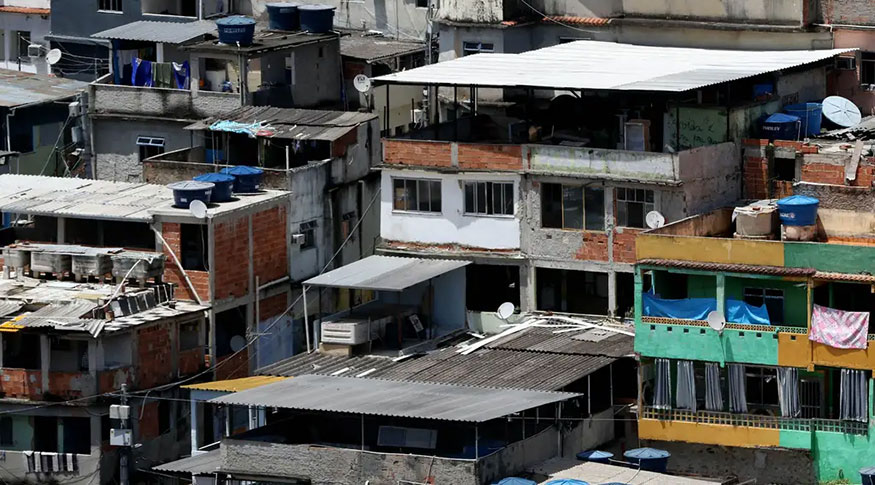
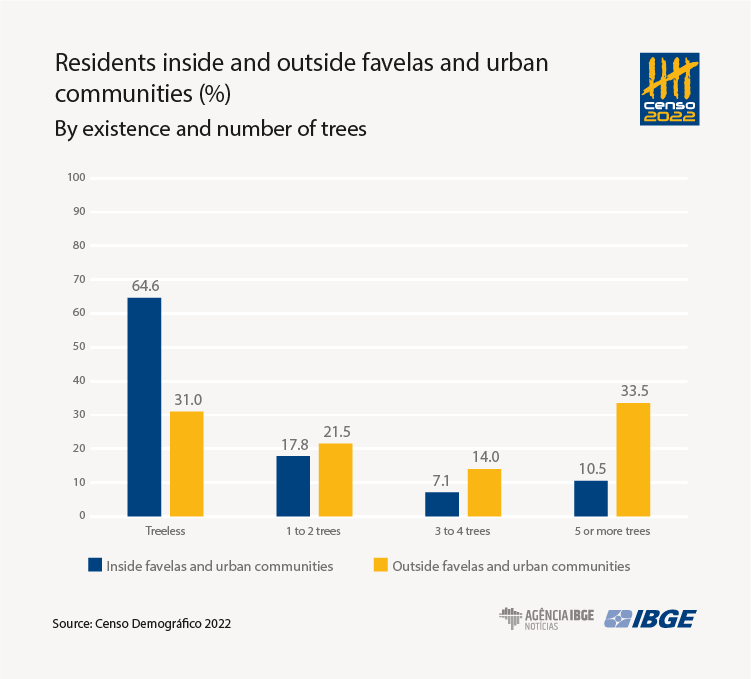
In the Brazilian favelas and urban communities, 64.6% of residents (10.4 million people) lived on stretches of roads without trees, while 35.4% (5.7 million people) lived on stretches of roads with trees. In places outside favelas and urban communities, 69.0% of residents lived on stretches of roads with trees. The difference is also large when analyzing stretches with 5 trees or more: 10.5% of residents of favelas and urban communities lived on roads with such afforestation, while 33.5% of residents outside favelas and urban communities lived in environments with this feature.
The data are from the 2022 Population Census: Favelas and Urban Communities: Urban characteristics of the surrounding of housing units, released today (5) by the IBGE. The survey covers 16.2 million people living in 12.3 thousand favelas and urban communities in 656 Brazilian municipalities. Comparisons are restricted to municipalities with favelas and urban communities.
The release takes place at the Franco Pellegrini Human Rights Center (CEDHU), in Salvador (BA), broadcast through social media and the IBGE Portal. The results are accessible via Sidra and the Interactive Geographic Platform (PGI).
Find out more: Favelas and Urban Communities: IBGE changes the name of subnormal agglomerates
The survey also brought data on the distribution of residents in relation to afforestation according to the color or race of the population living in favelas and urban communities. Among residents who declared themselves black, 68.0% lived in areas without trees, while 9.4% of this population lived in areas with five or more trees. On the other hand, 64.4% of people of brown color or race lived in areas without trees and 10.4% in places with five or more trees. The percentage of residents of white color or race who lived in areas without trees was 63.2% and 11.4% lived in places with five or more trees.
“There are no significant changes, but it is worth highlighting that the percentage of people who declared themselves to be of black color or race and lived on stretches of roads without trees was 4.8 points higher than the percentage of people who declared themselves to be of white color or race and lived on roads with this feature. Regarding the presence of trees, IBGE classified the information into three categories: ‘1 or 2 trees’, ‘3 or 4 trees’ and ‘5 or more trees’. In all of them, the percentage was slightly lower for the black population, indicating possible inequality in relation to this aspect in all of these territories,” points out Larissa Catalá, head of the Support Sector for Favelas and Urban Communities.
Read also: Nearly 20% of favela residents lived on streets without access to cars, buses and trucks
Considering the population size of favelas and urban communities, those with fewer residents had a higher percentage of residents on stretches of roads with trees. In favelas and urban communities with up to 250 residents, 45.9% of the population lived on stretches of roads with trees. This percentage gradually decreases, until reaching the lowest values in favelas and urban communities with 5,000 to 10,000 residents (31.7%) and in those with more than 10,000 residents (31.8%).
Among the 20 largest favelas and urban communities in Brazil in terms of number of residents, Sol Nascente, in Brasília (DF), was the only one with more than 70% of residents living on stretches of roads with trees (70.7%). All others had less than 60%, with the lowest proportion of residents living on stretches of roads with trees: Rio das Pedras - Rio de Janeiro (RJ), with 3.5%; Cidade de Deus/Alfredo Nascimento, in Manaus (AM), with 12.0%; Paraisópolis, in São Paulo (SP), with 12.0%; Rocinha, in Rio de Janeiro (RJ), with 12.3%; and Heliópolis, in São Paulo (SP), with 18.0%.
Among the states, 13 had less than 40.0% of their residents in favelas and urban communities living on stretches of roads with trees. Among them: Santa Catarina (22.9%), Bahia (25.3%), Pernambuco (25.6%), Alagoas (26.4%) and Rio de Janeiro (28.4%). On the other hand, one state in the North Region and all of the Central-West Region, in addition to the Federal District, had more than 60.0% of their residents in favelas and urban communities living on roads with the presence of trees: Tocantins (80.1%), Mato Grosso do Sul (76.9%), Federal District (69.1%), Mato Grosso (69.0%) and Goiás (64.3%). In all states there was a lower percentage of residents in favelas and urban communities on stretches of roads with trees compared to residents who did not live in favelas and urban communities.
Considering the large urban concentrations in which there was a low percentage of residents on stretches of roads with trees in favelas and urban communities, Florianópolis/SC (17.5%), Salvador/BA (21.2%), Recife/PE (24.7%), Maceió/AL (25.3%), Belo Horizonte/MG (26.5%) and Rio de Janeiro/RJ (26.5%) stand out. Four large urban concentrations showed a difference between the percentage of residents in stretches of roads outside and inside favelas and urban communities with trees greater than 40 points: Belo Horizonte/MG (76.1% versus 26.5%), Rio de Janeiro/RJ (70.0% versus 26.5%), Porto Alegre/RS (83.2% versus 40.8%) and São Paulo/SP (70.5% versus 29.9%).
Sidewalks show disparity between inside and outside favelas
While outside the Brazilian favelas and urban communities, 89.3% of residents lived on stretches of roads with sidewalks, the percentage drops to 53.9% of residents who lived in these territories.
Roraima was the only state that had a percentage below 75% of residents who lived on stretches of roads with sidewalks outside favelas and urban communities: 63.6%. Within these areas, only three states had a percentage greater than 75% of residents living on stretches of roads with sidewalks: Maranhão (76.2%), Sergipe (83.2%) and Piauí (84.0%). In all states there was a lower percentage of residents in favelas and urban communities on stretches of roads with sidewalks compared to residents who did not live in these areas.
Among the 20 largest favelas and urban communities in terms of resident population, three had more than 90% of their residents living on roads with sidewalks: Cidade Olímpica, in São Luís (MA), Zumbi dos Palmares/Nova Luz, in Manaus (AM), and Vila São Pedro, in São Bernardo do Campo (SP), with percentages equal to 99.3%, 94.1% and 90.3%, respectively. In contrast, Rocinha, in Rio de Janeiro (RJ), Pernambués, in Salvador (BA), and Paraisópolis, in São Paulo (SP), showed the lowest percentages for this item, 12.1%, 16.8% and 22.7%, respectively.
| Residents in permanent private households occupied in the enumeration areas selected for the Survey of Urban Characteristics of the Surroundings of Housing Units, in Favelas and Urban Communities, in total and in stretches of roads with sidewalks – 20 largest Favelas and Urban Communities in relation to the number of residents, 2022 | |||
|---|---|---|---|
| 20 largest Favelas and Urban Communities | In Favelas and Urban Communities | ||
| Total | On stretches of roads with sidewalks | On stretches of roads with sidewalks (%) | |
| Total | 847 632 | 522 760 | 61.7 |
| Sol Nascente (ARIS - Sol Nascente) - Brasília (DF) | 70 251 | 51 787 | 73.7 |
| Rocinha - Rio de Janeiro (RJ) | 69 327 | 8 362 | 12.1 |
| Paraisópolis - São Paulo (SP) | 57 617 | 13 070 | 22.7 |
| Cidade de Deus/Alfredo Nascimento - Manaus (AM) | 55 742 | 35 597 | 63.9 |
| Rio das Pedras - Rio de Janeiro (RJ) | 55 555 | 21 018 | 37.8 |
| Heliópolis - São Paulo (SP) | 55 447 | 34 525 | 62.3 |
| Comunidade São Lucas - Manaus (AM) | 53 538 | 46 851 | 87.5 |
| Coroadinho - São Luís (MA) | 51 004 | 43 756 | 85.8 |
| Baixadas da Estrada Nova Jurunas - Belém (PA) | 43 103 | 30 830 | 71.5 |
| Beiru / Tancredo Neves - Salvador (BA) | 37 586 | 15 012 | 39.9 |
| Zumbi dos Palmares/Nova Luz - Manaus (AM) | 34 678 | 32 621 | 94.1 |
| Pernambués - Salvador (BA) | 34 663 | 5 815 | 16.8 |
| Santa Etelvina - Manaus (AM) | 32 988 | 24 567 | 74.5 |
| Baixadas da Condor - Belém (PA) | 31 285 | 25 733 | 82.3 |
| Colônia Terra Nova - Manaus (AM) | 30 073 | 22 475 | 74.7 |
| Vila São Pedro - São Bernardo do Campo (SP) | 28 124 | 25 406 | 90.3 |
| Cidade Olímpica - São Luís (MA) | 27 319 | 27 126 | 99.3 |
| Chafik / Macuco - Mauá (SP) | 26 664 | 14 337 | 53.8 |
| Grande Vitória - Manaus (AM) | 26 633 | 23 589 | 88.6 |
| Jardim Oratório - Mauá (SP) | 26 035 | 20 283 | 77.9 |
The large urban clusters that showed the biggest differences between the percentages of residents on roads with sidewalks outside and inside favelas and urban communities were Campo Grande/MS (80.0% versus 6.2%), Florianópolis/SC (84.1% versus 28.3%) and São José dos Campos/SP (95.4% versus 33.8%).
The greater the population size of favelas and urban communities, the higher the percentage of residents who lived on roads with sidewalks. In areas with up to 250 residents, 47.3% lived on roads with sidewalks. This percentage gradually increases until it reaches 61.4% in favelas and urban communities with more than 10,000 residents.
The majority of elderly people in favelas and urban communities lived on roads with sidewalk obstacles
The survey revealed that within favelas and urban communities, only 3.8% of residents lived on stretches of roads with unobstructed sidewalks in Brazil. The number is almost six times lower than the percentage outside these areas: 22.4%. Approximately 15.5 million people lived in houses located on stretches of roads without sidewalks or with sidewalks with obstacles in favelas and urban communities.
The survey also shows that in all Major Regions, the percentage of residents over 60 years of age who lived on stretches of roads with unobstructed sidewalks was higher in areas outside favelas and urban communities than within these areas. “In the five Major Regions, less than 15% of residents of favelas and urban communities aged 60 or over lived on stretches of roads with unobstructed sidewalks, revealing a very unfavorable scenario that directly impacts the mobility and safety of the older portion of the population in these areas,” highlights Filipe Borsani, head of the Sector of Territorial Surveys.
The states with the biggest differences between the percentages of residents on stretches of roads with unobstructed sidewalks, comparing outside and inside favelas and urban communities, were Rio Grande do Sul (32.8% versus 5.0%) and Mato Grosso do Sul (29.2% versus 1.4%). On the other hand, the state with the smallest difference between these areas was Acre (6.5% versus 3.2%). It is noteworthy that, in this case, the difference was smaller due to the percentage found to be low also outside Favelas and Urban Communities: 6.5%.
In relation to large urban clusters, the survey shows that this urban quality is not related to the Major Region in which they are located. The highest percentages of residents in favelas and urban communities living on stretches of roads with unobstructed sidewalks, among large urban clusters, were found in all the Brazilian regions: Curitiba/PR (9.6%), Sorocaba/SP (8.7%), Natal/RN (7.8%), Goiânia/GO (6.0%) and Belém/PA (5.3%). Baixada Santista (SP) was the urban cluster with the biggest difference between the percentages outside and inside favelas and urban communities, with 45.9% versus 6.0%.
In favelas and urban communities with up to 250 people, the percentage of residents in stretches of roads with unobstructed sidewalks reached the highest value (4.4%) and, as the population in these places increased, the percentage decreased or remained the same, until reaching the lowest value in favelas and urban communities with 10,000 residents or more (3.5%), with the exception of those with more than 5,000 to 10,000 residents, with 3.9%.
The analysis of the 20 largest favelas and urban communities in 2022 in terms of population showed that five of them showed a percentage of residents living on stretches of roads with sidewalks without obstacles higher than that observed for the group of favelas and urban communities in Brazil (3.8%). The highlight was Baixadas do Condor, in Belém (PA), with the highest value (11%). On the other hand, Rocinha and Rio das Pedras, in Rio de Janeiro (RJ), had the lowest percentages (0.1% and 0.3%, respectively).
More than 95% of favela residents live on roads without ramps for wheelchair users
Around 15.7 million residents of favelas and urban communities lived on stretches of roads without a ramp for wheelchair users on the sidewalk, a percentage of 97.6%. Residents who lived on stretches of roads where the structure was present represented 2.4% of the total (391,024 people). In areas outside favelas and urban communities, 18.5% of residents lived on stretches of roads with a ramp for wheelchair users on the sidewalk.
Among the states, the highlight was Mato Grosso do Sul, where only 2.0% of residents of favelas and urban communities lived on stretches of roads with a ramp for wheelchair users on the sidewalk, while outside these locations the percentage reached 49.0%. Roraima had 14.7% of its residents in favelas and urban communities living on stretches of roads with a ramp for wheelchair users on the sidewalk, followed by Paraná (10.8%), Mato Grosso (8.7%) and Tocantins (8.0%). On the other hand, the states that showed the lowest percentages regarding the existence of this structure in favelas and urban communities were Pernambuco (0.9%), Santa Catarina (1.0%), Amazonas (1.4%), Rio de Janeiro (1.4%) and Rondônia (1.4%).
Among the large urban concentrations, there was a low percentage of residents on stretches of roads with wheelchair ramps on the sidewalk in favelas and urban communities in Campo Grande/MS (0.8%), São José dos Campos/SP (0.9%), Recife/PE (1.0%), Sorocaba/SP (1.1%) and São Paulo/SP (1.2%).
The population size of favelas and urban communities did not show a relationship with the percentage of residents on stretches of roads with a ramp for wheelchair users on the sidewalk. Both favelas and urban communities with up to 250 residents and those with more than 5,000 residents and less than 10,000 had similar percentages of residents with this structure in stretches of roads (3.0% and 3.2%, respectively). Favelas and urban communities with a population between 2,500 and 5,000 residents were those with the lowest percentage (2.1%).
The analysis of the 20 largest favelas and urban communities shows that all of them had low percentages of residents on stretches of roads with a ramp for wheelchair users on the sidewalk. Vila São Pedro, in São Bernardo do Campo (SP), had the highest percentage (7.4%), followed by Coroadinho, in São Luís (MA), with 4.2%, and Sol Nascente, in Brasília (DF), with 3.9%. On the other hand, those with the lowest percentages were Rocinha, in Rio de Janeiro (RJ), with 0.0%, Grande Vitória, in Manaus (AM), with 0.0%, Paraisópolis, in São Paulo (SP), with 0.1%, and Pernambués, in Salvador (BA), with 0.1%.
The survey also investigated the percentage of educational and health establishments, inside and outside favelas and urban communities, located on stretches of roads with sidewalks with ramps for wheelchair users.
Educational establishments in favelas and urban communities had a low presence of this urban element in the stretches of roads where they were located, while outside these areas the percentages observed were higher. Three regions stand out: Northeast (8.8% versus 24.8%), South (22.7% versus 50.6%) and Central-West (30.8% versus 52.4%).
Health establishments also showed great inequalities in terms of the presence of the issue in the stretches of roads where they were located, comparing inside and outside favelas and urban communities. Highlights are the South (27.6% against 69.0%) and Central-West (15.6% against 66.8%).
Less than 1% of favela residents live on roads marked for bicycles
In 2022, 0.9% of residents of favelas and urban communities lived on stretches of roads marked for bicycles, adding up to 150,810 people in Brazil. More than 16 million lived on stretches of roads without this feature in these locations. Outside favelas and urban communities, the percentage was also low, with 2.7% of residents finding this urban infrastructure.
Among the Federation Units, all showed a higher proportion of residents on stretches of roads marked for bicycles outside favelas and urban communities compared to residents of these areas. The biggest discrepancies were in Santa Catarina (7.2% versus 0.5%), Amapá (4.6% versus 0.5%) and the Federal District (4.4% versus 0.5%). Ceará and Pará showed the highest proportion of residents on stretches of roads marked for bicycles in favelas and urban communities, both with 2.2%. Roraima and Mato Grosso do Sul both scored 0.0% within favelas and urban communities, but outside there were 1.6% and 1.4%, respectively, of residents on stretches of roads marked for bicycles.
Among the 20 largest favelas and urban communities in terms of resident population, Rio das Pedras, in Rio de Janeiro (RJ), and Colônia Terra Nova, in Manaus (AM), did not have, in 2022, any residents living on roads marked for bicycles. Two other favelas and urban communities had more than 4.0% of residents in stretches with this urban infrastructure: Baixadas da Condor (6.6%) and Baixadas da Estrada Nova Jurunas (4.5%), both in Belém (PA).
Among large urban clusters, the lowest percentages of residents on stretches of roads marked for bicycles in favelas and urban communities were observed in Campo Grande/MS (0.0%), São José dos Campos/SP (0.1%), Cuiabá/MT (0.1%) and Natal/RN (0.4%). The large urban clusters with the greatest discrepancies were Florianópolis/SC (7.9% versus 0.6%), Baixada Santista/SP (5.5% versus 1.2%) and Fortaleza/CE (6.3% versus 2.5%).
Considering population size, the highest percentage of residents on stretches of roads marked for bicycles was observed in the smallest and largest size classes of favelas and urban communities (up to 250 residents and more than 10,000 residents, respectively) – both at 1.3%. The lowest percentage (0.8%) was present in the classes of 500 to 1,000 residents and 5,000 to 10,000 residents.