
Time Use
IBGE participates in launching of National Care Plan in Brasília


December 18, 2025 10h49 AM | Last Updated: December 22, 2025 03h23 PM
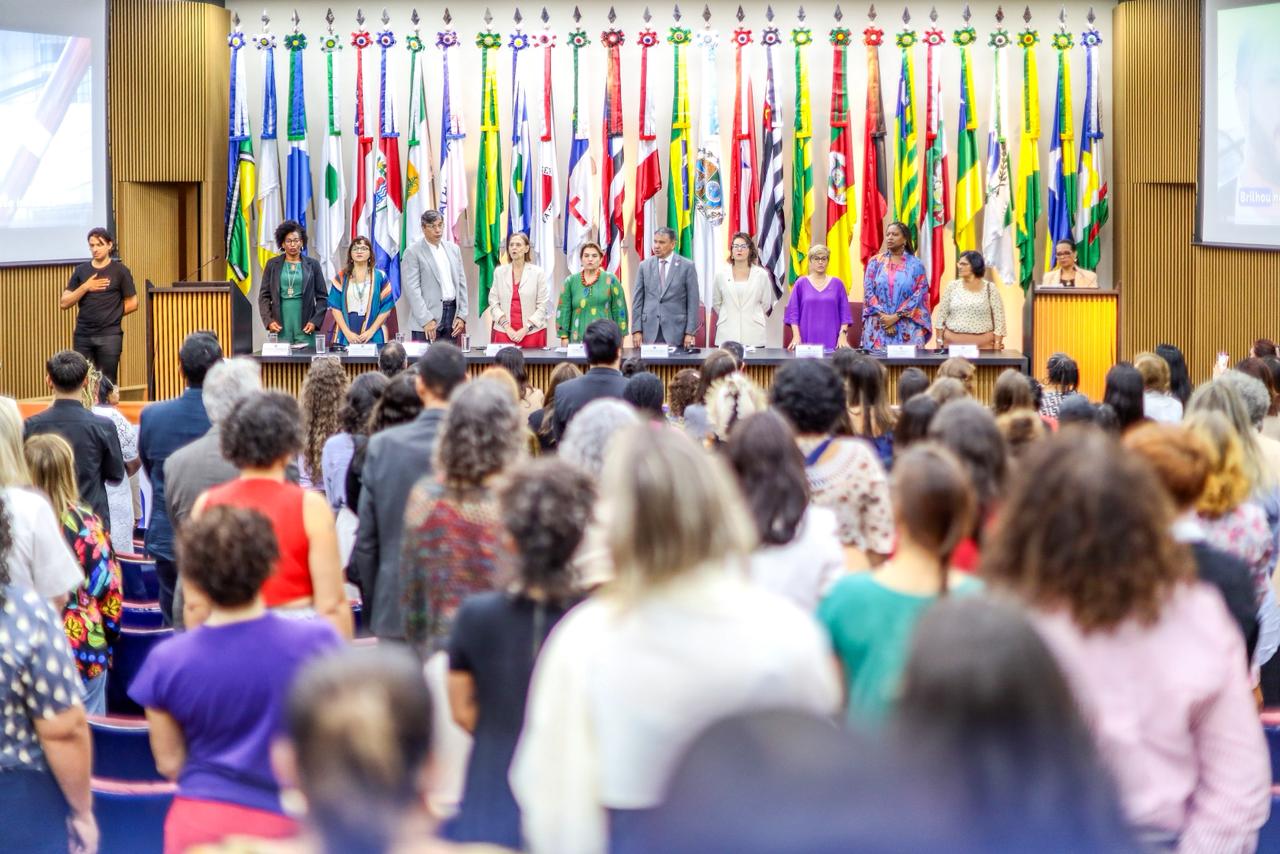
The Government of Brazil launched, on Monday (December 15), the National Care Plan, which will have an investment of R$25 billion by 2027. The Brazilian Institute of Geography and Statistics (IBGE) has participated in the interministerial technical group responsible since the beginning for the official construction of the agenda, in March 2023, and subsidized the structuring of actions based on its surveys.
Coordinated by the ministries of Development and Social Assistance, Family and Fight against Hunger (MDS), Human Rights and Citizenship, and Women, the strategy brings together 79 initiatives. Organized into five axes, the Plan involves policies such as public laundries, care libraries, training of care professionals and expanding the supply of daycare centers.
The launch took place in the MDS auditorium, in Brasília (DF), and was attended by the president of the IBGE, Marcio Pochmann; the minister of Development and Social Assistance, Family and Fight Against Hunger, Wellington Dias; the Minister of Women, Márcia Lopes; the coordinator of the IBGE Thematic Gender Commission, Daléa Soares Antunes; and other authorities.
Among the Plan's actions is including and improving data on care and time use in Brazilian national statistics, a task under the responsibility of the IBGE. The IBGE is carrying out a pilot test on time use in the 2024/2025 edition of the Consumer Expenditure Survey (POF) and reformulating the thematic module on Other Forms of Work of the Continuous National Household Sample Survey (Continuous PNAD).
The president of the IBGE, Marcio Pochmann, defended a reflection on the concepts of work used in statistics, to account for all forms of work activity. “The separation between work carried out at home - care work, reproduction work - and work carried out outside home - production work, recognized - has, in a way, been losing the border that divided them, as we are in a services society in Brazil, hyperconnected by the digital era,” explained Pochmann.
The minister of Development and Social Assistance, Family and Fight against Hunger, Wellington Dias, stated that the Plan is the result of the National Care Policy, sanctioned in 2024. “The law expresses the recognition that care is not a minor issue, or exclusive to the private sphere, but a central element for the reproduction and sustainability of life, the promotion of gender and racial equality and the autonomy of women,” stressed him.
Coordinator of the IBGE Thematic Gender Commission, Daléa Soares Antunes recalled that the Institute, by incorporating and improving information on time use and care in its surveys, contributes to identifying historically invisible inequalities. According to her, the initiative recognizes care as an "essential dimension for the sustainability of human life."
“The construction of the National Care Policy and the National Care Plan reaffirms, in a very significant way, the commitment of the BGE - and official Brazilian statistics - to making care work visible and promoting equality between men and women,” summarized Antunes.
When dealing with the transversality of the Plan, the minister of Women, Márcia Lopes, highlighted that care is the responsibility of the State, in the three spheres of government, and of society as a whole. “We know very well what it means to have arrived at this moment, to begin an even more arduous work, with greater conviction of the entire Brazilian society and making a voice in many countries, because this is an agenda today, without a doubt, international,” highlighted him.
The national secretary of the MDS Care and Family Policy, Laís Abramo, highlighted the trajectory of building the Policy. The process involved 20 ministries and the IBGE played an active role. Laís Abramo defended the importance of the representation of the Strategic and Management committees and the support of state and municipal governments for the actions to reach the Plan's target audience. “The strategic committee with equal representation from civil society is a central issue for this Plan to increasingly respond to the needs of Brazilian society in all its diversity,” pointed out the secretary.
National Care Plan
The five axes of the Plan provide for the guarantee of rights and promotion of policies for those in need of care and for those who provide unpaid care; the compatibility between paid work, education and family care needs; decent work for paid domestic and care workers; the recognition and appreciation of care work in its multiple expressions and cultural transformation towards a fairer social organization of care; and the governance and management of the National Care Plan.
The priority target audience is children and teenagers (with special attention to early childhood), elderly people in need of care, people with disabilities in need of care, paid care workers, paid workers with family care responsibilities and unpaid care workers.
During the launch event, three ordinances were published, one that establishes the Plan's actions, another that establishes its governance, composed of a Strategic Committee and a Management Committee, and another that opens the process of adhesion of the states, Federal District and municipalities to the initiative.
Watch the launch of the National Care Plan