
Agricultural production
Soybeans are expected to reach a new record in the time series in 2026


May 14, 2026 09h00 AM | Last Updated: May 14, 2026 04h02 PM

The April estimate for the national crop of cereals, legumes, and oilseeds for 2026 reached 348.7 million tonnes, with a new record preview for soybean production this year. This result is 0.7% higher than that of 2025 (346.1 million tonnes), a growth of 2.6 million tonnes. Compared to March 2025, there was an increase of 334,277 tonnes (0.1%). The data comes from the Systematic Survey of Agricultural Production (LSPA), released today (14) by the IBGE.
Rice, corn, and soybeans, which are the three main products in this group, represented 92.7% of the estimated production and account for 87.6% of the area to be harvested. Compared to the previous year, soybean production saw a 4.8% increase in estimated production (174.1 million tonnes), followed by sorghum, with 1.0%. The declines were in upland cottonneseed at -8.9%; in paddy rice at -10.6%; in corn at -2.5%; in beans at -4.6%; and in wheat at -6.8%. Regarding the area to be harvested, there were increases of 1.2% in soybeans; 3.4% in corn (increases of 11.9% in first-crop corn and 1.3% in second-crop corn); and 8.5% in sorghum, with declines of 4.3% in upland cottonneseed; 10.4% in paddy rice; and 3.8% in beans.
Carlos Alfredo Guedes, Agriculture Manager for the survey, spoke about the main crops: “Corn production is estimated at 138.2 million tonnes, a 2.5% decrease compared to last year's record, although conditions for the second crop are good and the final result depends on the harvest, which could be surprising. Some crops show a decline, such as beans (2.9 million tonnes), rice, and cotton, the latter with an estimated 9 million tonnes, a monthly increase of 3.4%, but an 8.9% decrease for the year, reflecting lower prices and a reduction in planted area. On the other hand, coffee stands out with an estimated production of 4 million tonnes and a 14.9% increase compared to the previous year, driven by the positive biennial cycle, good weather conditions, and more favorable prices, which stimulated an increase in cultivated area and productivity.”
Central-West Region keeps leading grain production
The Central-West region led in the volume of cereal, legume, and oilseed production with 174.5 million tonnes (50.0%). This was followed by the South, with 92.1 million tonnes (26.4%); the Southeast, with 30.6 million tonnes (8.8%); the Northeast, with 29.9 million tonnes (8.6%); and the North, with 21.5 million tonnes (6.2%). The estimated production of cereals, legumes, and oilseeds showed positive annual changes for the South (6.8%) and Northeast (7.8%) regions; and negative changes for the Central-West (-2.3%), Southeast (-1.5%), and North (-3.6%). Regarding monthly changes, the Northeast (2.1%) and Southeast (0.4%) regions showed production growth. The Central-West region showed stability (0.0%), while the North (-0.4%) and South (-0.4%) regions showed declines.
Mato Grosso leads as the largest national grain producer among the Federation Units, with a 30.9% share, followed by Paraná (13.5%), Rio Grande do Sul (10.8%), Goiás (10.7%), Mato Grosso do Sul (8.2%), and Minas Gerais (5.4%), which together accounted for 79.5% of the total.
Soybean should reach a new record in the time series in 2026
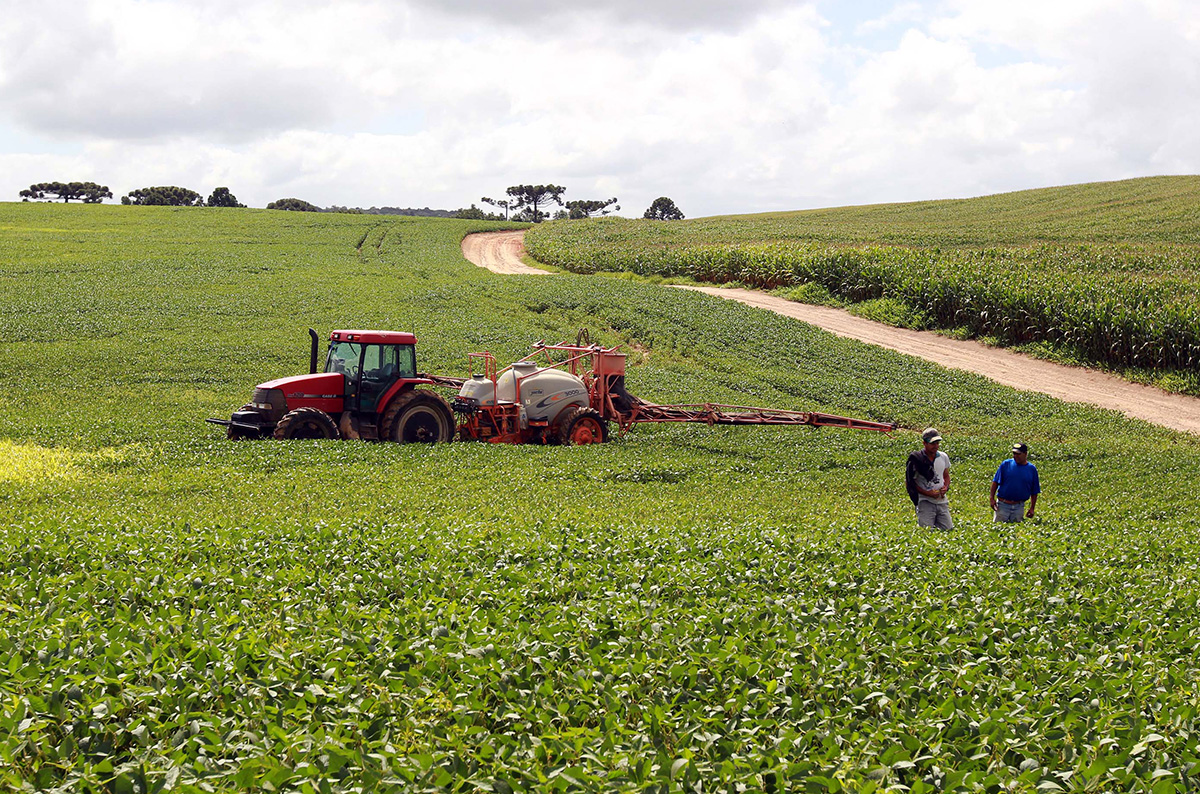
The estimate for national soybean production reached a new record in the time series in 2026, totaling 174.1 million tonnes, an increase of 0.2% compared to March and 4.8% compared to the volume obtained in 2025 (166.1 million tonnes).
Mato Grosso, the largest national producer, maintained its estimate of 50.5 million tonnes, stable compared to March and 0.7% above the 2025 harvest. Goiás is expected to harvest 19.8 million tonnes, maintaining the March forecast and remaining 2.6% below the volume produced in 2025. In Mato Grosso do Sul, production was estimated at 15.6 million tonnes, maintaining the previous information, but with a growth of 19.1% compared to the volume produced in 2025. Paraná, with 21.9 million tonnes, maintains the second largest production in the country, showing a slight decrease of 0.7% compared to March, but growth of 2.6% compared to 2025. In Rio Grande do Sul, the April estimate indicated production of 18.4 million tonnes, maintaining the strong increase of 34.6% compared to 2025.
Carlos Alfredo Guedes highlighted the performance of soybeans and the recovery of crops in Rio Grande do Sul: “This is a harvest quite similar to last year's, with growth driven mainly by soybeans. Soybean production was estimated at 174.1 million tonnes, an increase of 0.2% compared to the previous month and 4.8% compared to 2025, favored by very good weather conditions, which resulted in a productivity gain of about 3.7% and a record harvest. There was a recovery in production in the Southern Region, especially in Rio Grande do Sul, with an estimated 18.6 million tonnes of soybeans and growth of 34.6%, although initial projections were higher and have been revised downwards due to weather problems.”
Learn more about the Systematic Survey of Agricultural Production – LSPA:
What is the LSPA?
Time Series
Tables
Publications
The next release of the LSPA, relative to May 2026, will be on June 11.