
Agricultural production
2025 harvest is record; forecast for 2026 is 1.8% smaller


January 15, 2026 09h00 AM | Last Updated: January 15, 2026 11h02 AM
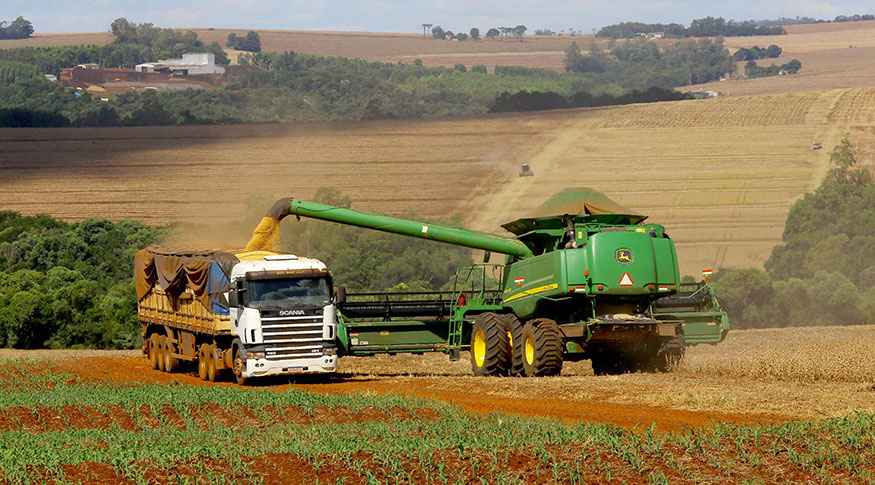
The 2025 grain harvest (cereals, legumes and oilseeds) reached 346.1 million tonnes, a record in the time series started in 1975. National production of soybeans (166.1 million tonnes), corn (141.7 million tonnes), cotton (9.9 million tonnes) and coffea canephora (1.3 million tonnes) also broke records. This is what the Systematic Survey of Agricultural Production (LSPA) released today (15) by the IBGE shows, which also brought the third forecast for the 2026 harvest: 339.8 million tonnes, with an estimated reduction of 1.8% (or less 6.3 million tonnes), compared to 2025.
The harvested area in 2025 was estimated at 81.6 million hectares, an increase of 3.2% (or 2.5 million hectares) compared to 2024. Contributing to this were increases of 5.7% in the planted area of cotton, 11.1% for rice, 3.7% for soybeans, 4.3% for corn and 15.6% for sorghum. On the other hand, there were reductions of 7.2% in the area of beans and 18.2% in the area of wheat.
Grain production more than doubled in 13 years
The 2025 harvest had an increase of 18.2% compared to the 2024 production. In the IBGE time series, it is observed that these 346.1 million tonnes of grains represent more than double the production achieved in 2012 (162.0 million tonnes). In other words: in 13 years, the Brazilian grain production more than doubled. However, the planted area did not grow at the same speed, changing only 66.8% in the same period: from 48.9 million hectares in 2012 to 81.6 million hectares in 2025. For Carlos Alfredo Guedes, IBGE Manager of Agriculture, “crop productivity gains are the result of years of research work by institutions such as Embrapa, which developed varieties adapted to the different Brazilian biomes. These gains are also due to the decisions of rural producers to invest increasingly in advanced technologies, aiming to achieve the maximum productive potential of plants.”
Guedes also notes that the 2025 record was mainly due to the performance of soybeans, corn and cotton, due to the very favorable weather conditions in the year.
Mato Grosso concentrated 32.0% of the Brazilian grain production in 2025
The Central-West Region concentrated more than half (51.6%) of the Brazilian grain production in 2025, with 178.7 million tonnes. The South Region came next, with 86.3 million tonnes, or 24.9% of the total. Grain production in the other regions was also significant, but was below 10%: Southeast, with 31.1 million tonnes, or 9.0%; Northeast, with 27.7 million tonnes or 8.0% and North, with 22.3 million tonnes, or 6.5%.
Among the states, Mato Grosso was the largest national grain producer in 2025, with a share of 32.0%, followed by Paraná (13.5%), Goiás (11.3%), Rio Grande do Sul (9.3%), Mato Grosso do Sul (8.1%) and Minas Gerais (5.5%). Together, these six states concentrate virtually 80% (79.7%) of the Brazilian grain harvest.
In 2026, the Brazilian grain harvest should decline 1.8% and reach 339.8 million tonnes
For 2026, the IBGE forecast is that the Brazilian harvest of cereals, legumes and oilseeds will decline by 1.8%, reaching 339.8 million tonnes, or 6.3 million tonnes less than the 2025 harvest. The IBGE Agriculture manager notes that this decline is mainly linked to corn, sorghum and rice crops. “As the 2025 harvest was very good for these products, we started from a high level of comparison, some of these crops will still be implemented in the second harvest, so we depend on the planting window and weather conditions to have more accurate estimates. Furthermore, profit margins are reduced, due to low prices, which has discouraged producers from increasing the area and investing in crops.”
In its December forecast for the 2026 harvest, the IBGE expects production increases in Paraná (1.5%), Rio Grande do Sul (25.2%), Piauí (16.9%) and Rondônia (0.5%). On the other hand, declines are expected in Mato Grosso (-7.9%), Goiás (-8.0%), Mato Grosso do Sul (-6.8%), Minas Gerais (-1.7%), Bahia (-4.7%), São Paulo (-4.8%), Tocantins (-2.9%), Maranhão (-0.7%), Pará (-8.6%), Santa Catarina (-1.6%) and Sergipe (-7.4%).
In 2026, the IBGE's LSPA will include canola and sesame, products that have been gaining importance in the cereal, legume and oilseed harvest in recent years.
About the LSPA
Implemented in November 1972, the LSPA provides monthly estimates on the quantity produced, planted area, harvested area and average yield of the most important agricultural products. The survey allows monitoring of each crop investigated, from the planting intention to the end of the harvest, and also the prognosis for the next harvest, based on specific surveys in October, November and December. Access data on Sidra. The next release of the LSPA, for January 2026, will be on February 12.