
CONFEST/CONFEGE 2025
IBGE Conference concluded with the Bahia Charter, a call for the Brazilian Society in defense of Statistical and Geoscientific Planning in the Digital Age with the implementation of SINGED


December 06, 2025 05h00 PM | Last Updated: December 09, 2025 04h47 PM

More than 100 activities were offered during the conference, including the opening ceremony, panels, thematic groups and working group sesssions, workshops, meetings and visits.
"To the Brazilian Society: Statistical and Geoscietific Planning in the Digital Age with the Implementation of SINGED
The Brazilian society has gone through a deep transformation: migration to the Digital Age, in which statitical and geoscientific information have become an essential part of Brazil's strategic ifrastructure. Similarly to energy, transportation or telecommunications, data — produced with scientific rigor, security, ethics and transparency - they support public policies, economic development, territorial protection, environmental management and defense of national sovereignty.
Bahia Charter, December 05, 2025"
Read in the closing ceremony of CONFEST/CONFEGE, the Bahia Charter warned the Brazilian society about the leading role, in the Digital Age, of statistical and geographic information, which have become an essential part of the country's strategic infrastructure.
He also spoke to data producers and users about information sovereignty in the Age of Artificial Intelligence: The Role of Official Data and the Restarts of PGIEG.
In this context, the Conference is a turning point in the statistical and geoscientific history of Brazil, by renewing the discussion of the PGIEG — a planning instrument that has been neglected since 1974, but that is central in the IBGE, not only as an institutional rite, but as a contemporary emergency: the necessity of official as a source of real information in an area dominated by Generative Artificial Intelligence (IA Gen).
During the conference, the IBGE presented a historic proposal for data governance, and released a summary of over 500 pages to guide the debate and support the General Plan of Statistical and Geographic Information (PGIEG) 2026–2030.
The closing session, held at Escola SESI, with a cocktail in front of the giant inverted world map of Bahia at the center of the world, featured institutional speeches by Walter Pinheiro, on behalf of the State Government of Bahia, the Federation of Industries of the State of Bahia (FIEB), Senai Cimatec, and Escola SESI, highlighting the importance of the event, especially with the signing of cooperation agreements.
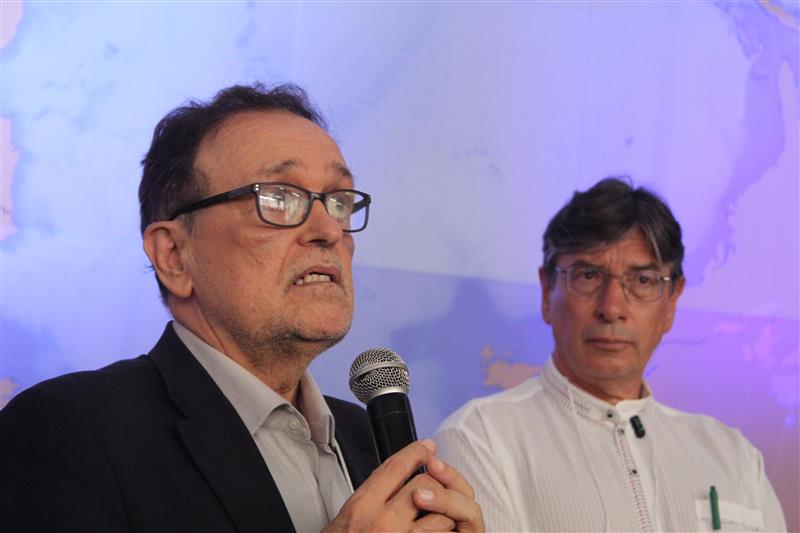
“On the upcoming December 15th, we already have a meeting scheduled to continue the agreement that was signed. The conference was very important for Bahia's technical system, especially for Cimatec itself, because the IBGE is the biggest Data Center in Brazil,” highlighted Walter Pinheiro, Director of Institutional Relations at Senai Cimatec.
According to Marcio Pochmann, president of the IBGE, the conference represents an institutional and strategic milestone for the future of official information in Brazil. “The Bahia Charter, resulting from the IBGE's National Conference of Data Producers and Users, synthesizes the collective commitment to a plan that allows Brazil to strengthen its statistical and geospatial sovereignty in a context of fast digital transformation for the period from 2026 to 2030. The document reaffirms the need to integrate producers, users, and public and private institutions into a common agenda for the qualification of information, expanding transparency, interoperability, and public trust. It also highlights the urgency of modernizing legal frameworks, consolidating the National System of Geosciences, Statistics, and Data (SINGED) and ensuring resources so that IBGE can fully exercise its strategic role of producing data of national interest, which is essential for planning, public policies, and Brazil's democratic development."
Bahia in the center of statistical and geoscientific data
The theme of the National Conference of Data Producers and Users (CONFEST/CONFEGE) was A Proposed General Plan for Statistical and Geographic Information (PGIEG) for the Development of Brazil in the Digital Age, for the period from 2026 to 2030.
Organized by the IBGE, with support from the State Government of Bahia, the Federation of Industries of the State of Bahia (FIEB), Senai-Cimatec, the United Nations Development Programme (UNDP), and the Union of Municipalities of Bahia (UPB), the conference was sponsored by the Federal Data Processing Service (Serpro) and Banco do Nordeste do Brasil S.A. (BNB).
Held for the first time out of Rio de Janeiro, the conference took place from December 3 to 5, 2025, in Salvador, at the facilities of the SESI campus, Senai-Cimatec, and Escola SESI.
After three days of hard work, the conference was a milestone for the presentation and discussion aimed at the elaboration of the PGIEG 2026–2030. This plan, the first since 1974, strengthens the new cycle of state planning and repositions Brazil on the same path as countries that treat official information as a strategic public asset.
The central element of this effort is the advance in the implementation of the SINGED – National System of Geostatistical Information for Development, which will guide the country in this second half of the 2020s. SINGED is not just a set of technologies: it is an intelligent data integration model, capable of coordinating official statistics, geospatial information, administrative systems, continuous surveys, vital records, and environmental, territorial, and economic databases.
Its mission is to ensure that by 2030, Brazil will have a modern, interoperable, secure, ethical, and sovereign public data infrastructure capable of supporting the:
- Formulation of long-term policies;
- Facing of regional inequalities;
- Monitoring of quality emergencies;
- Scientific and technological innovation;
- Strengthening of democracy and social participation;
- Protection of privacy andpublic interest in the use of data.
National and international historic participation
The conference featured more than 100 activities, bringing together more than 400 data producers, including public and private organizations, universities, and research centers, as well as a number of actors from the information production ecosystem. More than a thousand researchers, 400 IBGE technical staff and permanent and temporary employees, 1,500 students in workshops, and 230 speakers, moderators, and rapporteurs participated. The organization of the event involved more than 150 professionals. Both in person and online, the conference reached over eight thousand participants.
The opening ceremony featured the special participation of the Governor of Bahia, Jerônimo Rodrigues, as well as of authorities such as the IBGE superintendent in Bahia, André Urpia; the Director of Institutional Relations at Cimatec, Walter Pinheiro; the State Secretary of Education, Rowenna Brito; the superintendent of Banco do Nordeste in Bahia, Pedro Lima Neto; the president of FIEB, Carlos Henrique Passos; the Director of Business, Governments, and Markets at Serpro, André Agatte; Wilson Cardoso, the president of the Union of Municipalities in Bahia (UPB); and Valentina María, representative of the National Institute of Statistics of Uruguay, officially representing Mercosur, in addition to research institutes and researchers.
For the first time, the conference included three internationale events Pela primeira vez, a conferência incluiu três eventos internacionais:
- The Specialized Meeting on Mercosur Statistics (REES), part of the official agenda of the Mercosur presidency, currently held by Brazil, which brough together heads of statistics from the National Institutes of Statistics of Argentina, Brazil, Paraguay, and Uruguay.
- The Amazon Biome table, with representatives from the statistical institutes of Colombia, Ecuador, Peru, and Venezuela, as well as Brazil.
- A special agenda of activities from the United Nations Development Programme (UNDP).
Special coverage
The coverage of the event was another highlight, featuring articles on the IBGE portal and on a special website, as well as a regular posts on social media, setting a record for posts, with text, design, and multimedia.
Access the PGIEG 2026–2030 document.
Access the site of the conference here.