
Agricultural production
Soybean estimate points out to new record in time series


June 11, 2026 09h00 AM | Last Updated: June 11, 2026 11h53 AM
The Brazilian harvest of grains, cereals and legumes is expected to add up to 350.4 million tonnes in May 2026, an increase of 4.3 million tonnes compared to the previous year, which corresponds to an increase of 1.2%. In relation to April, the increase was 0.5%. The information comes from the Systematic Survey of Agricultural Production (LSPA), released today (11) by the IBGE.
Rice, corn and soybeans, which are the three main products in this group, represented a total of 92.8% of the production estimate and accounted for 87.6% of the area to be harvested. In relation to the previous year, there was growth of 1.1% in the area to be harvested for soybeans; 3.3% in corn (increases of 10.7% in the 1st crop and of 1.5% in the 2nd crop); and 9.3% in sorghum. The declines were 5.0% in upland cottonseed; 11.6% in paddy rice; and 4.4% in beans. With regard to production, there were increases of 5.1% for soybeans and 3.9% for sorghum; and decreases of 8.1% for upland cottonseed; 11.4% for paddy rice; 1.7% for corn (growth of 15.8% for the 1st crop and a decline of 5.5% for the 2nd crop); 5.8% for beans; and 7.8% for wheat.
The growth in the Brazilian grain production is due to greater investments made by producers, who expanded planting areas, as well as increased technology contributions to crops, although some products are not showing satisfactory profitability. The climate has also been favoring crops in most of the producing Federation Units. Grain production is a record in the time series and, in 2026, the highlight of the harvest is soybeans, as its production reaches almost half of the total estimated volume.
The technician from the IBGE Division of Agriculture, Carlos Barradas, highlights the performance of the oilseed. “In the Systematic Survey of Agricultural Production of May 2026, we have a record in the production of soybeans, coffea canephora and sorghum. However, we have a drop in the production of beans, whose production is limited to meet Brazilian domestic consumption, possibly resulting in the need to import small quantities of the product.”
Central-West maintains leadership in grain production
Central-West was the Major Region that led the production volume of cereals, legumes and oilseeds, with 175.9 million tonnes, which corresponds to 50.2%. Next, South, with 92.4 million (26.4%); Southeast, with 30.8 million (8.8%); Northeast, with 29.8 million (8.5%); and North, with 21.5 million (6.1%). The grain production estimate showed positive annual change for the South (7.1%) and Northeast (7.5%) regions; and negative for the Central-West (-1.5%), Southeast (-0.9%) and North (-3.8%). As for the monthly change, production increased in the South (0.3%), Southeast (0.6%) and Central-West (0.8%), while Northeast (-0.3%) and North (-0.2%) showed declines.
Among the Federation Units, Mato Grosso leads as the largest grain producer with a share of 31.0%, followed by Paraná (13.6%), Rio Grande do Sul (10.7%), Goiás (10.6%), Mato Grosso do Sul (8.3%) and Minas Gerais (5.5%), which, together, represented 79.7% of the total.
Soybean reaches new time series record
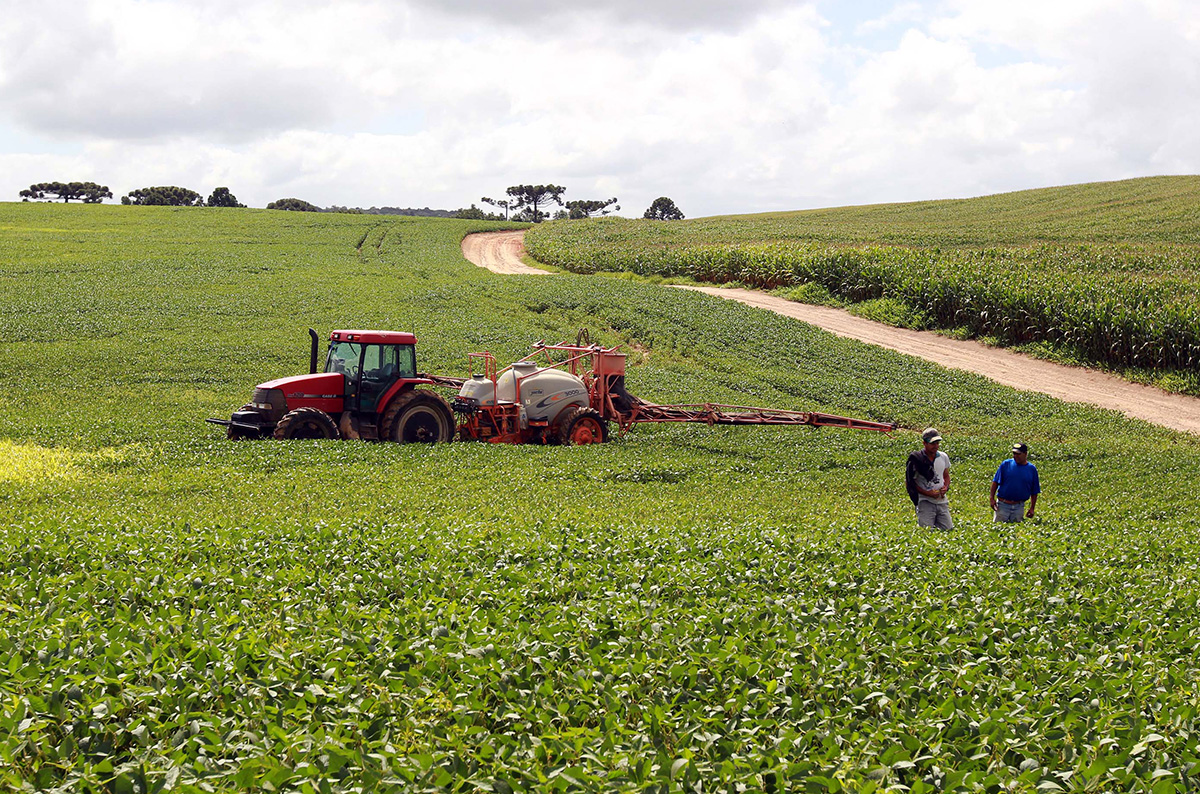
The estimate for the Brazilian soybean production reached 174.6 million tonnes, a new record in the time series, with an increase of 0.3% compared to April and 5.1% compared to the volume obtained in 2025 (166.1 million tonnes). The cultivated area should reach 48.3 million hectares, a growth of 1.1% compared to the previous year, while the expected average yield, of 3,617 kg/ha, represents an increase of 4.0% on the same basis of comparison, consolidating the maintenance of high technological levels and the recovery of regions that had been most affected by adverse weather events in the previous harvest.
Barradas explained about the record in the time series of soybean production in 2026. “Producers have expanded planting areas and invested more in this crop, which has become the main grain produced in Brazil. Currently, soybean production represents almost 50% of the Brazilian harvest of cereals, legumes and oilseeds. The weather also benefited the development of crops and contributed to an increase in productivity.”
Mato Grosso, the largest national producer, increased its estimates by 0.3%, reaching 50.7 million tonnes. Paraná, with 22.0 million tonnes, maintains the second largest production in Brazil, showing small adjustments in estimates this month, but with a growth of 2.7% compared to 2025. In Rio Grande do Sul, the May estimate indicated production of 18.4 million tonnes, maintaining the recovery of 34.6% in relation to the previous year's harvest. In Mato Grosso do Sul, the production was estimated at 15.8 million tonnes, showing a growth of 0.9% in the production, mainly due to better productivity.
Agricultural storage capacity grows 1.1% and reaches 233.8 million tonnes in the second half of 2025
The Survey of Stocks, also released today (11) by the IBGE, showed that available storage capacity in Brazil was 233.8 million tonnes in the second half of 2025, 1.1% higher than the previous semester. On the other hand, the number of establishments (9,668) grew 0.5% compared to the first half of 2025.
Only the South Region showed a reduction in the number of establishments in the period, while the others showed an increase, with emphasis on the North region, which increased by 4.7%; followed by the Northeast (1.9%); Southeast (1.5%) and Central-West (0.3%).
In relation to the stocks of the five main agricultural products existing in storage units, on December 31, 2025, corn stocks represented the largest volume (22.8 million tonnes), followed by soybean stocks (7.3 million), wheat (6.0 million), rice (2.9 million) and coffee (0.8 million). These products constitute 90.3% of the total stocked among the products monitored by the survey, with the remaining 9.7% made up of cotton, black beans, colored beans, and other grains and seeds. In total, the survey collected 44.1 million tonnes of products that it monitors.
Analyzing the time series of the survey over the last 28 years, conventional warehouses showed a drop in capacity of 56.9%. The capacity of bulk warehouses and silos grew by 151.4% and 469.7%, respectively. The increase in these types of storage is associated with the expansion of national grain production in recent decades, as these products are generally stored in bulk warehouses and silos.
Find out more about the Systematic Survey of Agricultural Production – LSPA:
What is the LSPA?
Time Series
Tables
Publications
Find out more about Survey of Stocks – ESTOQ:
What is the Survey of Stocks?
Tables
Publications