
Summary of Social Indicators
8.6 million persons got out of poverty between 2023 and 2024


December 03, 2025 10h00 AM | Last Updated: December 10, 2025 03h53 PM
Highlights
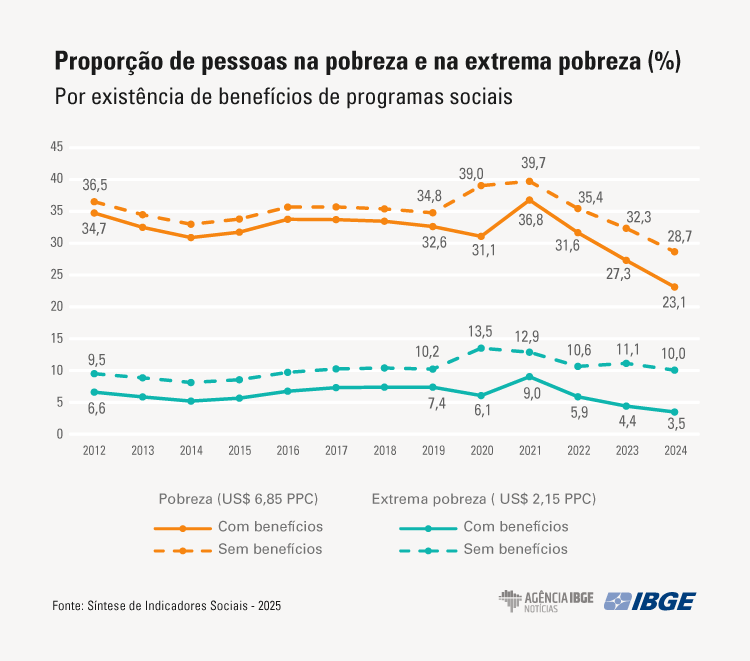
- Between 2023 and 2024, the proportion of the population living in poverty (line US$ 6.85 PPP or R$ 694 per month) decreased from 27.3% in 2023 to 23.1%. That was a reduction of 4.2 percentage points or 8.6 million persons living in poverty. The proportion of persons living in extreme poverty, in turn, (line US$ 2.15 PPP or R$ 218 per month) decreased from 4.4% to 3.5%, a decrease of 0.9 percentage points or 1.9 milion people in this condition.
- Without benefits from social programs, the proportion of persons living in extreme poverty increased from 3.5% to 10.0% of the population, whereas the proportion of poverty increased from 23.1% to 28.7% in 2024.
- Approximately 25.8% of the black persons and 29.8% of the brown person were poor, versus 15.1% of the white population.
- If the elderly population (60 years of age and over), who received retirement pensions, did not have access to social security benefits, extreme poverty in this group woud change from 1.9% to 35.2% and poverty, from 8.3% to 52.2%.
- In 2022, in Brazil, the income of the 20% best paid population was about 11 times that of the 20% with the lowest income. Among the forty states selected by OECD, Brazil has the second highest level of inequality in this comparison, only second to Costa Rica (12.3 times).
- In the employed population in the country, the proportion of poor population was 11.9%. Among the unemployed, poverty reached 47.6%. Besides, less than 0.6% of the empoyed persons were considered extremely poor, whereas among the unemployed extreme poverty reached 13.7%.
- In 2024, poverty was higher among workers without a formal contract (20.4%) and self employed persons (16.0%), and lower for persons with a formal contract (6.7%).
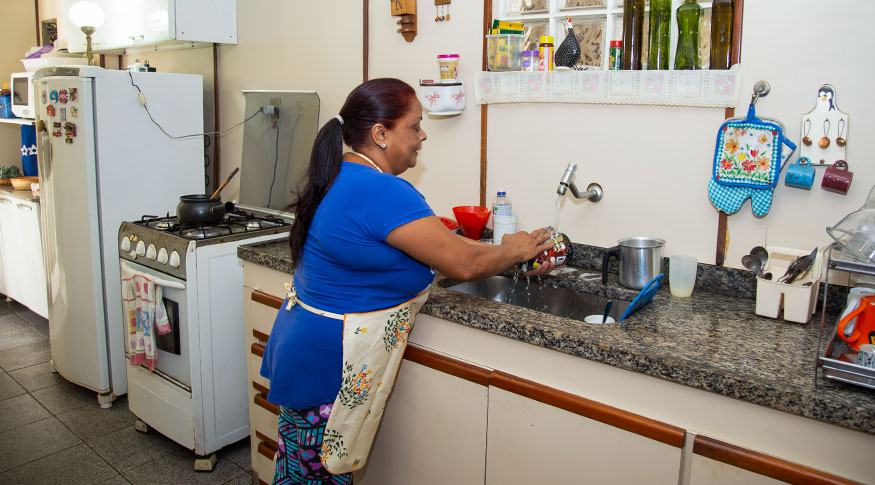
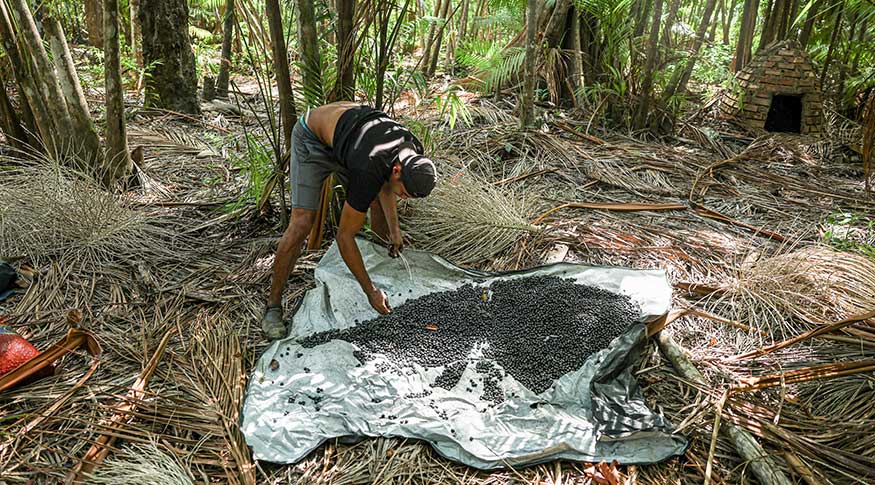
- Poverty was highest among agriculture workers (29.3%) and domestic workers (22.9%) and lower in the sector of public administration, health and social services (4.6%).
Between 2023 and 2024, considering the paramenters proposed by the World Bank, the country's population living in poverty (with per capita household income of US$ 6.85 PPP per day, or R$ 694 per month) fell ffrom 27.3% to 23.1%, a decrease of 8.6 million people. That was the third consecutive decrease of this indicator, which has dropped, year after year, since 2022, after reaching its highest percentage in 2021 (36.8%), during the Covid-19 pandemic.
The proportion of persons living in extreme poverty (per capita household income below US$ 2.15 PPP per day, or R$ 218 per month) fell from 4.4% in 2023 to 3.5% in 2024, a decrease of 1.9 million extremely poor people. Information comes from the Summary of Social Indicators on Standard of Living and Income Distribution. Read also news on labor and education.
| Year | Persons living in extreme poverty (US$ 2.15 PPP) | Persons living in poverty (US$ 6.85 PPP) | ||
|---|---|---|---|---|
| (%) | (thousand persons) | (%) | (thousand persons) | |
| 2012 | 6.6 | 12,985 | 34.7 | 68,390 |
| 2013 | 5.8 | 11,597 | 32.5 | 64,469 |
| 2014 | 5.2 | 10,380 | 30.9 | 61,771 |
| 2015 | 5.6 | 11,384 | 31.7 | 63,963 |
| 2016 | 6.7 | 13,697 | 33.7 | 68,545 |
| 2017 | 7.3 | 14,937 | 33.7 | 69,085 |
| 2018 | 7.4 | 15,178 | 33.4 | 68,812 |
| 2019 | 7.4 | 15,276 | 32.6 | 67,540 |
| 2020 | 6.1 | 12,613 | 31.1 | 64,737 |
| 2021 | 9.0 | 18,886 | 36.8 | 76,977 |
| 2022 | 5.9 | 12,329 | 31.6 | 66,494 |
| 2023 | 4.4 | 9,282 | 27.3 | 57,572 |
| 2024 | 3.5 | 7,354 | 23.1 | 48,948 |
Extreme poverty would be three times higherwithou social programs
If benefits from social programs were not available, extreme poverty would have been 6.5 percentage points higher (p.p.): from 3.5% to 10.0% of extremely poor people in the country's population. The absence of governmental social programs would also lead to an increase in the poor population from 23.1% to 28.7%.
In 2024, the maintenance of the amounts paid by the Bolsa Família program at a level higher than in the pre-COVID-19 pandemic period contributed to the continued reduction of poverty and extreme poverty. In addition to social programs, the greater dynamism of the labor market also contributed to this trend, especially the reduction of poverty, which is more affected by labor income, since the income of the extremely poor depend more on benefits from social programs.
By Major Region, the Northeast had the biggest annual drop in the proportion of poor people in its population (at the US$6.85 per day line): from 47.2% in 2023 to 39.4% in 2024, a decrease of 7.8 percentage points. The proportion of poor people in the South Region was the smallest in the country in 2024: 11.2%.
Black and brown persons, and women have the highest proportions of people in poverty
Proportionally, poverty affects women (24.0%) more than men (22.2%). The rates of poverty and extreme poverty reached 4.5% and 30.4%, respectively, among black or brown women, while among white men the percentages were 2.2% and 14.7%.
Black and brown persons represented 56.8% of the total population and 71.3% of the country's poor population. Among black persons, 25.8% were poor, and among brown persons, 29.8% were in this condition, while the prevalence of poverty among white persons was 15.1%. About 3.9% of the black persons and 4.5% of brown persons were extremely poor in 2024 (compared to 2.2% among white ones).
Half of old adults retirees and pensioners would be in poverty without social security
Among children and teenagers aged 0 to 14, 5.6% were extremely poor and 39.7% were poor, proportions higher than those of the population aged 60 and over: 1.9% and 8.3%, respectively.
The lowest poverty rate among older adults social security beneficiaries is mainly related to receiving pensions and retirement benefits, which are regularly adjusted according to the minimum wage. In the absence of these social security benefits, extreme poverty (US$ 2.15) in this age group would rise from 1.9% to 35.2%, and poverty (US$ 6.85) would increase from 8.3% to 52.2%.
In 2024, the Gini index for Brazil's per capita household income would be 7.5% higher without social program benefits, rising from 0.504 to 0.542. The impacts of the absence of benefits would be greater in the North and Northeast, with the Gini increasing by 14.2% and 16.4%, respectively, going from 0.488 to 0.557 in the North and from 0.499 to 0.582 in the Northeast. In the Southeast and South, the absence of social programs would have less impact, resulting in 3.7% and 4.7%, respectively, with the Gini rising from 0.490 to 0.513 in the Southeast, and from 0.457 to 0.474 in the South.
In 2024, Brazil's per capita household income Gini index would be 7.5% higher without the benefits of social programs, rising from 0.504 to 0.542. The impacts of the absence of benefits would be greater in the North and Northeast, with the Gini increasing by 14.2% and 16.4%, respectively, and going from 0.488 to 0.557 in the North and from 0.499 to 0.582 in the Northeast. In the Southeast and South, the absence of social programs would have less impact, reaching 3.7% and 4.7%, respectively, with the Gini rising from 0.490 to 0.513 in the Southeast and from 0.457 to 0.474 in the South.
The Gini index is one of the main indicators of inequality in income distribution. This index ranges from 0 to 1, with 0 representing perfect equality and 1 representing perfect inequality, where all income would be concentrated in a single person.
Brazil is the second country with the highest income inequality
In 2022, in Brazil, the income of the top 20% of the population was about 11 times the income of the bottom 20%. Among the forty countries selected by the OECD for this comparison, Brazil has the second highest income inequality, only behind Costa Rica (12.3 times) and ahead of Chile (10.1 times) and Mexico (7.8 times), as well as Portugal and Spain (5.5 times each), Italy (5.4 times), France (4.5 times), and Sweden (4.3 times), all closer to the OECD average (5.3 times).
Brazil has the highest proportion of poor workers in the OECD comparison
The Organization for Economic Cooperation and Development (OECD) considers as poor those workers who live in households where the householder is at working age and where there is at least one employed person, and the per capita household income is below a specific poverty line (50% of median income).
Of the 40 countries analyzed, Brazil had the highest proportion of poor workers (16.7%), followed by Costa Rica (15.1%) and Mexico (14.2%). Countries such as the United States (12.4%), Chile (12.9%), Spain (11.5%), Japan (10.4%), Italy (9.3%), and Canada (9.6%) also had a proportion above the OECD average (8.2%). On the other hand, the Czech Republic (3.6%), Belgium (4.0%), and Ireland (4.4%) had the smallest proportions of poor workers.
Brazil has 12 million workers living in poverty
The methodology of the World Bank considers extremely poor and poor workers to be those who are employed but live in households with per capita household income below the monetary thresholds of US$ 2.15 and US$ 6.85 PPP in 2017, respectively.
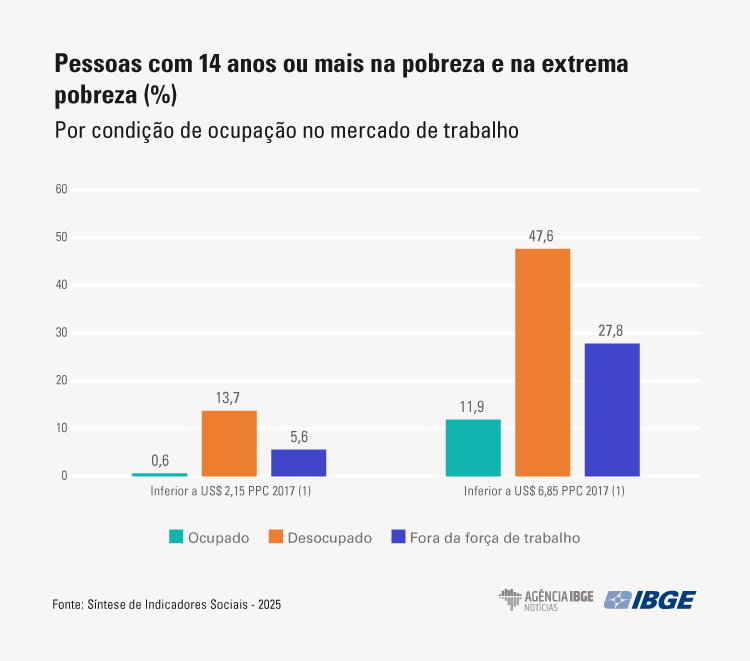
The proportion of employed persons living in poverty was 11.9% (or 12.0 million), while 47.6% (or 3.4 million) of the unemployed and 27.8% (or 17.9 million) of those outside the labor force were in this condition. About 0.6% (or 585 thousand) of employed persons were considered extremely poor in 2024, while among the unemployed the proportion reached 13.7% (or 987.2 thousand) and 5.6% (or 3.590 million) among those outside the labor force. Agriculture and domestic services have the highest proportions of poor workers.
Agriculture and Domestic Services have the highest proportions of poor workers
Among the employed population, the low proportion of extremely poor people (US$ 2.15) does not allow for a clear differentiation between the groups studied, which is possible in the case of poverty (US$ 6.85). More detailed information shows that the North and Northeast regions of the country had the highest proportions of poor workers, covering 22.2% and 24.0% of their employed populations, respectively, in 2024. Next were the Southeast (7.4%), Center-West (6.9%), and South (5.0%), the last three regions with proportions below the national average (11.9%).
In 2024, poverty was higher among workers without a formal employment contract (20.4%) and self-employed workers (16.0%), and lower among workers with a formal employment contract (6.7%). Similarly, poverty was more intense among workers in agriculture (29.3%) and domestic services (22.9%) and less intense in public administration, health, and social services (4.6%).
More about the survey
The Summary of Social Indicators: an analysis of the Brazilian population's living conditions 2025 aims to systematize and present a set of information related to the social reality of the country, based on highly relevant structural themes. In this edition, the topics are organized into three fundamental and complementary axes: Economic structure and labor market; Standard of living and income distribution; and Education. Additionally, in this edition, groups of occupation, the profile of older adults in the labor market, and a study on poor workers, also known as the Working Poor, are addressed.