

Quarterly Continuous PNAD: unemployment retreats in six out of 27 FUs in Q4 2025


February 20, 2026 09h00 AM | Last Updated: February 20, 2026 04h32 PM
The Brazilian unemployment rate was 5.1% in the fourth quarter of 2025, a significant reduction over the previous quarter (5.6%) and retreating 1.1 p.p. compared to the same moving quarter of 2024 (6.2%).
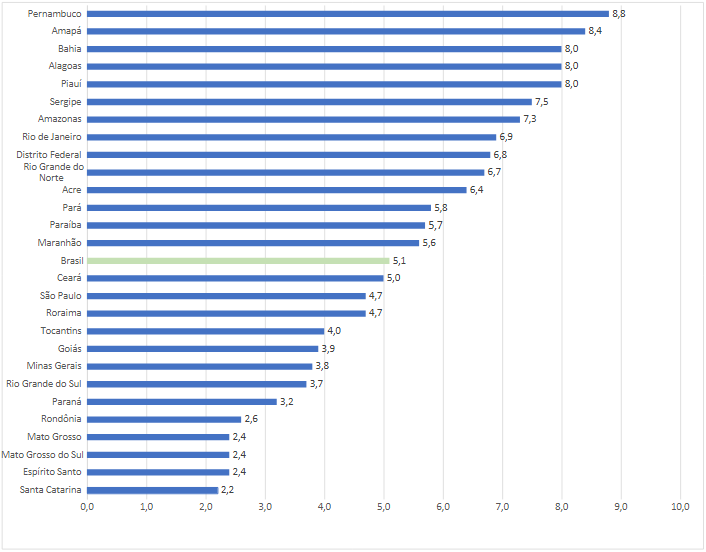
Compared to the previous quarter, the unemployment rate decreased in six Federation Units: São Paulo (0.5 p.p.), Rio de Janeiro (0.6 p.p.), Pernambuco (1.2 p.p.), Federal District (1.2 p.p.), Paraíba (1.3 p.p.) and Ceará (1.4 p.p.), with stability in the others. The highest unemployment rates were in Pernambuco (8.8%), Amapá (8.4%), Alagoas (8.0%), Bahia (8.0%) and Piauí (8.0%); the lowest ones were in Santa Catarina (2.2%), Espírito Santo (2.4%), Mato Grosso do Sul (2.4%) and Mato Grosso (2.4%).
The unemployment rate by sex was 4.2% for men and 6.2% for women in the fourth quarter of 2025. The unemployment rate by color or race was below the national average (5.1%) for white persons (4.0%) and above it for black (6.1%) and brown persons (5.9%).
The unemployment rate for people with incomplete secondary education (8.7%) exceeded the rates for other levels of schooling. For people with incomplete higher education, the rate was 5.6%, more than double that seen for those with complete higher education (2.7%).
In the fourth quarter of 2025, the composite underutilization rate (percentage of unemployed persons, time related underemployed persons and those in the potential workforce in relation to the expanded workforce) was 13.4%. Piauí (27.8%) registered the highest rate, followed by Bahia (25.4%) and Alagoas (25.1%). The lowest rates were in Santa Catarina (4.4%), Espírito Santo (5.9%) and Mato Grosso (6.1%).
The percentage of discouraged persons (in relation to the population in the workforce or discouraged) in the fourth quarter of 2025 was 2.4%. Maranhão (9.1%), Alagoas (8.0%) and Piauí (7.3%) recorded the highest percentages and the lowest ones were in Santa Catarina (0.3%), Rio Grande do Sul (0.6%) and Mato Grosso do Sul (0.6%).
In the fourth quarter of 2025, the percentage of persons employed with a formal contract was 74.4% of the persons employed in the private sector in Brazil. The highest percentages were in Santa Catarina (86.3%), São Paulo (82.2%) and Rio Grande do Sul (81.5%), while the lowest ones were in Maranhão (52.5%), Piauí (54.3%) and Paraíba (54.8%).
The percentage of the Brazilian self-employed population in the fourth quarter of 2025 was 25.3%. The highest percentages were in Maranhão (34.0%) and Pará (30.3%) and the lowest ones were in the Federal District (17.0%), Acre (18.8%) and Tocantins (20.8%).
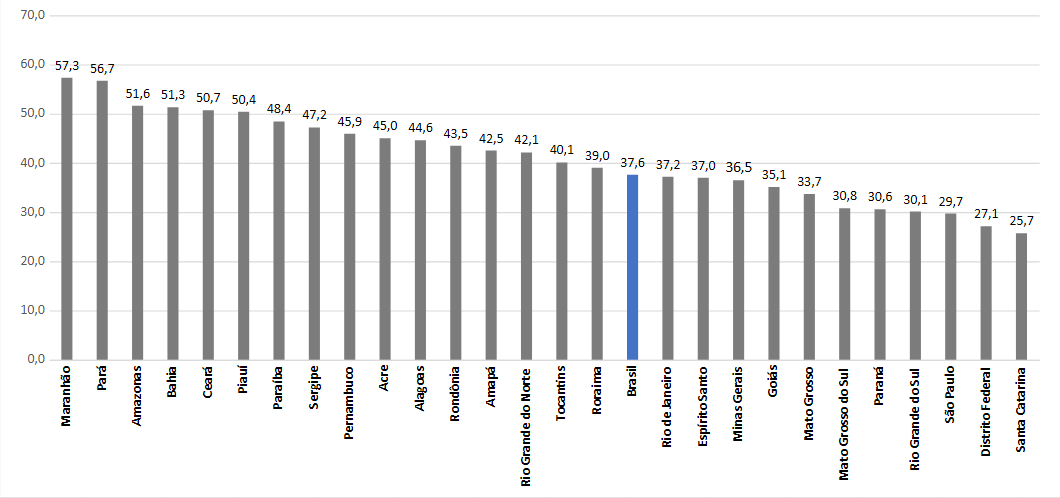
The informality rate for Brazil was 37.6% of the employed population. The highest rates were in Maranhão (57.3%), Pará (56.7%) and Amazonas (51.6%) and the lowest ones were in Santa Catarina (25.7%), Federal District (27.1%) and São Paulo (29.7%).
In the fourth quarter of 2025, Brazil had 1.1 million people who had been looking for work for two years or more. This contingent fell 19.6% compared to the same quarter in 2024, when 1.3 million people were in this condition.
On the other hand, 1.1 million people were looking for work for less than a month. This contingent fell 23.1% over the same quarter of 2024, when 1.4 million people had been looking for a job for less than a month.
Unemployment rates fell in six FUs compared to the previous quarter
Compared to the previous quarter, the unemployment rate decreased in six Federation Units: São Paulo (0.5 p.p.), Rio de Janeiro (0.6 p.p.), Pernambuco (1.2 p.p.), Federal District (1.2 p.p.), Paraíba (1.3 p.p.) and Ceará (1.4 p.p.), with stability in the others. The highest unemployment rates were in Pernambuco (8.8%), Amapá (8.4%), Alagoas (8.0%), Bahia (8.0%) and Piauí (8.0%); the lowest ones were in Santa Catarina (2.2%), Espírito Santo (2.4%), Mato Grosso do Sul (2.4%) and Mato Grosso (2.4%).
Unemployment rate of persons aged 14 or over,
by Federation Units (%) - Q4 2025
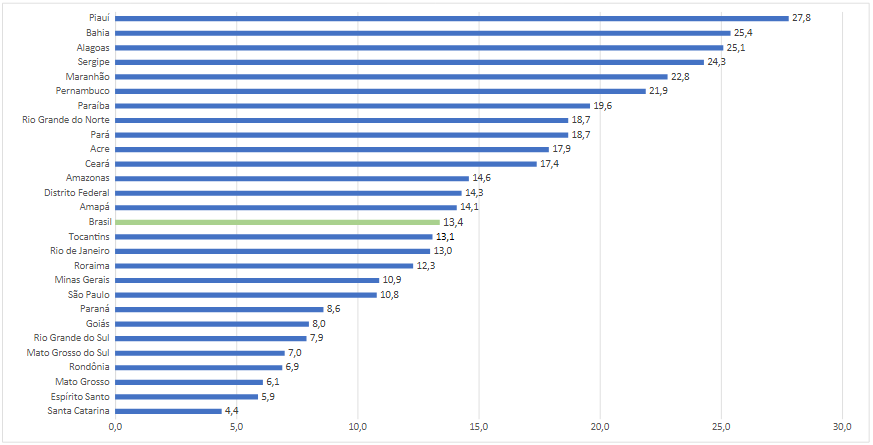
PI has the highest underutilization rate (27.8%) and SC, the lowest one (4.4%)
In the fourth quarter of 2025, the composite underutilization rate (percentage of unemployed persons, time related underemployed persons and those in the potential workforce in relation to the expanded workforce) was 13.4%. Piauí (27.8%) registered the highest rate, followed by Bahia (25.4%) and Alagoas (25.1%). The lowest rates were in Santa Catarina (4.4%), Espírito Santo (5.9%) and Mato Grosso (6.1%).
Composite underutilization rate of the workforce by FU (%) – Q4 2025
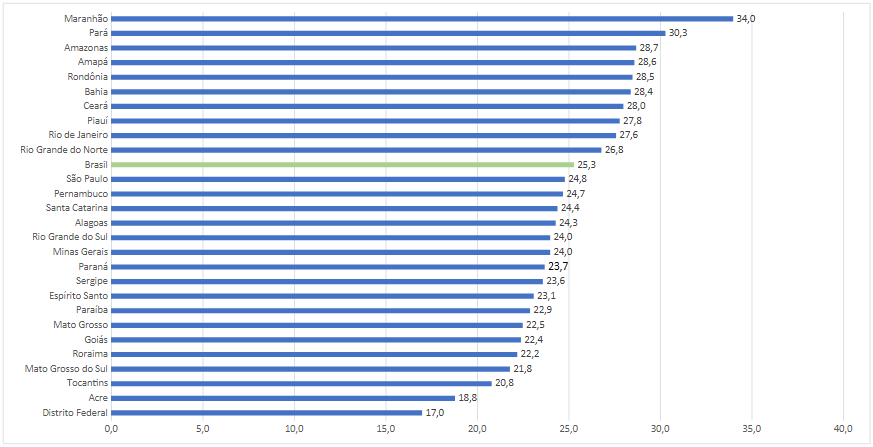
MA has the highest proportion of self-employed persons (34.0%) and the Federal District, the lowest one (17.0%)
The percentage of the Brazilian employed population working independently in the fourth quarter of 2025 was 25.3%. The highest percentages were in Maranhão (34.0%) and Pará (30.3%) and the lowest ones were in the Federal District (17.0%), Acre (18.8%) and Tocantins (20.8%).
Percentage of self-employed persons, by FU (%) - Q4 2025
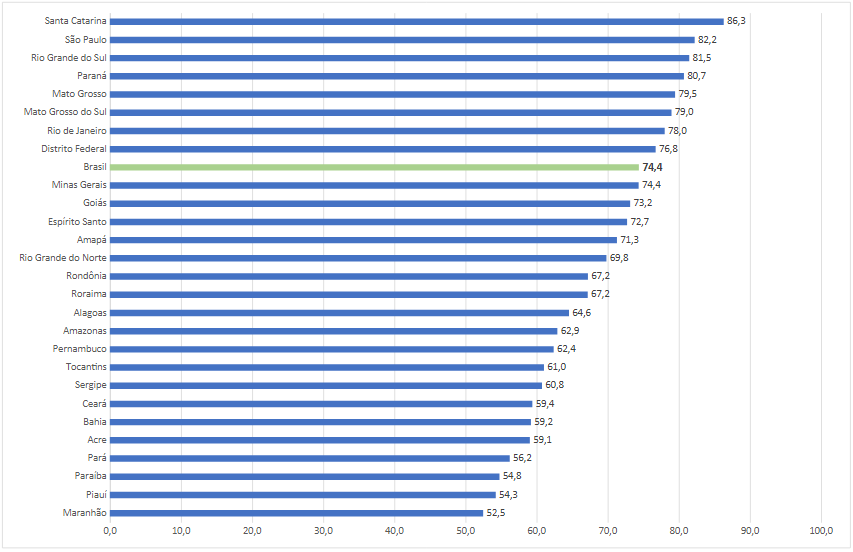
Lowest percentage of workers with a formal contract is from MA (52.5%) and the highest one is from SC (86.3%)
In the fourth quarter of 2025, the percentage of persons employed with a formal contract was 74.4% of the persons employed in the private sector in Brazil. The highest percentages were in Santa Catarina (86.3%), São Paulo (82.2%) and Rio Grande do Sul (81.5%), while the lowest ones were in Maranhão (52.5%), Piauí (54.3%) and Paraíba (54.8%).
Percentage of persons employed WITH a formal contract among persons employed in the private sector,
by FUs (%) - Q4 2025
Compared to the previous quarter, average earnings remain stable in three regions
In the fourth quarter of 2025, the real average earnings from all jobs, usually received per month, by persons aged 14 years or over, employed in the reference week, with income from work, was estimated at R$3,613. This result showed growth both in relation to the immediately previous quarter (R$ 3,527) and in relation to the same quarter of the previous year (R$ 3,440).
In the comparison between the third quarter and the fourth quarter of 2025, the North (R$ 2,846) and Southeast (R$ 4,033) regions showed a statistically-significant increase in earnings, while the others remained stable. Compared to the fourth quarter of 2024, all regions showed expansion.
The average real wage bill from all jobs, usually received per month, by persons aged 14 years or over, employed in the reference week, with income from work, was estimated at R$367,551 million, registering growth, both in relation to the previous quarter (R$356,668 million) and compared to the fourth quarter of 2024 (R$345,521 million).
MA has the highest informality rate (57.3%) and SC, the lowest one (25.7%)
The informality rate for Brazil was 37.6% of the employed population in the fourth quarter of 2025. The highest rates were in Maranhão (57.3%), Pará (56.7%) and Amazonas (51.6%) and the lowest ones were in Santa Catarina (25.7%), Federal District (27.1%) and São Paulo (29.7%). To calculate the proxy of the informality rate of the employed population, the following populations are considered: worker in the private sector without a formal employment contract; domestic worker without a formal employment contract; employer without registration with the CNPJ; self-employed worker without CNPJ registration; auxiliary family worker.
Informality rate of the employed population, by FUs
Number of persons looking for work for two years or more fell 19.6% compared to 2024
In the fourth quarter of 2025, Brazil had 1.1 million people looking for work for two years or more. This contingent fell 19.6% compared to the same quarter in 2024, when 1.3 million people were in this condition.
On the other hand, 1.1 million people had been looking for work for less than a month. This contingent fell 23.1% over the same quarter of 2024, when 1.4 million people had been looking for a job for less than a month.
Notice:
Considering that the capture of information intended for monitoring quarterly fluctuations in the workforce is carried out only for the population aged 14 years or over, table 5919, which presents the level of schooling for the total resident population, was excluded from the table plan for quarterly release. For quarterly information on the workforce, disaggregated by level of schooling, consult table 4095, whose target population corresponds to the population aged 14 years and over. Additionally, information on schooling level can also be consulted in tables 7128 and 7129, from the annual Education module.



