

Continuous PNAD: unemployment rate is 5.1% and uderutilization rate is 13.4% the quarter ending in December


January 30, 2026 09h00 AM | Last Updated: January 31, 2026 01h41 AM
The unemployment rate (5.1%) in the quarter ending in December 2025 was the lowest in the time series that began in 2012, decreasing in both comparisons: -0.5 percentage points (p.p.) against the previous moving quarter (5.6%) and -1.1 p.p.against the same moving quarter of 2024 (6.2%).
| Indicator/Period | Oct-Nov-Dec 2025 | Jul-Aug-Sep 2025 | Oct-Nov-Dec 2024 |
|---|---|---|---|
| Unemployment rate | 5.1% | 5.6% | 6.2% |
| Underutilization rate | 13.4% | 13.9% | 15.2% |
| Usual real earnings | R$ 3,613 | R$ 3,527 | R$ 3,440 |
| Change of usual earnings in relation to: | 2.4% | 5.0% | |
The unemployed population (5.5 million) was the lowest figure in the time series, decreasing by 9.0% (542,000 fewer persons) in the quarter and falling by 17.7% (1.2 million) in the year.
The employed population (103.0 million) reached a record high in the time series, growing in both comparisons: 0.6% (565,000 persons) in the quarter and 1.1% (1.2 million) in the year. The employment rate (percentage of employed persons in the working-age population) was 58.9%, a record high for the series, varying by 0.2 percentage points in the quarter (58.7%) and remaining stable for the year (58.7%).
The composite underutilization rate (13.4%) was the lowest in the series, declining in both comparisons: -0.5 percentage points compared to the previous quarter (13.9%) and -1.8 percentage points compared to the same quarter of 2024 (15.2%).
The underutilized population (15.3 million) was similar to the lowest number recorded in the quarter ending in December 2014 (15.3 million), declining in both comparisons: -3.3% (515,000 fewer persons) in the quarter and -12.3% (2.1 million fewer persons) in the year. The underemployed population due to insufficient hours (4.5 million) remained stable in the quarter and fell 7.1% in the year (343,000 fewer persons).
The population out of the workforce (66.2 million) remained stable in the quarter and grew by 2.1% (an increase of 1.3 million people) year-on-year.
The discouraged population (2.6 million) remained stable in the quarter and fell by 11.5% (a decrease of 343,000 persons) year-on-year. The percentage of discouraged workers (2.4%) did not show significant variation in the quarter and decreased by 0.3 percentage points in the year.
The number of employed persons in the private sector (53.0 million) was a record for the series, but without significant variation in the quarter and with growth of 1.1% year-on-year (an increase of 578.000 persons).
The number of workers with a formal contract in the private sector (except domestic workers) was a record for the series (39.4 million), with stability in the quarter and an increase of 2.4% (an increase of 939,000 persons) year-on-year. The number of workers without a formal contract in the private sector (13.6 million) remained stable in the quarter and decreased by 2.6% (361.000 fewer persons) year-on-year. The number of workers in the public sector (13 million) reached a record high in the historical series, showing stability in the quarter and growth of 3.9% (483,000 more persons) year-on-year.
The number of self-employed workers (26.1 million) was a record high in the time series, remaining stable in the quarter and growing by 2.5% (an increase of 638,000 persons) in the year.
The informality rate was 37.6% of the employed population (or 38.7 million informal workers), close to the 37.8% (or 38.7 million persons) observed in the quarter ending in September and below the 38.6% (or 39.3 million persons) recorded in the quarter ending in December 2024.
The usual real earnings from all jobs (R$ 3,613) was a record high, with increases of 2.4% in the quarter and 5.0% in the year. The total usual real income (R$ 367.6 billion) was again a record high, with an increase of 3.1% (an increase of R$ 10.9 billion) in the quarter and 6.4% (an increase of R$ 22 billion) in the year.
Unemployment rate - Brazil - 2012/2025
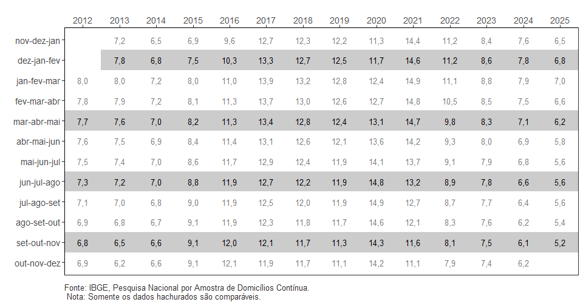
The workforce (employed and unemployed individuals) for the October-December 2025 quarter was estimated at 108.5 million persons, remaining stable in both comparisons.
The analysis of employment by group of activity compared to the July-September 2025 quarter showed increases in: Trade, repair of motor vehicles and motorcycles (1.6%, or 299,000 more persons) and Public administration, defense, social security, education, human health and social services (1.5%, or 282,000 more persons). The other groups did not show significant change.
Compared to the October-December 2024 quarter, an increase was observed in the following groups: Information, Communication and Financial, Real Estate, Professional and Administrative Activities (3.7%, or 475,000 more persons) and Public administration, defense, social security, education, human health and social services (5.5%, or 1 million). There was a decrease in the Domestic Services group (4.9%, or 289,000 fewer persons).
Composite underutilization rate – Quarters - September - November – Brazil – 2012 to 2025 (%)
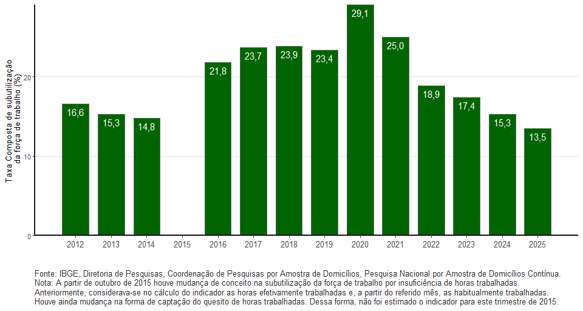
Average real monthly earnings, by groups of activity, compared to the July-September 2025 quarter, showed an increase in the following categories: Agriculture, livestock, forestry, fishing and aquaculture (3.7%, or an increase of R$ 82) and Information, Communication and Financial, Real Estate, Professional and Administrative Activities (5.1%, or an increase of R$ 254). The other groups did not show significant change.
Compared to the same quarter of 2024, the following categories showed increases: Agriculture, livestock, forestry, fishing and aquaculture (9.3%, or an increase of R$ 196); Construction (5.5%, or an increase of R$ 147); Information, Communication and Financial, Real Estate, Professional and Administrative Activities (5.8%, or an increase of R$ 287); Public administration, defense, social security, education, human health and social services (4.7%, or an increase of R$ 219); and Domestic services (4.8%, or an increase of R$ 63). The other groups did not show significant change.


