

Continuouis PNAD: in 2025, annual unemployment rate was 5.6% whereas underutilization rate hit 14.5%


January 30, 2026 09h00 AM | Last Updated: January 30, 2026 11h34 PM
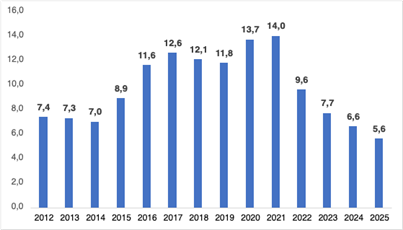
The annual unemployment rate was 5.6% in 2025, the lowest rate in the time series that started in 2012. This result represents a decrease of 1.0 percentage point (p.p.) compared to the 2024 figure (6.6%). From 2019 (11.8%), the year before the Covid-19 pandemic, the decrease was 6.2 p.p. From 2012, when the rate was 7.4%, the decrease was 1.8 p.p.
The total unemployed population in 2025 reached 6.2 million persons, a decrease of approximately 1.0 million (-14.5%) from 2024 (7.2 million).
The employed population reached 103 million persons in 2025, breaking the record for the time series that started in 2012, and was 1.7% higher than in 2024. Against the 2012 figure (89.3 million), there was an increase of 15.4%.
The employment rate (percentage of employed persons in the working-age population) was also a record high, estimated at 59.1% in 2025, 0.5 percentage points above that in 2024 (58.6%). In 2012, the indicator had registered 58.1%.
The annual estimate of the composite underutilization rate was 14.5%, a decrease of 1.7 percentage points from 2024, when the rate was estimated at 16.2%. This indicator was 24.4% in 2019, 15.8% in 2014, and 18.6% in 2012.
The annual estimate of the underutilized population (16.6 million persons in 2025) decreased by 10.8% compared to 2024. Despite the reduction, this number is 2.0% above the lowest level in the series, of 2014 (16.3 million).
The number of time-related underemployed persons in 2025, estimated at 4.6 million, decreased by 7.0% against the previous year.
In 2025, the annual estimate of the discouraged population decreased by 9.6% from 2024, reaching 2.9 million persons. The highest estimate for this population occurred in 2021 (5.5 million) and the lowest in 2014 (1.6 million discouraged workers).
The number of workers with a formal contract in the private sector increased by 2.8% in 2025 from 2024, reaching 38.9 million persons, the highest figure in the series that started in 2012.
The annual estimate of workers without a formal contract fell by 0.8% in 2025, and reached 13.8 million people. Against 2014, when the estimate was 10.7 million persons, the increase was 28.8%.
The number of self-employed workers totaled 26.1 million in 2025, an increase of 2.4% from 2024 to 2025. From 2012, the beginning of the series, when this figure was the lowest in the series (20 million), there was a 30.4% increase.
In 2025, the number of domestic workers fell by 4.4%, reaching 5.6 million persons.
The annual informality rate decreased from 39.0% in 2024 to 38.1% in 2025.
The annual usual real earnings was estimated at R$ 3,560, 5.7% higher (R$ 192) than estimated for 2024. Against 2012, there was an increase of 15.5%.
The annual usual real wagebill reached R$ 361.7 billion, the highest in the series, with an increase of 7.5% (R$ 25.4 billion more) compared to 2024. From 2012 to 2024, this wagebill grew by 36.1%.
Unemployment rate - Brazil (%)
Annual estimate of the employed population by group of activity in 2024
Among the activities, Information, communication and financial, real estate, professional and administrative activities, with an increase of 6.8%, had the greatest percentage increase in employed population in 2025 from 2024, totaling 13.4 million persons. In relation to 2012, the increase in employment in the sector was 40.1% (an additional 3.8 million persons).
Trade, repair of motor vehicles and motorcycles, the group with the most people employed in absolute figures (19.5 million), had a slight increase from the previous year (0.3%), employing an additional 62,000 persons in 2025. Against the beginning of the series, when this activity employed 17.0 million persons, there was an increase of 14.5%.
Public administration, defense, social security, education, human health and social services, the second biggest group in 2025 (19 million), registered an increase of 5.0% in employed persons compared to 2024. From 2012, when it employed 14 million, there was an increase of 34.9%.
Construction showed a 3.9% drop in employment in 2025, with 302,000 fewer persons employed, falling to 7.4 million, against 7.7 million in 2024. In the time series, after growing for four years between 2020 and 2024, the sector showed a contraction in employment.
General industry also saw an increase from 2024 to 2025, of 2.3%, reaching 13.3 million employed. This number is 2.7% above the 2012 level (13 million) and 0.5% below 2014, when it reached the highest number in the series, at 13.4 million persons.
On the other hand, Agriculture, livestock, forestry, fishing, and aquaculture grew by 1.1%, totaling 7.9 million persons. Against the beginning of the time series in 2012, when it employed 10.1 million persons, there was a decrease of 22.3%.
Another decrease in employment in 2025 was observed in Domestic services, which employed 5.7 million persons, a 4.1% decrease compared to 2024, when it employed 6 million. With a decrease of 243,000 persons employed in the year, the group remains at a level close to that recorded at the beginning of the time series in 2012 (6 million).


