

Continuous PNAD: unemployment rate is 5.2% and labor underutilization rate is 13.5% in quarter ended in November


December 30, 2025 09h00 AM | Last Updated: December 30, 2025 01h06 PM
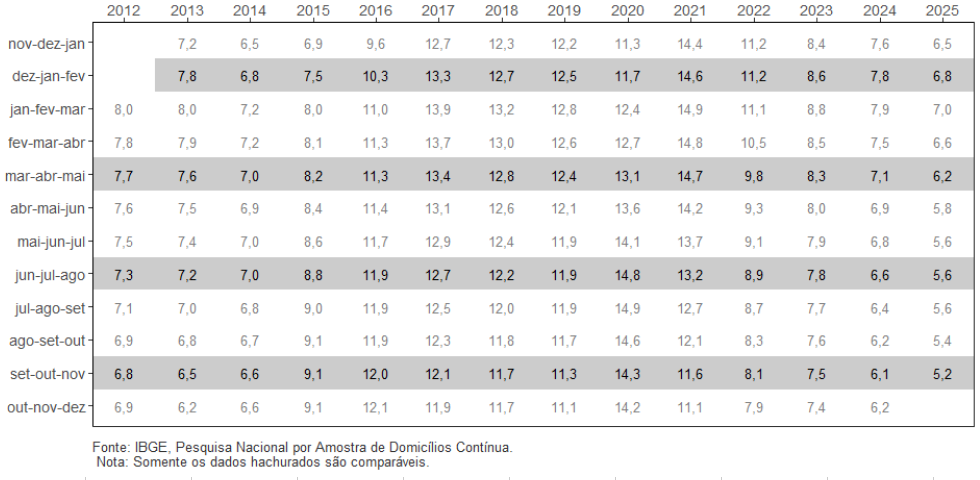
The unemployment rate (5.2%) in the quarter ended in November 2025 was the lowest in the time series that began in 2012, decreasing in both comparisons: -0.4 percentage points (pp) compared to the previous moving quarter (5.6%) and -0.9 pp compared to the same moving quarter of 2024 (6.1%).
| Indicator/Period | Sept-Oct-Nov 2025 | Jun-Jul-Aug 2025 | Sept-Oct-Nov 2024 |
|---|---|---|---|
| Unemployment rate | 5.2% | 5.6% | 6.1% |
| Labor underutilization rate | 13.5% | 14.1% | 15.3% |
| Usual real earnings | R$ 3,574 | R$ 3,509 | R$ 3,420 |
| Change of usual earnings in relation to: | 1.8% | 4.5% | |
The unemployed population (5.6 million) was the lowest number in the time series, decreasing by 7.2% (441,000 fewer persons) in the quarter and falling by 14.9% (988,000 fewer persons) in the year.
The employed population (103.0 million) reached a record high in the time series, growing in both comparisons: 0.6% (601,000 persons) in the quarter and 1.1% (1.1 million more) in the year. The employment-to-population ratio (percentage of employed persons in the working-age population) was 59.0%, a record high in the time series, changing by 0.2 percentage points in the quarter (58.8%) and remaining stable for the year (58.8%).
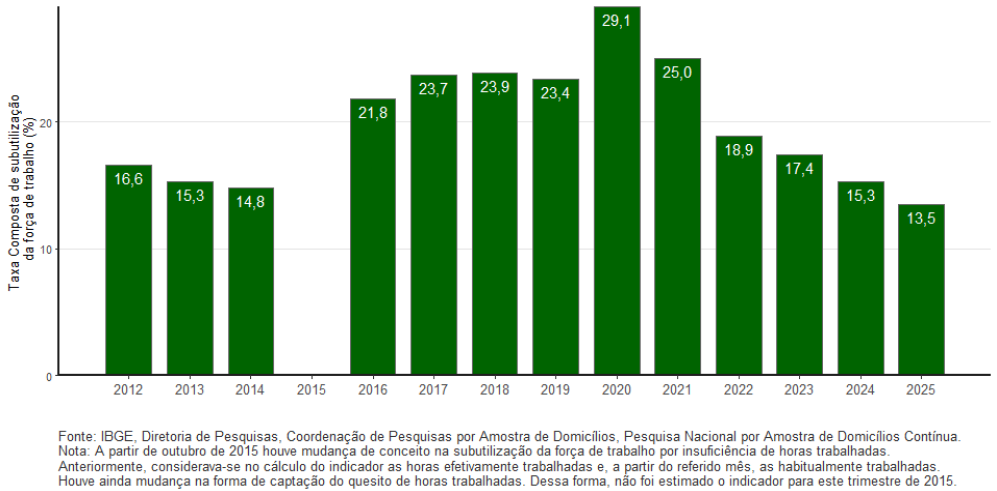
The composite labor underutilization rate (13.5%) was the lowest in the series, declining in both comparisons: -0.6 percentage points compared to the previous quarter (14.1%) and -1.7 percentage points compared to the same quarter of 2024 (15.3%). The underutilized population (15.4 million) reached its lowest level since the quarter ending in December 2014 (15.3 million), declining in both comparisons: -3.9% (627,000 fewer persons) in the quarter and -11.9% (2.1 million fewer persons) in the year.
The time-related underemployed persons (4.5 million) remained stable in the quarter and fell 9.1% (457,000 fewer persons) in the year. The population outside the labor force (66.0 million) remained stable in the quarter and grew 1.9% (1.2 million more persons) in the year.
The discouraged population (2.6 million) was the lowest since the quarter ended in December 2015, remaining stable during the quarter and decreasing by 12.9% (386,000 fewer persons) year-on-year. The percentage of discouraged workers (2.3%) did not change significantly during the quarter and decreased by 0.3 percentage points year-on-year.
The number of employed persons in the private sector (53.0 million) was a record high in the series, but without significant changes during the quarter or year-on-year.
The number of employed persons with formal contracts in the private sector (excluding domestic workers) was a record high in the series (39.4 million), remaining stable during the quarter and increasing by 2.6% (1.0 million more persons) year-on-year. The number of employed persons without formal contracts in the private sector (13.6 million) remained stable during the quarter and decreased by 3.4% (486,000 fewer persons) year-on-year. The number of employees in the public sector (13.1 million) was a record high, with an increase of 1.9% (250,000 more persons) in the quarter and 3.8% (484,000 more persons) in the year.
The number of self-employed workers (26.0 million) was a record high, remaining stable in the quarter and growing 2.9% (734,000 more persons) in the year.
The informality rate was 37.7% of the employed population (or 38.8 million informal workers), below the 38.0% (or 38.9 million) observed in the quarter ended in August and also below the 38.8% (or 39.5 million) reached in the quarter ended in November 2024.
The usual real earnings from all jobs (R$ 3,574) was a record high, with increases of 1.8% in the quarter and 4.5% in the year.
The usual real wage bill (R$ 363.7 billion) was again a record, with an increase of 2.5% (an additional R$ 9.0 billion) in the quarter and 5.8% (an additional R$ 19.9 billion) in the year.
Unemployment rate - Brazil - 2012/2025
The workforce (employed and unemployed individuals) in the September-November 2025 quarter was estimated at 108.7 million persons, remaining stable in both comparisons.
The analysis of employment by activity groups compared to the previous moving quarter showed an increase in employed individuals only in Public administration, defense, social security, education, human health, and social services (2.6%, or 492,000 more persons), with stability in the others.
Compared to the September-November 2024 quarter, there was an increase in two groups: Transportation, storage, and mailing (3.9%, or 222,000 more persons) and Public administration, defense, social security, education, human health, and social services (5.6%, or 1 million more persons). There was a reduction in the Domestic services group (6.0%, or 357,000 fewer persons) and stability in the others.
Composite underutilization rate – Quarters from September to November – Brazil – 2012 to 2025 (%)
The average real monthly earnings by activity group, compared to the previous moving quarter, showed an increase in one category: Information, Communication and Financial, Real Estate, Professional and Administrative Activities (5.4%, or R$ 266 more). The other groups did not show significant change.
Compared to the same quarter of 2024, there was an increase in five categories: Agriculture, livestock, forestry, fishing and aquaculture (7.3%, or R$ 154 more), Construction (6.7%, or R$ 177 more), Information, Communication and Financial, Real Estate, Professional and Administrative Activities (6.3%, or R$ 307 more), Public administration, defense, social security, education, human health and social services (4.2%, or R$ 197 more) and Domestic services (5.5%, or R$ 71 more). The other groups did not show significant change.


