

IBGE: Harvest estimate for 2026 is 332.7 million tonnes, 3.7% lower than in 2025


November 13, 2025 09h00 AM | Last Updated: November 24, 2025 02h13 PM
The first estimate for the national output of grain, cereals, legumes and oilseeds for 2026 is 332.7 million tonnes, with a decrease of 3.7% (or 12.9 million tonnes) from 2025. The IBGE has included two items for the 2026 harvest, canola and sesame, which have increased in importance among cereals, legumes and oilseeds harvested in the last few years.
| 1st estimate for 2026 | 332.7 million tonnes |
| Change in harvests 2026 / 2024 | -3.7% (-12.9 million tonnes) |
| October estimate for 2025 | 345.6 million tonnes |
| Change in estimates October/September 2025 | 1.1% (3.7 million tonnes) |
| Harvest change 2025 / 2024 | 18.1% (52.9 million tonnes) |
The October estimate for the 2025 harvest of cereals, legumes and oilseeds reached 345.6 million tonnes, a record figure in the time series of LSPA, with an increase of 18.1% (or 52.9 million tonnes) from the previous year, when the estimate was 292.7 million tonnes. From September, there was an increase of 3.7 million tonnes (1.1%).
The area to be harvested was 81.5 million hectares, with increases of 3.1% (2.4 million hectares more) against the area harvested in 2024 and of 0.1% (63.8 thousand hectares) from the preceding month.
Altogether, rice, corn and soybeans, the three main products in this group, represent 92.6% of the output estimate and account for 87.9% of the area to be harvested in 2025. Against 2024, there were increases of 4.8% in the area to be harvested of upland cottonseed; of 11.1% in that of paddy rice; of 3.6% in that of soybeans; of 4.2% in that of corn (-5.1% in the 1st crop and +6.8% in the 2nd crop); and of 12.7% in that of sorghum, with drops of 6.2% and of 18.7% in the area to be harvested of beans and wheat, respectively.
Increase in output is observed in upland cottonseed (10.6%); paddy rice (18.7%); soybeans (14.5%); corn (23.5%), being +13.8% in the 1st crop and +25.9% in the 2nd crop); sorghum (31.0%); wheat (4.5%); and beans had a drop of 1.9%. Soybeans, corn and sorghum recorded record output in 2025.
In October 2025, the IBGE had its first area and production estimate for the 2026 harvest, which is expected to reach 332.7 million tonnes, a 3.7% decline (12.9 million tonnes) from 2025. The 2025 harvest was a record in IBGE's time series, resulting from a year in which the climate benefited crops in most producing states, with more severe rainfall restrictions only in Rio Grande do Sul. For the 2026 harvest, IBGE is including canola and sesame, products that have been gaining importance in the cereal, legume, and oilseed harvest in recent years, although their cultivation is still limited to a few states.
The drop in production is mainly due to lower estimates for corn (-9.3% or -13.2 million tons), sorghum (-11.6% or -604,400 tons), rice (-6.5% or -815,000 tons), cotton (-4.8% or -466,900 tons), wheat (-3.7% or -294,800 tons), beans (-1.3% or -38,600 tons), and peanuts (-2.1% or -25,500 tons). Soybean production is estimated to grow by 1.1% or 1.8 million tons.
Production is expected to grow in Paraná (2.4%) and Rio Grande do Sul (22.6%), with drops in Mato Grosso (-9.8%), Goiás (-7.8%), Mato Grosso do Sul (-12.2%), Minas Gerais (-4.7%), Bahia (-4.0%), São Paulo (-6.9%), Tocantins (-7.8%), Maranhão (-3.3%), Pará (-8.3%), Santa Catarina (-13.4%), Piauí (-0.6%), Rondônia (-2.4%) and Sergipe (-6.5%).
The area to be harvested in 2026 is 81.5 million hectares, a growth of 1.1% or 879,100 hectares. For the products, there have been increases in the areas of corn (0.7% or 148,700 hectares), soybeans (0.3% or 132,700 hectares), and wheat (0.2% or 4,400 hectares), and reductions in the area of cottonseed (-0.7% or -14,100 hectares), peanuts (-3.3% or -11,400 hectares), rice (-3.3% or -57,000 hectares), beans (-1.8% or -47,400 hectares), and sorghum (-0.7% or -9,900 hectares).
The area to be harvested is expected to grow in Mato Grosso (0.9%), Bahia (0.1%), and Rondônia (0.2%). with decreases in Goiás (-0.4%), Mato Grosso do Sul (-1.1%), Minas Gerais (-0.1%), São Paulo (-1.3%), Tocantins (-0.6%), Maranhão (-0.3%), and Ceará (-0.1%).
UPLAND COTTONSEED – The estimate for cottonseed production in 2026 is 9.3 million tons, a 4.8% drop compared to the volume produced in 2025. The average yield, at 4,425 kg/ha, fell by 4.1%, while the area to be harvested decreased by 0.7%.
PADDY RICE – The first estimate for 2026 points to a production of 11.8 million tonnes, a 6.5% drop compared to the volume produced in 2025, with reductions of 3.3% in the area to be harvested and 3.3% in the average yield.
BEAN SEED – The first estimate for bean production in 2026, considering all three crops, is 3.0 million tons, a 1.3% reduction compared to the harvest in 2025. The first crop is expected to produce 930,600 tons; the second one, 1.3 million tons; and the third crop, 784,300 tons. Despite the reduction compared to 2025, this production should meet Brazilian consumption in 2026, eliminating the need for imports.
CORN GRAIN – The estimate for corn production in 2026 is 128.4 million tonnes, a drop of 9.3% or 13.2 million tonnes less than in 2025. For the first crop, production is estimated to reach 26.3 million tonnes, an increase of 0.9% from 2025, with the average yield falling by 2.4% and the area to be harvested growing by 3.3%. For the second corn crop, the production estimate is 102.1 million tonnes, a decline of 11.6% compared to 2025, with a reduction of the same value for the average yield.
SOYBEAN – The first production estimate for 2026 indicates a 1.1% increase against 2025, totaling 167.7 million tons, which would constitute a new record in national production of the legume, surpassing the production registered in the previous year. The expansion in production is mainly due to the expected 0.8% increase in average yield, totaling 3,507 kg/ha, and a planted area 0.3% larger than that registered in the last harvest.
SORGHUM GRAIN - The October estimate for the 2026 sorghum harvest is 4.6 million tons, indicating an 11.6% decrease compared to the 2025 harvest. The average yield (3,099 kg/ha) is expected to show an 11.0% reduction. A 0.7% reduction is estimated for the total area, occurring in the North (-5.4%), Northeast (-1.3%) and Southeast (-3.0%), while in the Central-West and South, a recovery of 1.1% and 159.2%, respectively, is expected. Sorghum production should account for 1.4% of the national total of grains, cereals, legumes and oilseeds, distributed across 1.5 million hectares.
October 2025 estimate is for a harvest of 345.6 million tonnes
The October 2025 estimate for the national harvest of cereals, legumes, and oilseeds was 345.6 million tons, 18.1% higher than that of 2024 (292.7 million tonnes), a growth of 52.9 million tonnes, a record in the IBGE's time series. Against the previous month, there was an increase of 3.7 million tonnes (1.1%). The area to be harvested was 81.5 million hectares, an increase of 2.4 million hectares compared to the area harvested in 2024, with an annual growth of 3.1%. Compared to the previous month, the area to be harvested showed an increase of 63,774 hectares (0.1%).
Rice, corn, and soybeans are the three main products in this group, and together represent 92.6% of the estimated production and account for 87.9% of the area to be harvested in 2025. From 2024, there were increases of 4.8% in the area to be harvested for upland cottonseed; 11.1% for paddy rice; 3.6% for soybeans; 4.2% for corn (-5.1% in the first crop and +6.8% in the second crop); and 12.7% for sorghum, with drops of 6.2% in the area to be harvested for beans and 18.7% for wheat.
In terms of production, there were increases of 10.6% in upland cottonseed; 18.7% in paddy rice; and 14.5% in soybeans. 23.5% in corn (+13.8% in the first crop and +25.9% in the second crop); 31.0% in sorghum; 4.5% in wheat; and a decrease of 1.9% in beans.
For soybeans, the production estimate was 165.9 million tons, a record in the series. Corn also registered a record, with an estimate of 141.6 million tons (26.1 million tons of corn in the first crop and 115.5 million tons of corn in the second crop). Paddy rice production was estimated at 12.6 million tons; wheat at 7.9 million tons; cottonseed at 9.8 million tons; and sorghum at 5.2 million tons.
All the Major Regions experienced annual production growth
The estimated production of cereals, legumes, and oilseeds grew in all the Major Regions from the previous year: Central-West (23.6%), South (10.0%), Southeast (19.4%), Northeast (8.0%), and North (21.4%). Regarding the monthly change, there were increases in the South (0.5%), Midwest (1.7%) and Southeast (2.3%). The Northeast Region (-0.3%) and the North Region (-1.0%) recorded drops.
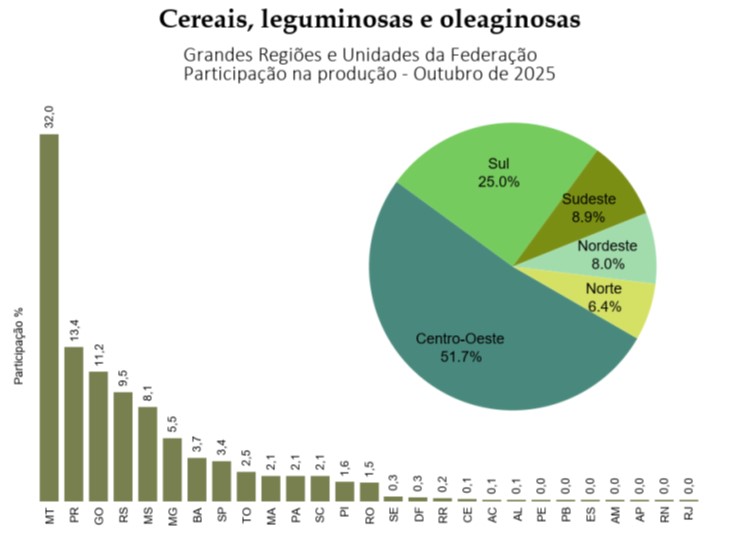
In the distribution of production by Federation Units, Mato Grosso leads as the largest national grain producer, with a 32.0% share, followed by Paraná (13.4%), Goiás (11.3%), Rio Grande do Sul (9.4%), Mato Grosso do Sul (8.2%), and Minas Gerais (5.5%), which together accounted for 79.8% of the total. Regarding regional shares, the distribution is as follows: Central-West (51.7%), South (24.9%), Southeast (8.9%), Northeast (8.1%), and North (6.4%).
The main positive absolute changes in production estimates, compared to the previous month, occurred in Mato Grosso do Sul (2,794,982 t), São Paulo (683,395 t), Paraná (212,300 t), Rio Grande do Sul (180,957 t), Goiás (115,317 t), Bahia (53,700 t), Roraima (21,540 t), Rio Grande do Norte (786 t), and Rondônia (77 t). Negative variations occurred in Tocantins (-228,721 t), Ceará (-98,974 t), Maranhão (25,222 t), Acre (-4,855 t), Pernambuco (-2,407 t), Minas Gerais (-292 t), and Rio de Janeiro (-3 t).
Highlights in the October 2025 estimate against the previous month
Against September, there were increases in production estimates for oranges (8.0% or 1,028,462 t), sorghum (5.0% or 246,302 t), barley (4.1% or 23,128 t), second-crop corn (2.9% or 3,221,728 t), oats (2.2% or 28,492 t), tomatoes (1.9% or 87,602 t), cassava (1.3% or 273,409 t), rice (1.2% or 153,814 t), wheat (0.8% or 61,437 t), second-crop beans (0.5% or 5,852 t), and soybeans (0.0% or 47,385 t), as well as declines. Bean seed (third crop) -5.0% or -40,322 t, cashew nuts -2.4% or -3,581 t, first crop beans -1.1% or -10,684 t, and first crop corn -0.2% or -42,728 t.
PADDY RICE – The production estimate was 12.6 million tons, a 1.2% increase compared to the previous month's estimate and an 18.7% increase compared to the 2024 harvest, with an 11.1% increase in harvested area and a 6.9% increase in productivity. In Rio Grande do Sul, the production estimate grew by 1.8% from the previous month, mainly due to higher crop productivity (1.9%). The estimate is for an output of 8.7 million tonnes, a 22.1% increase compared to the previous harvest. The state is responsible for 69.3% of national production. Santa Catarina maintained the production estimate from the previous month. Compared to 2024, the increase is 13.6%, due to higher productivity (13.1%). The state is the second main national producer, responsible for 10.1% of output.
CASHEW NUT – The October estimate for cashew nut production was 144,300 tonnes, resulting in a 2.4% decrease from the previous month. This drop is partly due to a reduction in average yield (-2.1%), as well as smaller planted and harvested areas (-0.3%). The average yield was 321 kg per hectare during the period under analysis, below the 358 kg/ha of the 2024 harvest. Compared to the previous year's harvest, production fell by 10.4%, mainly due to lower yield (-10.3%) and, to a lesser extent, a marginal decrease in planted area (-0.1%).
CEREAIS DE INVERNO (em grão) – The main winter crops produced in Brazil are wheat, white oats, and barley. For wheat (grain), the estimated production reached 7.9 million tons, an increase of 0.8% compared to the previous month and a growth of 4.5% compared to 2024. The average yield, in the monthly comparison, grew by 1.1%, while the area to be harvested fell by 0.3%. Against the previous year, the planted area and the area to be harvested declined by 18.8% and 18.7%, respectively, while the average yield increased by 28.5%.
Oat (grain) production was estimated at 1.4 million tonnes, with increases of 2.2% against the previous month and 27.7% compared to the volume harvested in 2024. The average yield, of 2,314 kg/ha, grew by 0.4% compared to the previous month, while the harvested area increased by 1.7%. From the previous year, the harvested area grew by 13.8%, while the average yield increased by 12.3%.
For barley (grain), the estimated production was 590,100 tons, with increases of 4.1% from the previous month and 41.8% against the volume produced in 2024. The planted area grew by 17.9%, while the yield increased by 20.3% in the annual comparison.
BEAN (seed) – The October estimate for bean production, considering all three harvests, was 3.0 million tons, a 1.5% reduction from September and a 1.9% decrease against the 2024 harvest. The estimate for the first bean crop was 984,800 tons, representing 32.4% of the national share among the three harvests, 1.1% less than the September estimate. There was a 0.1% increase in the area to be harvested and a 1.2% reduction in yield. The second crop was estimated at 1.3 million tons, representing 42.5% of the total among the three harvests. Compared to September, there was a 0.5% increase in the production estimate; a 1.3% increase in average yield and a 0.9% reduction in the harvested area. Regarding the third bean crop, the October production estimate was 763,200 tons, a 5.0% reduction compared to the previous month. In the annual comparison, a 5.8% reduction in production is expected due to a 4.0% decrease in the estimated average yield and a 1.8% decrease in the area to be harvested.
ORANGES - The estimated output of orange was 13.9 million tonnes, an increase of 8.0% against he previous month, with an increase of 2.3% in planted area and the area to be harvested, and 5.6% in productivity..
CASSAVA (roots) – Production is expected to reach 20.8 million tonnes, an increase of 1.3% from the previous month and growth of 9.4% against the volume produced in 2024, with increases of 5.8% in the area to be harvested and 3.4% in average yield.
CORN (grain) - The output estimate was 141.6 million tonnes, a record in the IBGE's time series, with growth of 2.3% from the previous month and 23.5% compared to the volume produced in 2024. The area to be harvested grew by 0.4% and the average yield grew by 1.9% in the monthly comparison, being expected to reach 6,367 kg/ha.
Corn - 1st crop had an output of 26.1 million tons, a 0.2% drop from September, but a 13.8% increase against the volume produced in the same period in 2024. The harvested area in the current crop year fell 5.1% to 4.4 million hectares, while the yield increased 19.9% to 5,876 kg/ha.
Regarding corn - 2nd crop, there were increases of 2.9% against the previous month and 25.9% compared to the volume produced in the same period in 2024, reaching 115.5 million tonnes, a record estimate in the IBGE's time series. From September, there were increases of 0.4% in the area to be harvested and 2.5% in the average yield. Against the previous year, there were increases of 6.8% in the area to be harvested and 17.9% in the average yield.
SOYBEANS (seed) – The national soybean production hit a new record in the time series in 2025, totaling 165.9 million tonnes, an increase of 14.5% compared to the amount obtained in the previous year. National production is expected to see a 10.5% increase in average annual yield, reaching 3,480 kg/ha (58 sacks/ha), contributing to the harvested volume of soybeans representing almost half of the total cereals, legumes, and oilseeds produced in the country in 2025. In turn, the total planted area should reach 47.8 million hectares, an increase of 3.1% in the year (1.4 million hectares).
SORGHUM - Sorghum production reached 5.2 million tonnes, a 5.0% increase compared to the previous month, with increases of 3.8% in average yield and 1.2% in harvested area. Compared to the previous year, production shows a growth of 31.0%.
TOMATO - National tomato production was 4.7 million tonnes in October, an increase of 1.9% or 87,600 tonnes compared to September, and a growth of 1.5% compared to the 2024 harvest. The increase was mainly due to a 2.1% increase in harvested area. The average yield fell by 0.2%, reaching 74,829 kg/ha.


