

90 years
16th Brazil in Figures Seminar discusses dimensions of Brazilian reality


May 13, 2026 05h17 PM | Last Updated: May 18, 2026 04h28 PM

The 16th Brazil in Figures Seminar, held at Casa Brasil IBGE this Wednesday and Thursday (May 13th and 14th), brought together, in eight thematic panels, specialists and researchers from the IBGE who wrote the 23 chapters of the special 90th-anniversary edition of the Institute.
The seminar is directly linked to the launch of the 33rd edition of the publication "Brazil in Figures," a traditional bilingual (Portuguese and English) IBGE publication, which presents a comprehensive overview of the country's social, demographic, and economic data. For the first time, almost all the articles were written by specialists from the institution itself, with only the chapter on the Judiciary written by external partners from the National Council of Justice – CNJ.
The publication was launched on May 4th at an event that brought together more than 20 diplomatic representations and international organizations, public and private managers, in Brasília. The ceremony, held at the Itamaraty Palace, with the support of the Ministry of Foreign Affairs, gathered authorities, specialists and guests.
At the opening of the first day, representing the CDDI, the deputy coordinator, Leandro Albertini, welcomed those present. "I hope everyone enjoys these days. It's a seminar rich in information and marks the beginning of our Institution's celebrations. The publication is of great relevance, with 23 articles."
The general coordinator of the CDDI, José Daniel Castro, sent a message directly from Barcarena (PA), where he is overseeing the second pilot test of the 12th Census of Agriculture, Forestry and Aquaculture: "I want to thank everyone who is participating wether online or in person, as well as the IBGE officials who participated in this edition, and others, throughout these years. This is one of the most important publications of the IBGE and, in these 90 years, it features articles written by IBGE officials. It is a gift offered to the population in printed and digital formats."
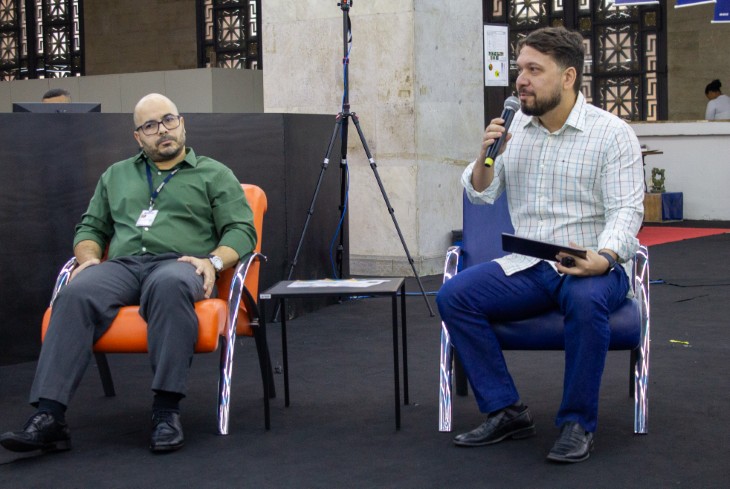
The theme of the first panel was IBGE Memory. Fabio Mauro de Carvalho Leite, a staff member in the IBGE's Memory sector and author of the presentation "IBGE: Information as Public Heritage," reminded the audience that the work is traditionally illustrated with images from national museum collections and that, in this edition, images exclusively from the IBGE's archive were used. He drew a parallel between the IBGE and the structure of a museum, thinking of the Institute as a large national museum. "The IBGE fulfills, with rigor and scale, what defines a museum's mission: preserving, organizing, and making public a heritage that belongs to everyone," he concluded.
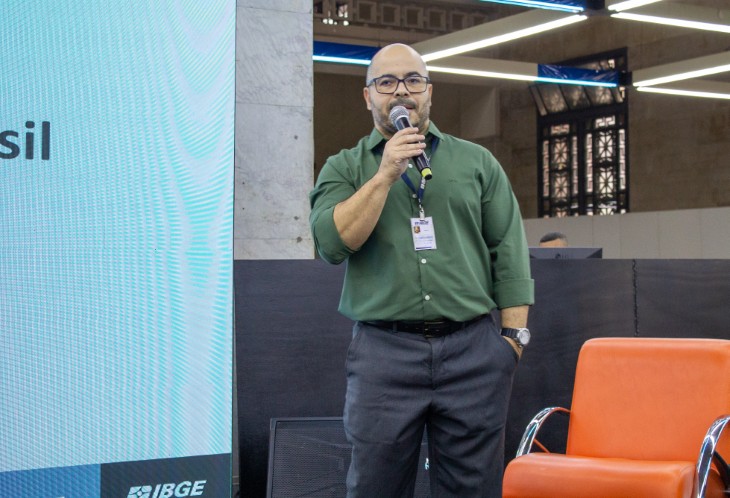
In this edition, the chapter "A Brief History of Brazil" was written by Leandro Miranda Malavota, from the Library department. He explained that the chapter's objective is to provide a historical synthesis of Brazilian social formation from various perpectives. This time, the chosen thematic focus was the relationship between technological capacity and the economic and social development of a country, using the Brazilian experience as a case study. "History is not just an aspect of erudition; it also offers important theoretical and methodological tools for solving present-day problems. It doesn't only refer to the past; it also points out to the present and the future," he explained.
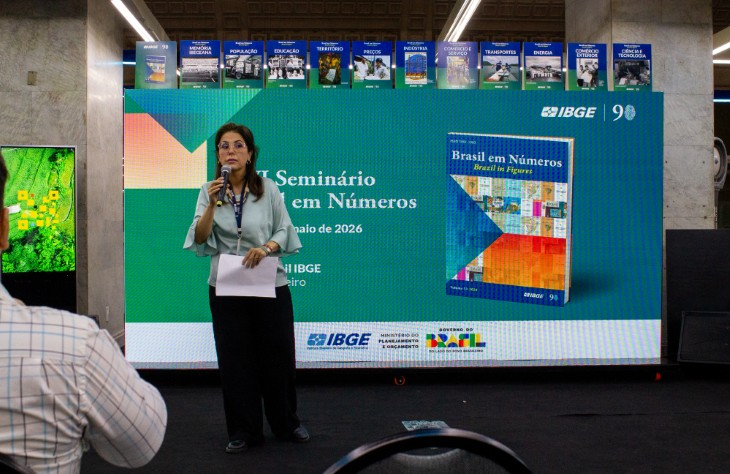
Panel 2, on Social Statistics, was presented by Luciene Longo, author of the chapter on Population. In her presentation, Ms. Longo highlighted the importance of a country knowing the characteristics of its population: "it is from this knowledge that one can focus on public policies to improve living conditions." The researcher emphasized the process of population aging as a factor that will exert impact on the social and economic organization of the country, explaining the demographic transition process and concluding that "population aging in Brazil is an ongoing, irreversible process characterized by accelerated and heterogeneous transformations among different regions of the country and geographical areas."
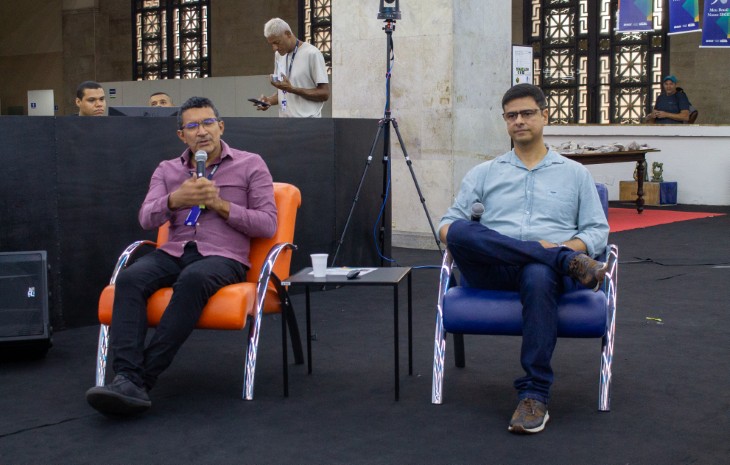
Next, the Geosciences panel addressed the topic of Territory, which was presented by officials Rodrigo Rachid de Souza and José Antonio Sena do Nascimento, who spoke about physical aspects and the Brazilian administrative structure, respectively. “Today’s territory is the result of a whole social process over time,” Mr. Sena pointed out at the beginning of his presentation, adding that it “is fundamentally a space defined and delimited by and from power relations.” Mr. Souza showed the characteristics of the Brazilian Major Regions and also spoke about the evolution of the country’s administrative structure, explaining that “the regional division is pragmatic, aiming to reach different realities in an optimized way.”
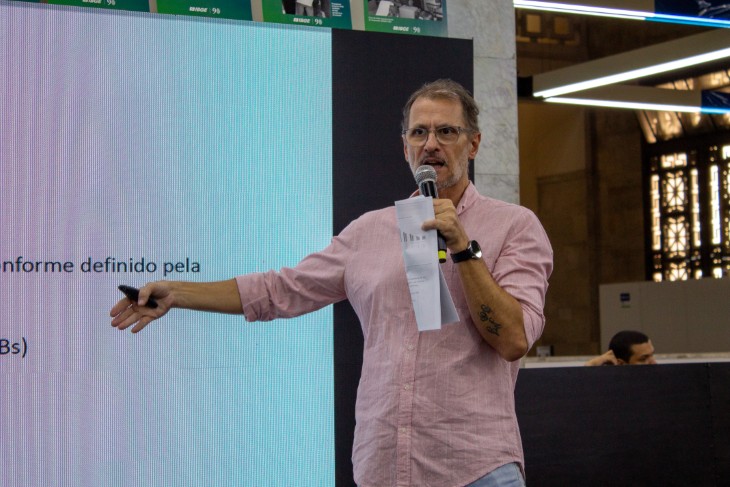
The fourth panel addressed Economic Statistics. José Fernando Pereira Gonçalves spoke about Prices, presenting the price indicators calculated by the IBGE, their differences, and applications. Mr. Gonçalves provided an overview of the behavior of inflation measured by the IPCA (Extended Consumer Price Index) in 2024. Data on Industry were presented by Rafael de Lima Monteiro, who discussed the diagnosis of two decades of virtual stagnation and the challenges of industrial reconstruction: "the question is not why industry fell in a specific year, but why it cannot sustain its expansion trend," provoked the researcher. Following this, Marcelo Miranda Freire de Melo spoke about Trade and Services, presenting results from 2023.
The fifth and final panel of the day, on Multidomain Statistics, featured a presentation by Mauro Emílio Araújo on the evolution of the dissemination of foreign trade data by the IBGE. David Montero Dias spoke about the Energy sector, concluding that "the decarbonization of the economy is in progress, and therefore, we are experiencing the energy transition process in Brazil, and for this reason, we need to monitor and continue these technological policies in order to maintain this trend." At the same panel, Rafael de Lima Monteiro also spoke about Science and Technology, arguing that "the main challenge for Brazilian postgraduate studies is not the scarcity of scientific production nor the lack of funding, but the institutional configuration that structures its incentives, evaluation criteria, and its historically fragile relationship with the productive sector."
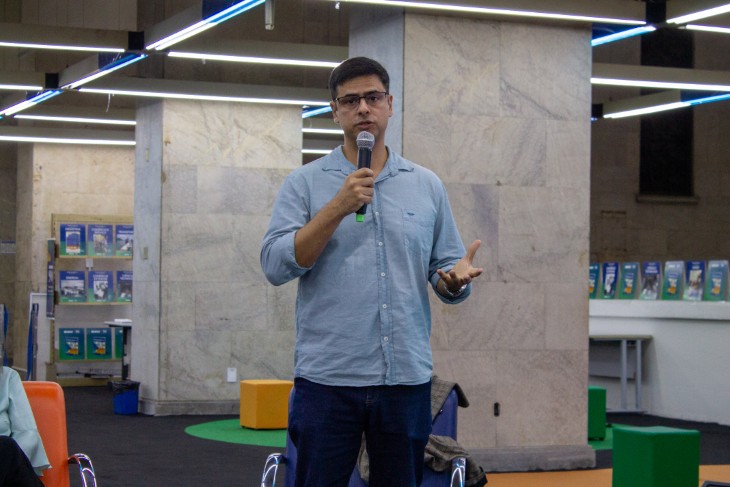
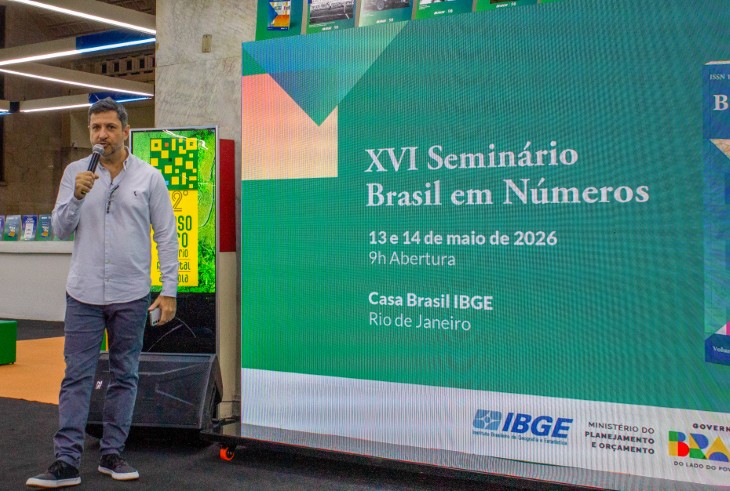
On the second day of the 16th Brazil in Figures Seminar, Isabela Torres, from the Information Recovery Department, spoke about the project, providing an overview of the publication. She highlighted the international reach of the work, which, in addition to the printed edition, has all its bilingual editions available in the IBGE library. “It’s a publication with many layers: statistical, geographical, analytical, and also the artistic aspect, with artworks from museums,” she described. Ms. Torres also emphasized the importance of the IBGE State Superintendencies for disseminating the work and reminded attendees that the publication is “an excellent way to give back to society, and especially to academia, the results of the work produced by the IBGE.”
Panel 1 was on Social Statistics of Health and Labor and included the virtual participation of staff members Hugo de Paula Oliveira and Jefferson Mariano. Mr. Oliveira states that in his chapter he sought to “establish a relationship between development and health. These are intrinsically linked themes. When a country, a state, or a municipality offers quality healthcare to its citizens, this is reflected in development. And similarly, when a region has better development, this is also reflected in health.”
Next, Mr. Mariano analyzed the behavior of the Brazilian labor market in 2024, which he characterized as “a period marked by economic advances and recovery in employment levels, in contrast to the persistence of structural inequalities.” He highlighted that “the behavior of the labor market is linked to other important issues, such as demographic dynamics, industrial activity, agriculture, services, aspects related to social security, that is, themes that are related to the development of the Brazilian economy itself.”
The second panel of the day, on Social Statistics, addressed issues of the Judiciary with the participation of Ana Lúcia Aguiar, Federal Judge of the Regional Federal Court (TRF) of the 4th Region; Gabriela Moreira de Azevedo Soares, Executive Director of the Judicial Research Department of the CNJ; and Igor Tadeu Silva Viana Stemler, Technical Director of the Judicial Research Department of the CNJ, presented an overview of the data from the judiciary, highlighting the CNJ's constitutional mandate to publish semi-annual statistical reports.
Regarding Political Participation, also at panel 2, Andrielly Ferreira Silva, Supervisor of Data Collection and Quality at the IBGE Agency in Eirunepé (AM), spoke. The law student explained that her work consisted of "analyzing the 2024 election numbers in light of the 1988 Constitution, seeking to understand what these numbers reveal about Brazilian democracy, political rights, and popular sovereignty." Ms. Silva presented figures on polling stations, voters, political pluralism and party concentration, and valid, null, and blank votes, concluding that "the challenge for Brazilian democracy is not only to guarantee access to voting, but to ensure that each vote has real weight and becomes a legitimate expression of the popular will, in accordance with the constitutional principles of efficiency, pluralism, and popular sovereignty."
Following this, Professor Paulo Wagner Teixeira Marques, who due to technical reasons was unable to participate in the panel on Multidomain Statistics the previous day, presented his chapter on Transportation, co-authored with Felipe Pires do Rio Mazur, Mauro Sergio Pinheiro dos Santos de Souza, and Raphael Rocha dos Reis. Mr. Marques explained that the article's focus was not only on the extent of road networks, but also on cargo transportation, highlighting that, for geographers, transportation networks "first and foremost provide an interpretation of the characteristics of the flow of people and goods in the territory, as a corollary of historical conditions, assisting the geographer in identifying centralities in the territory."
The afternoon session began with panel 3, on Economic Statistics, which featured presentations on Agriculture, by Evande Praxedes da Silva, and Public Finance, by Alex de Almeida Uchôas. Mr. Silva presented an overview of Brazilian agriculture and its challenges, such as "increasing the total productivity of production factors, promoting the efficient use of energy, and strengthening sustainable systems, with environmental conservation and prioritization of high value-added crops."
Complementing the panel, Mr. Uchôas presented his article as an in-depth analysis of our public accounts over the last decade. He concludes that the experience of the 2023-2024 period suggests that “fiscal sustainability will require a combination of three pillars: consistent primary surpluses, anchored in revenues and expenditures compatible with the economic cycle; active debt management, paying attention to the cost-risk ratio; and the requalification of expenditure, in order to expand the space for social and productive investments that support growth.”