

In June, IBGE estimates crops of 347.4 million tonnes for 2026


July 14, 2026 09h00 AM | Last Updated: July 16, 2026 11h04 AM
The June 2026 estimate for the production of cereals, legumes, and oilseeds was 347.4 million tonnes—0.4% higher (or an increase of 1.3 million tonnes) than the output in 2025 (346.1 million tonnes)—representing a 0.8% decrease (or a drop of 3.0 million tonnes) compared to the May 2026 estimate.
| June Estimate/2026 | 347.4 million tonnes |
| June 2026/May 2026 - Change | (-0.8%) -3.0 million tonnes |
| 2026/2025 Crop - Change | (0.4%) +1.3 million tonnes |
The area to be harvested totaled 83.2 million hectares, an increase of 1.6 million hectares compared to the area harvested in 2025—a growth of 1.9%. Compared to the previous month, the area to be harvested showed a decline of 60,985 hectares (-0.1%).
Rice, corn, and soybeans are the three main products in this group; combined, they accounted for 92.8% of the estimated production and represent 87.4% of the area to be harvested. The production estimate for soybeans was 174.8 million tonnes. As for corn, the estimate was 136.5 million tonnes (29.7 million tonnes from the first crop and 106.8 million tonnes from the second crop). Rice (paddy) production was estimated at 11.2 million tonnes; wheat at 6.6 million tonnes; upland cottonseed at 9.1 million tonnes; and sorghum at 5.6 million tonnes.
Regarding production, there were increases of 5.3% for soybeans and 2.9% for sorghum, as well as decreases of 8.2% for upland cottonseed, 11.8% for paddy rice, 3.7% for corn (a 15.6% increase for the first crop and a 7.9% decline for the second crop), 5.5% for beans, and 15.0% for wheat.
Regarding the area to be harvested, compared to the previous year, there was growth of 1.3% in the soybean area, 2.7% in the corn area (increases of 9.1% for first-crop corn and 1.2% for second-crop corn), and 15.6% in the sorghum area, while declines occurred in the areas for upland cottonseed—down 5.0%—paddy rice (down 12.3%), and beans (down 3.9%).
Central-West leads production in June 2026, with 172.4 million tonnes
Among the Major Regions, the production volume of cereals, legumes, and oilseeds was distributed as follows: Central-West, 172.4 million tonnes (49.6%); South, 92.4 million tonnes (26.5%); Southeast, 30.8 million tonnes (8.9%); Northeast, 29.8 million tonnes (8.6%); and North, 22.2 million tonnes (6.4%). Production estimates for cereals, legumes, and oilseeds showed positive annual change for the South (6.8%) and Northeast (7.3%) regions, while negative changes were recorded for the Central-West (-3.5%), Southeast (-0.9%), and North (-0.5%). Regarding monthly change, the North region showed production growth (3.5%) and the Southeast remained stable (0.0%), whereas the Central-West (-2.0%), Northeast (-0.2%), and South (-0.2%) experienced declines.
Compared to May, there were increases in production estimates for canola (71.8% or 214,761 t), oats (5.8% or 75,226 t), sesame (5.7% or 19,746 t), grapes (4.6% or 98,641 t), barley (1.0% or 6,651 t), soybeans (0.1% or 235,724 t), and Arabica coffee (0.0% or 1,277 t). Declines were recorded for wheat (-7.7% or -554,985 t), Canephora coffee (-3.6% or -48,494 t), second-crop corn (-2.6% or -2,803,150 t), cacao (-1.0% or -3,228 t), and sorghum (-0.9% or -52,207 t).
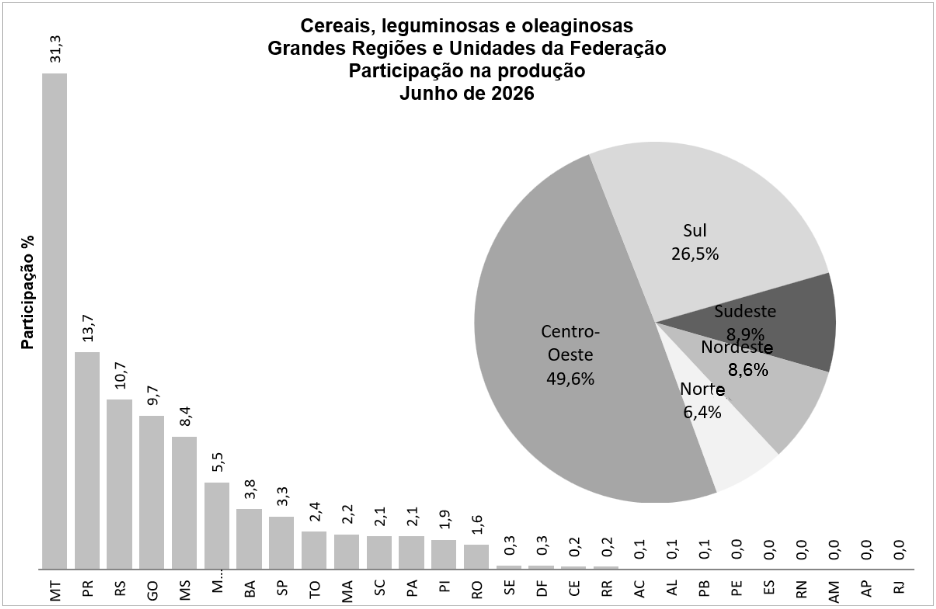
Regarding the distribution of production across the Federation Units, Mato Grosso leads as the largest national grain producer, with a 31.3% share, followed by Paraná (13.7%), Rio Grande do Sul (10.7%), Goiás (9.7%), Mato Grosso do Sul (8.4%), and Minas Gerais (5.5%); together, these states accounted for 79.3% of the total.
The main positive absolute changes in production estimates compared to the previous month occurred in Pará (609,492 t), Rondônia (162,161 t), Paraná (93,600 t), Maranhão (17,453 t), Minas Gerais (9,366 t), and Rio Grande do Norte (309 t). Negative changes occurred in Goiás (-3,446,559 t), Rio Grande do Sul (-316,279 t), Sergipe (-63,359 t), Tocantins (-19,486 t), Pernambuco (-8,047 t), Ceará (-3,421 t), Amazonas (-952 t), Espírito Santo (-296 t), and Amapá (-11 t).
CACAO (nut) – The June estimate for Brazilian cacao production was 321.0 thousand tonnes, a 1.0% decrease compared to the previous month and an 8.9% increase year-on-year. The expected average production yield was 499 kg/ha, compared to 458 kg/ha in the 2025 crop and 520 kg/ha in May 2026. In the month-over-month comparison, the North Region drove the decline, primarily due to the performance of Pará—a state responsible for 49.4% of national production—where output fell by 2.2%.
COFFEE (bean) – Brazilian production, considering both Arabica and Canephora species, was estimated at 4.0 million tonnes—or 66.0 million 60-kg bags. This represents a 1.2% decline compared to the previous month and a 14.7% increase compared to 2025 (a record year in the time series, which dates back to 2002, when the unit of measurement changed and reporting shifted to coffee beans).
For Arabica coffee, estimated production was 2.7 million tonnes (44.4 million 60-kg bags), remaining virtually unchanged from the previous month. Weather conditions have benefited crops in the Center-South region; furthermore, a positive biennial cycle is expected for the 2026 crop. For Canephora coffee, production was estimated at 1.3 million tonnes (21.6 million 60-kg bags), a 3.6% decrease from the previous month and a 3.0% increase compared to the volume produced in 2025.
CANOLA – Canola was included in the Systematic Survey of Agricultural Production starting in 2026, given its growing importance in Brazilian agricultural production. Production was estimated at 513.7 thousand tonnes, a 71.8% increase compared to the previous month. Estimates for planted area and yield rose by 59.4% and 7.9%, respectively. Rio Grande do Sul is the only state in Brazil that produces canola commercially.
WINTER CEREALS (grain) – The main winter cereals produced in Brazil are wheat, white oats, and barley. For wheat (grain), estimated production was 6.6 million tonnes, a decline of 7.7% compared to the previous month and 15.0% compared to 2025. Year-over-year, the planted area and the area to be harvested declined by 14.1% and 14.0%, respectively, while the average yield fell by 1.1%. In Rio Grande do Sul, which accounts for 41.2% of the national total, estimated production was 2.7 million tonnes, a decline of 17.1% compared to the previous month and 20.9% compared to 2025.
Oat (grain) production was estimated at 1.4 million tonnes, an increase of 5.8% compared to the previous month and 2.6% compared to the volume produced in 2025. Compared to the previous year, the planted area and the area to be harvested are increasing by 1.8% and 2.5%, respectively, and the average yield is growing by 0.2%. The largest producers of the cereal are Rio Grande do Sul, with 999.6 thousand tonnes—an increase of 8.4% compared to the previous month and 6.8% compared to the quantity harvested in 2025—and Paraná, with 254.4 thousand tonnes—a decline of 0.8% compared to May and 1.1% compared to 2025.
For barley (grain), estimated production was 685.3 thousand tonnes, an increase of 1.0% compared to the previous month and 8.3% compared to the volume produced in 2025. In the year-over-year comparison, the planted area showed growth of 14.7%, with a 5.6% decline in average yield. Paraná is the leading barley producer, with an output of 566.4 thousand tonnes—representing a 2.5% increase compared to May and a 14.9% rise over the 2025 production volume—and is projected to account for 82.6% of the Brazilian crop in 2026.
SESAME (grain) – Brazilian sesame production in 2026 is expected to reach 364.8 thousand tonnes, a 5.7% increase over the previous month, driven by a 5.0% expansion in planted area. The area to be planted for the current crop is projected to reach 584.3 thousand hectares, reflecting the crop's growing importance to the country in recent years. The IBGE began tracking production of this crop starting with the 2026 harvest. Mato Grosso is the leading Brazilian producer, with 210.6 thousand tonnes, and is expected to account for 57.7% of national production, with its estimates remaining unchanged in June.
Pará is the second-largest sesame producer, with an estimated production of 120.4 thousand tonnes—a 17.2% increase compared to the previous month.
CORN (grain) – The estimated corn production was 136.5 million tonnes, representing declines of 2.1% compared to the previous month and 3.7% compared to the volume produced in 2025. Compared to the previous month, there was a 1.5% reduction in average yield and a 0.6% reduction in the area to be harvested. Regarding the production obtained in 2025, the drop in the estimate stems from a 6.2% decline in average yield, given that there was growth of 2.1% in planted area and 2.7% in the area to be harvested.
First-crop corn production totaled 29.7 million tonnes, a 0.2% decline compared to the previous month. Compared to the previous year, production is 15.6% higher, driven by a 9.1% increase in harvested area and a 5.9% increase in average yield. The largest decline in the production estimate for June occurred in Pará (-9.1% or -92,835 tonnes), while the most significant increases were seen in Minas Gerais (0.2% or 9,465 tonnes), Paraná (0.4% or 15,600 tonnes), and Goiás (0.7% or 9,604 tonnes).
The estimated production for second-crop corn was 106.8 million tonnes, a 2.6% decline compared to May. Compared to the previous year, the production estimate shows a 7.9% reduction, resulting from a 9.0% decline in average yield, as the area showed 1.2% growth. Mato Grosso is Brazil's leading corn producer for this harvest, with 52.7 million tonnes—a 3.5% decline compared to the volume produced in 2025. The state maintained the production estimate reported the previous month. Mato Grosso’s output is expected to account for 49.3% of the national crop.
SOYBEANS (grain) – The estimate for Brazilian soybean grain production was revised upward again, reaching 174.8 million tonnes—a new record in the IBGE’s time series—representing a 0.1% increase over May and a 5.3% rise compared to the 2025 figure (166.1 million tonnes). Cultivated area reached 48.4 million hectares, a 1.2% increase year-over-year, while the expected average yield of 3,618 kg/ha represents a 4.0% gain on the same basis of comparison. Mato Grosso, the largest national producer, kept its June estimates unchanged with a production of 50.7 million tonnes. Compared to 2025, production was 1.0% higher, driven by a 2.1% increase in planted area and a slight 1.1% drop in average yield, reflecting specific adjustments in certain municipalities.
SORGHUM (grain) – The June estimate for sorghum production was 5.6 million tonnes, a 0.9% drop compared to May, which had set a historical monthly record. Year-over-year, production is expected to rise by 2.9%, driven by a 15.4% expansion in planted area, which more than offsets the 11.0% decline in average yield. The estimated planted area for sorghum is expected to be around 1.8 million hectares—or 2.1% of the total area dedicated to cereals, legumes, and oilseeds—accounting for 1.6% of that group's total production. Average yield is projected to reach 3,126 kg/ha in June 2026, compared to 3,512 kg/ha in the 2025 season. Goiás is the leading sorghum producer, contributing 1.7 million tonnes, which represents 31.2% of the total.
GRAPES – Grape production is expected to end the year at 2.2 million tonnes, a slight increase of 1.4% compared to 2025 (2,209,104 tonnes) and a 4.6% rise over the May estimate. The South Region accounts for 51.9% of national production, with 1.2 million tonnes—8.4% higher than in 2025 and 1.1% above the May estimate. In Rio Grande do Sul, the leading producer, the projection is 1.1 million tonnes (a 9.9% increase over 2025), with a yield of 22,004 kg/ha (a 9.5% increase). In the Northeast, June estimates show a slight recovery in production compared to May; the projection was revised to 911.3 thousand tonnes—a 6.5% drop relative to 2025, but a 10.4% increase over the previous month's figure. Pernambuco maintained its position as the second-largest producer with 801.9 thousand tonnes (a 7.8% annual decrease), with a yield of 45,373 kg/ha and an area of 17.7 thousand hectares (-1.1%).


