

RBMC
IBGE inaugurates three new stations of the Brazilian Continuous Monitoring Network and publishes time series of geodetic networks


December 09, 2025 10h00 AM | Last Updated: December 11, 2025 09h47 AM
Highlights
- Three new stations of the Brazilian Network for Continuous Monitoring of GNSS Systems were inaugurated in Caruaru (PE), Colorado do Oeste (RO) and Santa Helena (PR).
- The Brazilian Network for Continuous Monitoring of Systems currently has 153 active stations, distributed throughout the national territory.
- The IBGE also released the updated time series of the Stations of the Brazilian Network for Continuous Monitoring of GNSS Systems (RBMC) and the Permanent Tide Gauge Network for Geodesy (RMPG).
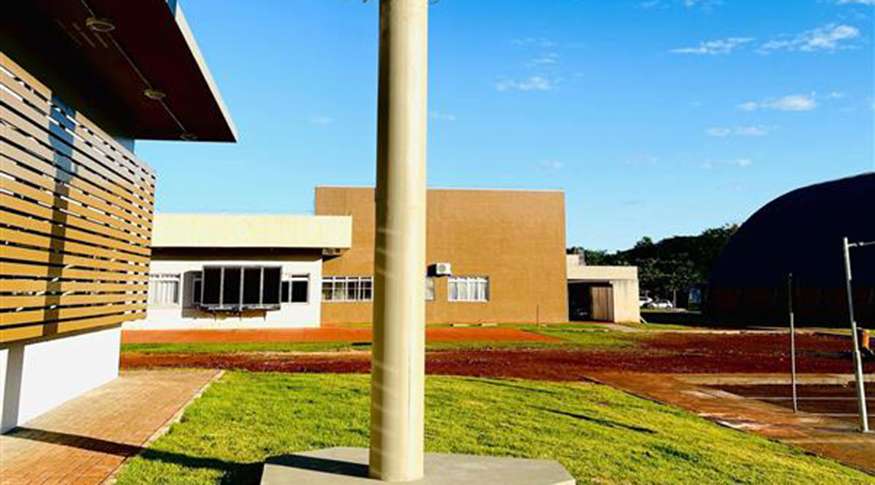
The Brazilian Institute of Geography and Statistics (IBGE) inaugurates today (9) three new stations of the Brazilian Network for Continuous Monitoring of GNSS Systems (RBMC). The stations are located in Caruaru (PE), Colorado do Oeste (RO) and Santa Helena (PR). With these faciities, the RBMC now has 153 active stations, distributed throughout the national territory.
The PECA station, installed in partnership with the Federal University of Pernambuco (UFPE), Caruaru Campus, reinforces geodetic coverage in the Pernambuco Agreste region and supports teaching, research and professional application initiatives in the region.
The ROCO station, located at the Federal Institute of Rondônia (IFRO), Colorado do Oeste Campus, expands the presence of the Brazilian Network for Continuous Monitoring (RBMC) in southern Rondônia and resumes the network's presence in the city, which previously relied on the ROCD station, discontinued in 2019.
The STHA station, installed in partnership with Itaipu Binacional, UTFPR, and FUNTEF-PR, integrates the recent expansion of geodetic infrastructure in western Paraná, meeting scientific, academic, and operational demands.
In addition to the network expansion, 10 more stations now provide observations with a tracking interval of 1 second. This benefits post-processing applications and can reduce field occupancy time for those who use these stations as a reference in their surveys. The stations that now offer data in this range are: AMHA (Humaitá/AM), AMPT (Parintins/AM), CEEU (Eusébio/CE), GOUR (Uruaçu/GO), MABB (Bacabal/MA), MGGV (Governador Valadares/MG), MGIN (Inconfidentes/MG), MTLE (Primavera do Leste/MT), RSSL (São Leopoldo/RS), and SCCH (Chapecó/SC), totaling 74 stations with this capability.
According to the Geodesy Coordinator, Maíra Kronemberg, “the applications of the RBMC reach a wide diversity of technical and professional activities. The network is used daily by surveyors, engineers, cartographers, and researchers who depend on precision georeferencing for urban and rural surveys, infrastructure projects, telecommunications, sanitation, energy, and environmental studies.”
Set of geodetic stations in the Geodetic Database is published
The IBGE has released a set of new Level References (RRNN), GNSS stations connected to the RRNN, and Gravimetric Stations (EEGG), incorporated into the Brazilian Geodetic System (SGB) throughout 2025. All information is already published and available to users in the Geodetic Database (BDG).
The IBGE has been establishing geodetic reference networks since the 1940s. The geodetic stations, physically materialized on the ground, make up these networks and constitute the fundamental infrastructure of the SGB. “These references are essential for precision georeferencing, large engineering works, mapping, geophysical applications, environmental management, geodynamic studies, and scientific research,” emphasizes the Geodesy Coordinator.
The altimetric densification aims to increase the precision and coverage of height data throughout the national territory. Reliable heights are crucial for infrastructure projects such as highways, railways, and basic sanitation works. In accordance with international recommendations for the unification of vertical reference systems (UN Resolution No. 1/2015), the IBGE has contributed to the establishment of the International Height Reference Frame (IHRF) through altimetric and gravimetric densification around the RBMC stations selected by the IBGE to comprise the IHRF in Brazil. In 2025, new Level References (RRNN) were made available in the Presidente Prudente region, SP, completing the connection circuit of the IHRF-PPTE station to the SGB's High-Precision Height Network.
In the SGB modernization process, the gravity values measured at the Gravimetric Stations (EEGG) play an essential role in calculating official altitudes, relating these altitudes to the Earth's gravity field, enabling the adequate representation of water mass flow. The increase of GNSS stations connected to the National Tide Gauge Network (RNN) aims to improve the accuracy of the hgeoHNOR2020 model and expand its potential use in vertical positioning applications. Among the most recent advances, the new connections made available in the state of Acre stand out, which will help develop in the future the new version of the hgeoHNOR model in the western Amazon region, an area previously not covered by the model due to the absence of data.
Time series of the Stations of the Brazilian Network for Continuous Monitoring of Systems and the Permanent Tide Gauge Network for Geodesy are released
The IBGE also released updated time series from the stations of the Brazilian Network for Continuous Monitoring of GNSS Systems (RBMC) and the Permanent Tide Gauge Network for Geodesy (RMPG). The update brings together the series produced by the stations that continuously monitor three-dimensional variations occurring at points on the Earth's surface and sea level, now consolidated for the period extending from July 2001 to December 2024.
The GNSS data from the RBMC stations are processed daily, allowing for the evaluation of observation quality and interventions, whenever necessary, to correct any inconsistencies.
The RBMC stations are part of the SIRGAS-CON Regional Reference Network (Geodetic Reference System for the Americas). “It is a collaborative effort between the countries of the continent. It is one of the most precise geodetic networks in the world, enabling continuous monitoring of station coordinates. Weekly processing allows for the identification of local and regional displacements, such as the movement of tectonic plates and heigt variations resulting from hydrological load in the Amazon,” explains Guiderlan Mantovani.
The RMPG (Permanent Tide Gauge Network for Geodesy) series are updated annually, following the criteria defined in the report "Monitoring the Variation of Mean Sea Level at the Stations of the Permanent Tide Gauge Network for Geodesy – RMPG 2001–2020". Each station has a unique series, constructed from daily data available on the IBGE, after corrections related to instrumental failures and adjustments to the reference height of the sensors. The time series can be accessed in the "Data Analysis" section on the official RMPG website.
In Brazil, the official vertical references originate from tide gauge observations made in the ports of Imbituba (SC), from 1949 to 1957, and Santana (AP), between 1957 and 1958. With six stations installed and operated by the IBGE, the RMPG monitors the relationship between this vertical datum—which defines the reference surface based on mean sea level—and other references used in nautical cartography and coastal engineering. This information supports research aimed at modernizing Brazilian height measurements and understanding the variation in mean sea level.
Daily evaluation and participation in international networks
As part of the RMPG operation, the data recorded by the tide gauges are processed daily. This procedure ensures the monitoring of the quality of the published information and allows for data retrieval in case of transmission failures.
In addition to national use, all RMPG stations contribute to the Global Sea Level Observing System (GLOSS), coordinated in Brazil by the Directorate of Hydrography and Navigation (DHN) of the Navy. The stations transmit information in near real-time, with updates every five minutes, to the GLOSS Active Network, directly collaborating with the Caribbean Tsunami Warning sub-network.
Note regarding the Belém Tide Gauge Station:
The Belém Tide Gauge Station series will not be published for the year 2024. The equipment remained inoperative for a large part of the period, making it impossible to collect consistent data and generate a representative series.